Stainless steel welding: TIG/MIG
Argon welding of stainless structures for food equipment: TIG and MIG technologies, weld inspection and protection against intergranular corrosion.
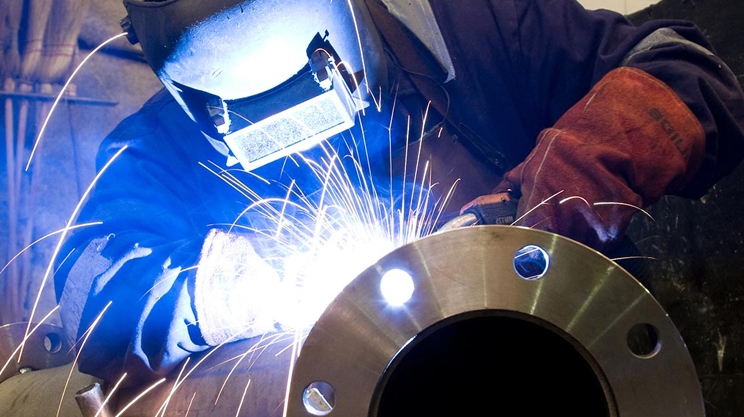
Welding stainless steel is a discipline of its own, where a mistake is costly: a poor weld on food equipment becomes a corrosion site and a zone where product accumulates. Stainless behaves differently from structural steel — it distorts more and is sensitive to overheating. In this article we look at TIG and MIG technologies, explain when to choose which, and show how we control weld quality.
Why stainless is harder to weld
Stainless steel AISI 304/316L has three features that complicate welding. First, low thermal conductivity — heat concentrates in the weld zone and causes warping. Second, a high thermal expansion coefficient: the part “plays” when heated more than carbon steel. Third, the risk of intergranular corrosion — when overheated in the +450…+850 °C range, chromium near the weld binds with carbon, and the metal in that zone loses corrosion resistance.
So welding stainless is not simply “joining two parts” but the controlled input of heat with protection from oxygen and a limit on heating.
TIG and MIG: two technologies
For stainless food structures we use two methods:
- TIG (tungsten inert gas) — an arc between a non-consumable tungsten electrode and the part in an argon atmosphere. It produces the cleanest, most precise weld; the speed is low. It is the choice for thin metal and responsible, visible welds.
- MIG (semi-automatic) — an arc with a continuously fed consumable wire in a shielding gas. Faster than TIG, more productive; the weld is coarser. The choice for long welds on thicker metal and load-bearing frames.
In practice one structure often combines both methods: the frame is welded with MIG, and product-contact surfaces with TIG.
Welding parameters by thickness
The welding regime is matched to the metal thickness. Below are indicative parameters for AISI 304 stainless steel.
| Metal thickness | Method | Shielding gas | Current |
|---|---|---|---|
| 0.8–1.5 mm | TIG | argon 99.99% | 30–70 A |
| 1.5–3 mm | TIG | argon 99.99% | 70–130 A |
| 2–4 mm | MIG | Ar + 2% CO₂ | 120–180 A |
| 4–8 mm | MIG | Ar + 2% CO₂ | 180–260 A |
Engineer’s tip. For food equipment the back of the weld must be protected by argon backing. Without backing, the reverse side oxidises and a porous scale forms — and it is right there, in an unseen zone, that corrosion begins after a year of operation.
Weld inspection and finishing
We check weld quality on food equipment in several steps. Visual inspection — no pores, undercuts or lack of fusion. Welds in the product-contact zone are ground and polished to a smooth surface with no recesses where product lodges. For responsible joints we apply pickling and passivation, which restore the protective oxide film disturbed during welding.
Welding is rarely a standalone service — more often it is the final stage of making an assembly after turning and milling work. We hand over a finished structure with cleaned and passivated welds, ready for operation in a food environment.
Distortion control
Because of its high thermal expansion coefficient, stainless steel distorts during welding more than carbon steel. A thin sheet “waves”, a frame structure twists. Fighting this only after welding is expensive, so distortion is anticipated in advance.
The basic techniques we use on stainless structures:
- Tack welds — short preliminary welds fix the geometry before the main pass.
- Reverse welding sequence — welds are laid not in a row but in a scattered order, so heat is distributed evenly.
- Jigs and clamps — hold the parts rigidly in the design position during cooling.
- Dosed heat — the minimum sufficient current, cooling pauses between passes.
A competent combination of these techniques allows a structure to be handed over with a geometry deviation within tolerance, without laborious straightening.
Choosing the grade: 304 or 316L
For welded food structures the choice of stainless grade is not only a question of corrosion resistance but also of weldability. AISI 304 is the universal grade for most food environments: water, vegetables, fruit, dry raw material. AISI 316L, with added molybdenum, is needed where there is salt, acid or marinade — in pickling, seafood processing and marinating lines.
The letter L in the 316L designation means a reduced carbon content. This matters precisely for welded structures: less carbon, less risk of intergranular corrosion in the weld zone. So for responsible welded units in an aggressive environment we always take the low-carbon modification, not ordinary 316.
Conclusion
Welding stainless steel for food equipment is a controlled process: the right method for the thickness, protection of the reverse side, a limit on overheating and mandatory weld finishing. It is weld quality that determines whether a structure serves for years or blooms with corrosion within a season. Need a stainless structure or repair of a welded assembly? Get in touch. More on manufacturing services under the tag services.