Static electricity grounding on a conveyor
Why a static charge on a conveyor is dangerous, how to measure and control it: antistatic belt, frame grounding and brush dischargers.
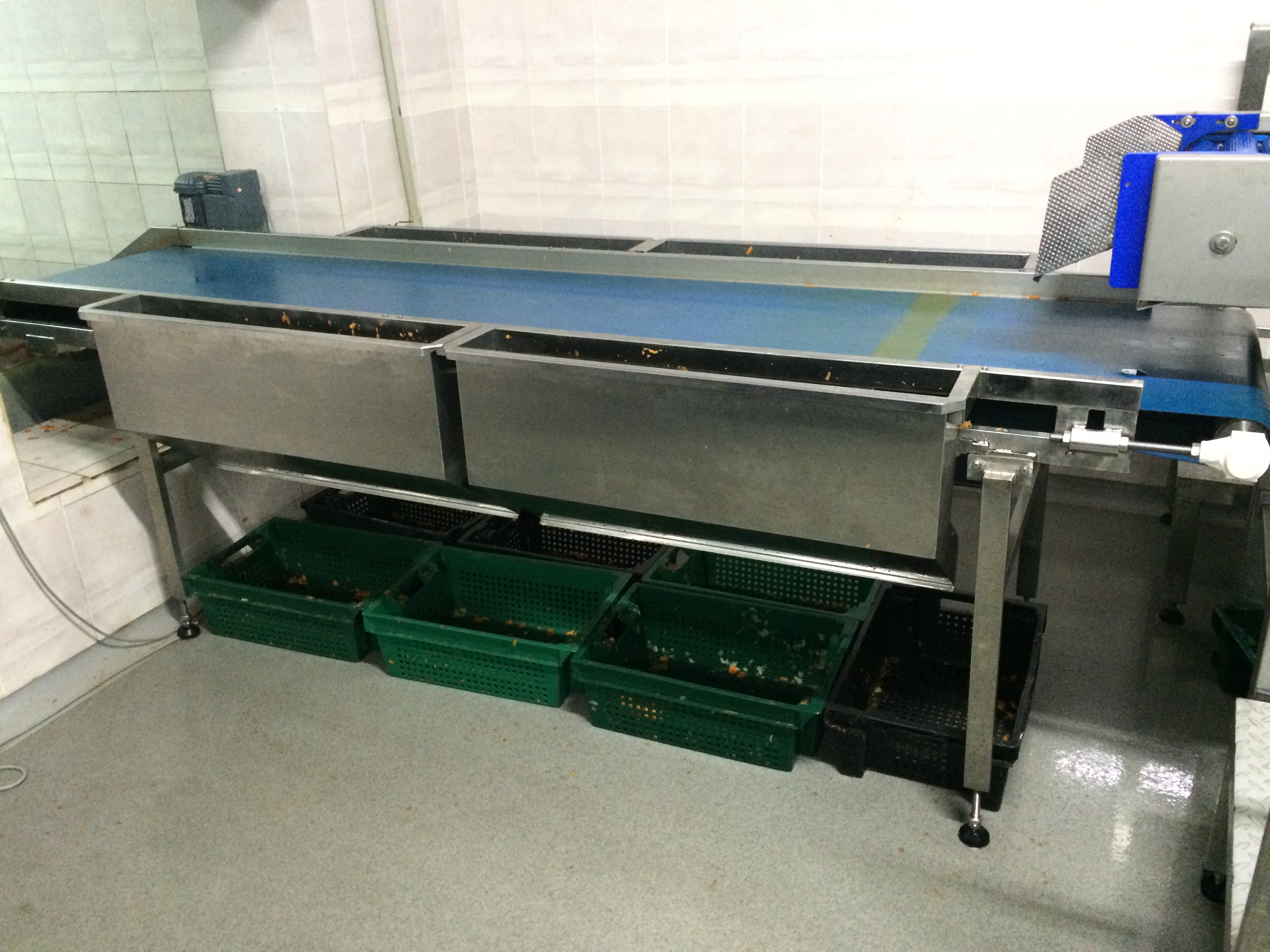
A conveyor belt moving over a dry drum works as a generator of static electricity — literally like a school electrophorus. On a line handling flour, icing sugar or dry powder, the accumulated charge becomes not a trifle but a source of ignition. In this article we break down where static comes from, what it threatens and how to drain it properly.
Where a static charge comes from on a conveyor
Static arises from the triboelectric effect: when two different materials rub, electrons transfer from one to the other. On a conveyor, friction is constant — the belt slides over the deck, wraps the drums, contacts the dry product. The drier the air and the higher the dielectric resistance of the belt, the faster the charge grows.
The potential on an isolated belt can reach several kilovolts. A discharge between a charged belt and grounded metal gives a spark with enough energy to ignite a dust-air mixture.
The most dangerous combination is a dry belt plus fine combustible dust in the workshop air. Flour, starch or sugar dust at a concentration of a few tens of grams per cubic metre forms an explosive environment, and it is precisely a static discharge that most often becomes the ignition source. That is why on such lines static control is not a recommendation but a requirement of industrial safety.
Why static is dangerous
The consequences of an accumulated charge go far beyond an unpleasant “shock” for the operator:
- Ignition and explosion — a spark ignites suspended dust of flour, starch, sugar, dry milk.
- Product spoilage — a charged surface attracts dust and fine particles, contaminating clean product.
- Electronics failure — an ESD discharge disables sensors, scale boards, controllers.
- Product sticking — light particles cling to the belt instead of moving in the flow.
How to measure and standardise the charge
To manage static you have to measure it. We use a non-contact field-strength meter and a leakage-resistance meter. Below are reference standard ranges for food lines.
| Parameter | Standard |
|---|---|
| Surface resistance of antistatic belt | 10⁶–10⁹ Ohm |
| Conveyor frame grounding resistance | no more than 4 Ohm |
| Belt potential after a discharger | up to 100 V |
| Charge drain time | less than 0.5 s |
| Relative humidity of the zone (desirable) | 45–60% |
Engineer’s tip. A grounded conveyor frame does not save you from static if the belt itself is a dielectric — the charge on it has nowhere to go. Only two solutions work together: a conductive (antistatic) belt plus a reliable grounding loop with resistance up to 4 Ohm. One without the other is a half-measure.
Protective measures
Fighting static is a system, not a single element. On our projects we apply a combination of measures:
- Antistatic belt with a surface resistance of 10⁶–10⁹ Ohm — the charge drains through the belt onto the grounded drum.
- Grounding of all metal units — frame, drums, trays joined into a single loop.
- Brush or needle dischargers above the belt — they remove residual charge from the product surface.
- Conductive rollers and bearings — they ensure electrical contact of rotating parts with the frame.
- Humidity control — keeping 45–60% relative humidity sharply reduces accumulation.
For dry bulk and flammable products an antistatic belt is mandatory — more on this in the article on antistatic belts. We always consider grounding together with general conveyor safety.
How grounding is accounted for at the design stage
It is cheaper to build antistatic protection into the structure than to retrofit a finished line. At the design stage we resolve several questions at once. First, we determine the zone class by explosion hazard — for rooms with combustible dust these are zones 21 or 22 by classification, and the equipment requirements depend exactly on it. Second, we put the right belt type into the specification: for contact with a food product this is an antistatic belt with a PVC or PU coating, certified to regulation EU 1935/2004.
Separately we design the loop itself: we take the cross-section of the grounding conductor as at least 4 mm² in copper, the joints — bolted with toothed washers, not welded “on the quick”. All detachable units — tensioning stations, removable trays — get flexible jumpers, because with parts moving, a rigid contact quickly loses conductivity. This approach is cheaper than rework and passes the labour-safety inspection straight away.
Control and maintenance
Grounding is not “fit and forget”. The loop degrades: contacts oxidise, clamps loosen, the conductive layer of the belt wears. Once a quarter we check the grounding resistance and the belt’s surface resistance with an instrument. If the leakage resistance has grown, we clean the contacts and retighten the joints. A worn antistatic belt is replaced even if it is still mechanically intact: a loss of conductivity nullifies the whole system.
It is worth entering the measurement results into a log — this shows the dynamics. A gradual rise in grounding resistance signals corrosion of the loop long before it completely “fails”. Static control is logical to fit into the general planned maintenance schedule of the line, alongside tension and grease checks.
Conclusion
Static electricity on a conveyor is an invisible but real risk, especially where there is dry combustible dust. Protection works only as a complex: an antistatic belt, a grounded loop with resistance up to 4 Ohm, dischargers and humidity control. Planning a line for dry bulk products or want to check an existing one? Get in touch — we will assess the static risks and select a solution.