Belt scrapers and brushes: choosing the material
How to choose a conveyor belt scraper for the product: polyurethane, polyethylene, nylon, metal-detectable materials and the pressure.

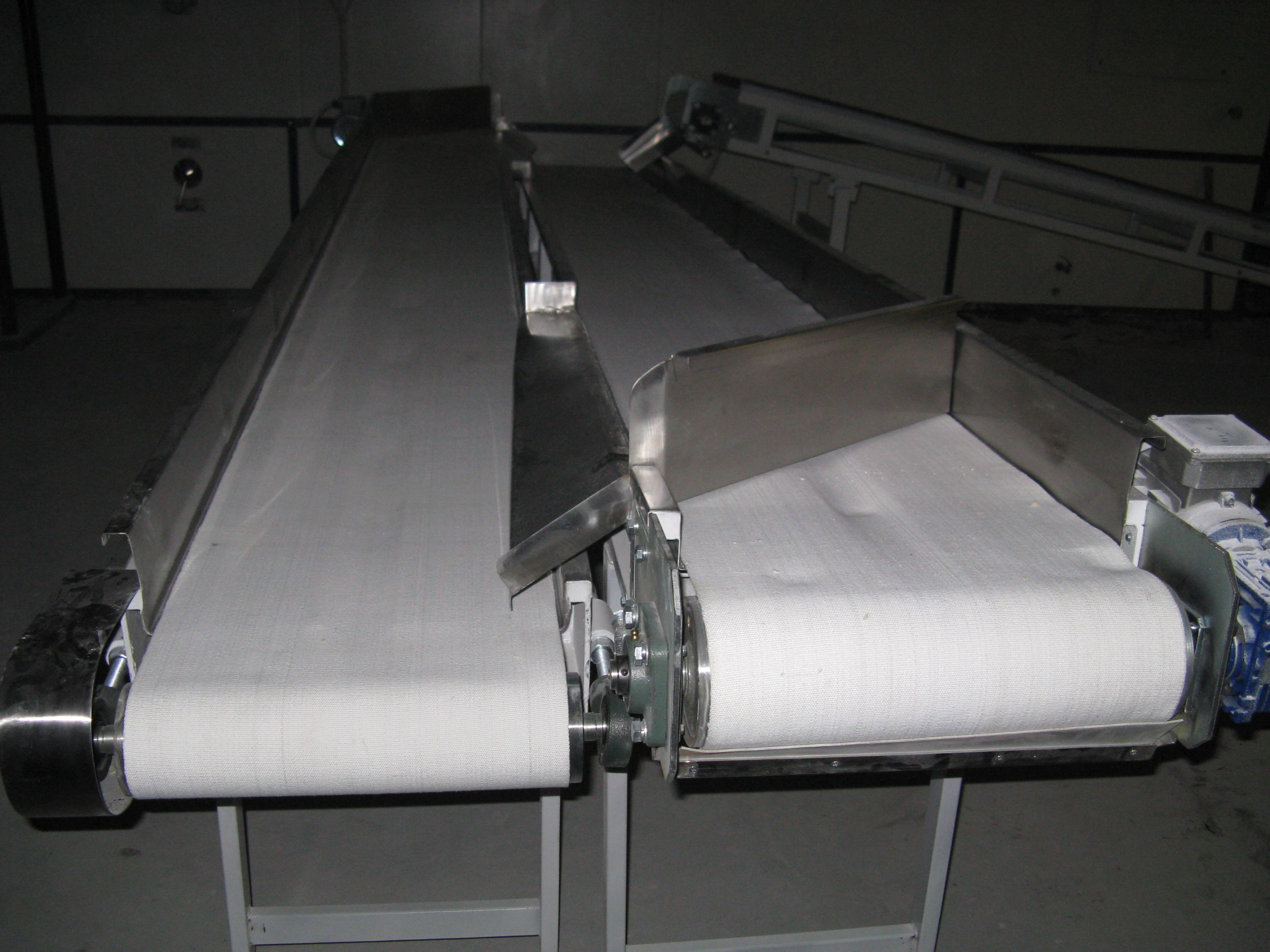
Without cleaning, the belt carries product residue on the return side — it falls under the conveyor, sticks to the drums and makes the mat “wavy”. Scrapers and brushes solve this problem, but only if correctly matched to the product. The article covers which scraper material to choose and why the pressure matters more than the stiffness.
Why clean the belt during operation
Product residue on the belt is not just dirt under the conveyor. Build-up on the drive drum changes its effective diameter: a product layer of just 2–3 mm on a 200 mm drum already shifts the belt speed by 2–3% and disrupts synchronisation with adjacent conveyors. Dried product on the rollers makes the mat run unevenly, and local build-up on one side provokes belt mistracking sideways. In food production any residue is also a medium for bacteria. That is why cleaning the belt during operation is not cosmetics but a condition for a stable and hygienic line. On sanitation-sensitive sections we design the cleaning unit per EHEDG principles: removable, with no blind cavities, accessible for washing.
Scraper or brush: when to use which
The choice between a scraper and a brush is determined by the nature of the contamination:
- Scraper — for wet, sticky product forming a continuous film: sauces, dough, minced meat, purée.
- Brush — for dry bulk build-up and textured belts where a scraper does not reach the recesses.
- Scraper + brush combination — for complex products with both a film and dry residue.
- Counter scraper on the return side — as a second stage, removing what the main one missed.
Scraper materials
| Material | For product | Temperature | Hardness | Feature |
|---|---|---|---|---|
| Polyurethane | Universal, wet | -20 … +80 °C | 85–95 Shore A | Wear-resistant, does not scratch the belt |
| UHMW polyethylene | Sticky, greasy | -40 … +80 °C | 60–65 Shore D | Low friction, cheap |
| Nylon | Dry, abrasive | -20 … +100 °C | 75–80 Shore D | Stiffer, holds shape |
| Metal-detectable PU | Food lines with MD | -20 … +80 °C | 85–90 Shore A | A fragment is seen by the metal detector |
| Stainless bristle | Hot processes | up to +200 °C | — | For ovens and hot zones |
Pressure matters more than material
The most common mistake is to bet on scraper stiffness rather than the correct pressure. Too weak a pressure leaves a product film, too strong accelerates wear of both belt and scraper and adds load to the drive. An approximate working force is 1.5–3.5 N per centimetre of edge width; it is fine-tuned on site by the cleanliness of the run-off. The right solution is a spring-loaded or torsion holder that keeps a constant force regardless of edge wear: a rigidly tightened nut holds the pressure only for the first day, after which the edge wears and contact disappears. For delicate coated belts we take soft 85 Shore A polyurethane and moderate pressure; for thick rubber belts with bulk product one can go to a harder material and more force. Separately, we make sure the scraper covers the full working width of the belt with a small overhang past the edge — otherwise uncleaned streaks remain at the edges.
Engineer’s tip. A metal-detectable scraper is mandatory on any line with a metal detector. An ordinary polyurethane one, having chipped off, passes the check unnoticed and ends up in the product. It is a penny part, but economising on it is a direct threat to the consumer.
Mounting scheme: primary and secondary scraper
Quality cleaning is rarely done with a single scraper. The classic two-stage scheme is a primary scraper on the drive drum plus a secondary one on the return side. The primary one is set at an angle tangent to the drum, in the zone 5–10° below the belt run-off point: here the mat is still pressed to the drum and does not vibrate, so the edge removes the bulk of the product cleanly. The secondary scraper works on the straight section of the return side and picks up the thin residual film.
The edge attack angle is a separate parameter. For soft polyurethane we take a positive angle of 10–15°, where the scraper “shears” the product; for hard materials — zero or negative, so the edge does not bite into the belt coating. At the belt splice the scraper must pass resiliently — a rigidly fixed edge hits the fastener and destroys it within weeks.
Typical mounting mistakes
From the experience of line visits we see the same slips. The first — the scraper is set too far from the run-off point, where the belt has already left the drum and vibrates: the edge “jumps” and leaves streaks. The second — the pressure is set “with the nut dead tight” instead of a spring, and within a couple of weeks of wear the scraper stops reaching the belt. The third — drainage is ignored: the removed product has nowhere to drain, it accumulates on the scraper and returns to the mat. That is why we always provide a tray or a sloped shelf under the scraper to carry away the sheared-off product.
Replacement frequency and wear monitoring
The scraper edge wears unevenly — faster where there is more product. Signs for replacement: a product film reappears on the belt, the edge has become rounded, gaps have appeared across the width. The approximate life of a polyurethane edge on wet product is 800–1500 operating hours; on abrasive product it drops 2–3 times. To avoid catching the moment “by eye”, we mark a wear limit line on the holder. We change the metal-detectable scraper on a strict schedule, not waiting for full wear — even a small chip means a particle has already reached the belt. It is convenient to combine replacement with scheduled line stops for sanitary treatment. Proper belt cleaning is part of scheduled conveyor maintenance; more practical material is under the tag maintenance.
Conclusion
A scraper and a brush are small but critical parts: they determine the line’s cleanliness, the evenness of belt travel and product hygiene. The key to the result is a material matched to the product and a stable pressure from a spring-loaded holder. Need to select a cleaning system for your belt? Get in touch — we will advise the material and the mounting scheme.