Vibrating chute: technical specs and operating principle
The operating principle of a vibrating chute, throughput adjustment, technical specs and typical bulk product feeding tasks.
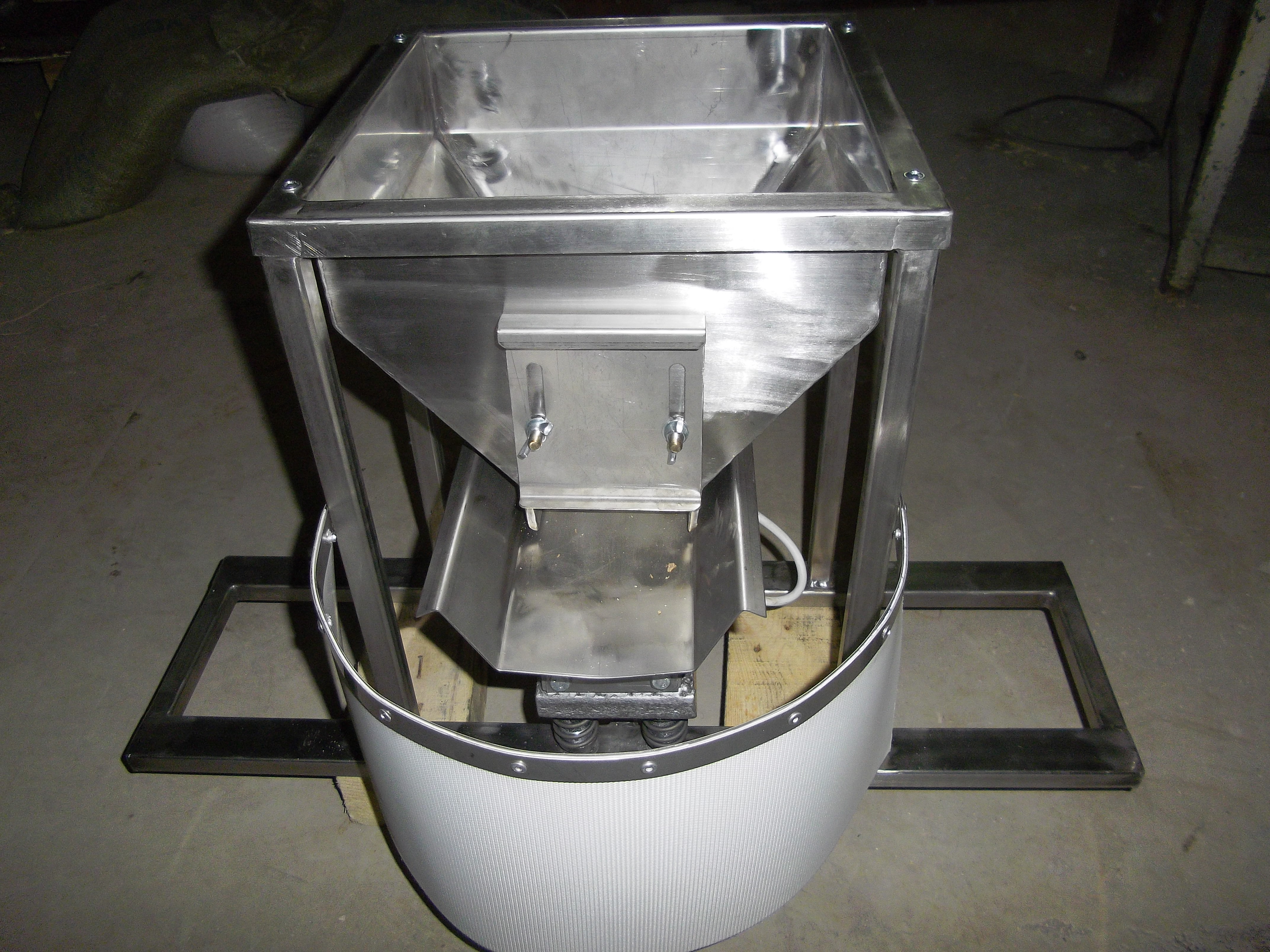
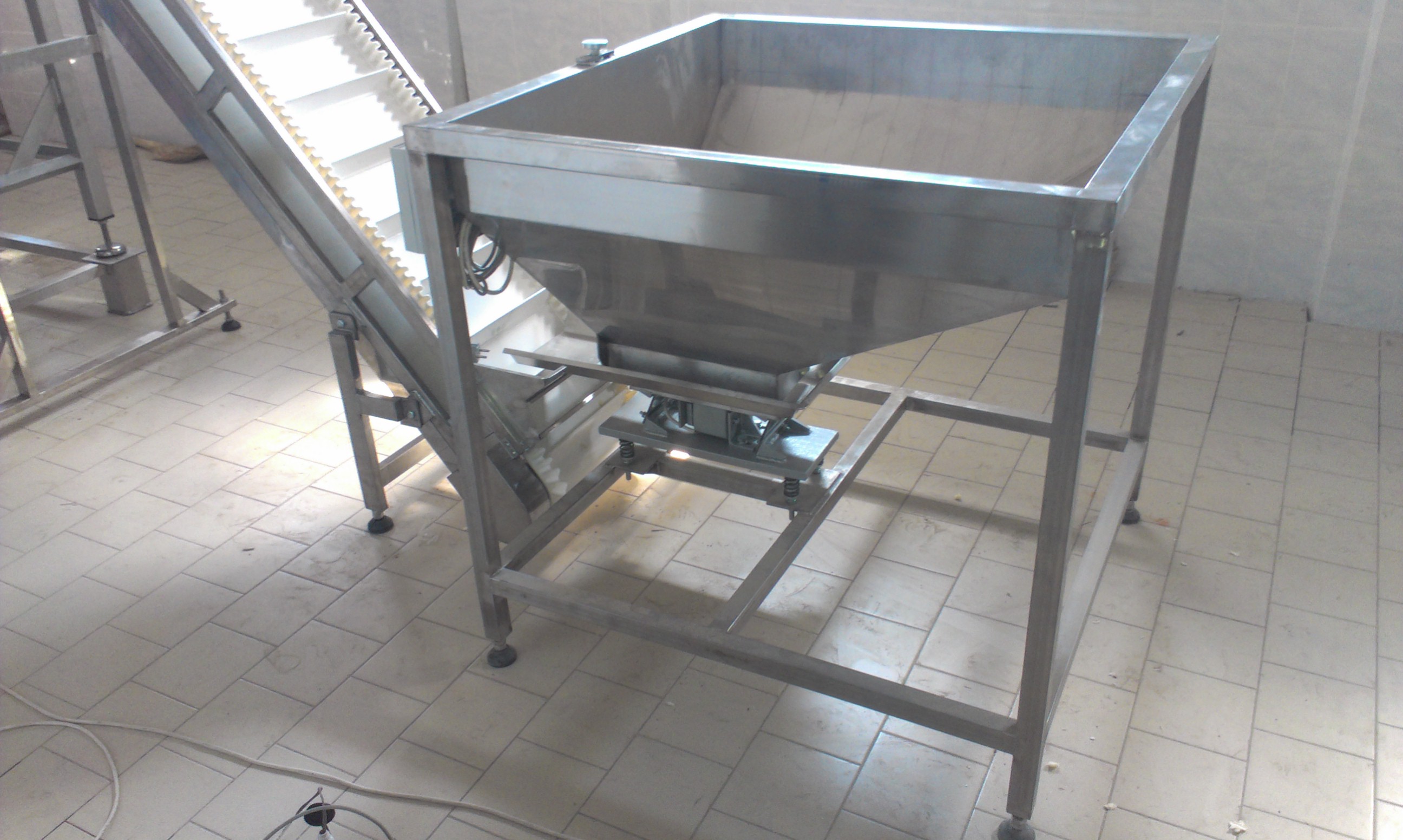
A vibrating chute is a trough that moves bulk or small unit product through directed vibrations. Unlike a belt or screw, a vibrating chute has no moving parts in the product-contact zone, so it is easy to clean and does not damage fragile items. Let’s break down the operating principle and key specs.
Operating principle
The vibratory drive gives the trough fast oscillations at an angle to the horizontal — usually 20–30°. With each cycle the product is tossed forward and up, moving in microsteps. Together this produces an even flow toward the outlet. The product speed depends on the frequency and amplitude of the oscillations. If the trajectory angle is too small, the product slides but does not separate from the trough; if too large, it bounces too high and moves chaotically. The optimal 20–30° gives exactly the “microstep” mode in which the flow is even and controllable.
There are two drive types:
- Electromagnetic — frequency 50–100 Hz, small amplitude, instant start/stop, precise dosing;
- Inertial (unbalanced) — frequency 10–25 Hz, larger amplitude, for heavy and large flows.
The key tuning parameter is the oscillation mode relative to resonance. Electromagnetic vibrating chutes work in a sub-resonant mode: the spring system is tuned so the working frequency is slightly below the natural oscillation frequency. This gives a stable amplitude and an instant response to voltage change. Inertial drives with unbalanced weights work in a super-resonant mode — they are less sensitive to changes in the product mass on the trough, which is convenient for uneven loading.
Throughput adjustment
The throughput of a vibrating chute is changed without stopping the line — this is its main advantage as a feeder. Unlike a belt or a screw, where the speed is usually fixed, a vibrating chute allows the flow to be smoothly and instantly adjusted to the tempo of the next operation. Adjustment is done by:
- changing the oscillation amplitude (supply voltage control);
- changing the frequency (for drives with a variable-frequency drive);
- changing the trough installation angle;
- a gate at the loading point.
In practice, amplitude adjustment via voltage control is the most convenient: it is fast, precise and needs no mechanical rebuilds. The trough installation angle is set once during installation — it is a coarse adjustment of the range. In packaging systems a vibrating chute is often connected to the common automation: a weighing doser itself sends a signal to reduce the amplitude when the accumulated portion approaches the set weight.
Technical specifications
Below are typical parameters of vibrating chutes we build for food lines.
| Parameter | Value |
|---|---|
| Drive type | electromagnetic / inertial |
| Oscillation frequency | 10–100 Hz |
| Throughput | 0.1–20 t/h |
| Trough incline angle | 0…+15° (lift) / down to -5° (descent) |
| Trough material | AISI 304 stainless steel |
| Operating temperature | -20…+80 °C |
Engineer’s tip. A vibrating chute is sensitive to correct mounting. A trough rigidly bolted to the common frame transmits vibration to the whole structure and loses throughput. Always set it on spring or rubber vibration mounts.
Trough geometry for the product
The trough shape is no less important than the drive. For fine bulk product a flat trough with low sides is enough. For fragile items the bottom is given an impact-softening coating. If the product also needs to be levelled into a single layer, the trough is made wider and slower. A special case is a trough with a perforated or mesh bottom: as the product moves, it self-cleans, and fine impurities and crumbs sift through. For feeding multihead weighers the trough is made conical or with radial sections that distribute the product evenly around the circle of weighing heads. The trough length is limited to 2–3 metres: on a longer track the oscillations decay and a second drive is needed.
Typical tasks
A vibrating chute is used where controlled, gentle feeding is needed:
- dosing bulk products for packaging;
- distributing flow before weighing dosers and multihead weighers;
- discharging product from a bunker without bridging;
- feeding fragile items (biscuits, crisps, nuts) without breakage.
More on the design is in the bunkers and vibrating chutes section, and on bulk product feeding in general in the articles tagged feeding.
Advantages over other feeding types
Why does a vibrating chute beat a belt or a screw on many lines? First of all, hygiene. There are no moving parts, bearings or seals in the product-contact zone — nothing where product accumulates. The trough is washed with a water jet in minutes. Second, gentleness: the product is not pulled or compressed, only tossed in microsteps, so breakage of biscuits or nuts is practically zero. Third, dosing accuracy: the instant start and stop of an electromagnetic drive allow portions to be measured with an error of a few grams. Finally, a vibrating chute self-cleans after stopping — no product remains on it, which matters when changing the product variety or for allergen control.
Conclusion
A vibrating chute is a simple, hygienic and precisely controlled feeder for bulk and fragile products. The right choice of drive type and vibration mounts determines its throughput and service life. To select a vibrating chute for your product — get in touch.