In-line check-weigher: how it works
How a check-weigher works, weighing accuracy, integration with the packaging line and rejection of out-of-weight packs.

A check-weigher is a conveyor that weighs each pack on the move and rejects those that fall outside the permitted weight range. It sits between filling and packaging and guarantees that neither an underweight nor an overweight unit gets into the box. In this article we look at how a check-weigher is built and how it is integrated into a line.
Why weigh every pack
A filling machine always has dose scatter. A multihead weigher, a screw or a volumetric filler give a weight with a deviation of ±1–3% depending on the product. An underweight pack is a consumer complaint and a labelling violation. An overweight one is a direct loss for the manufacturer, who “gives away” product.
A check-weigher turns statistical control (sample weighing) into total control: not every tenth pack is checked, but all one hundred percent. This allows the average dose to be kept closer to nominal and saves on overfilling.
How a check-weigher is built
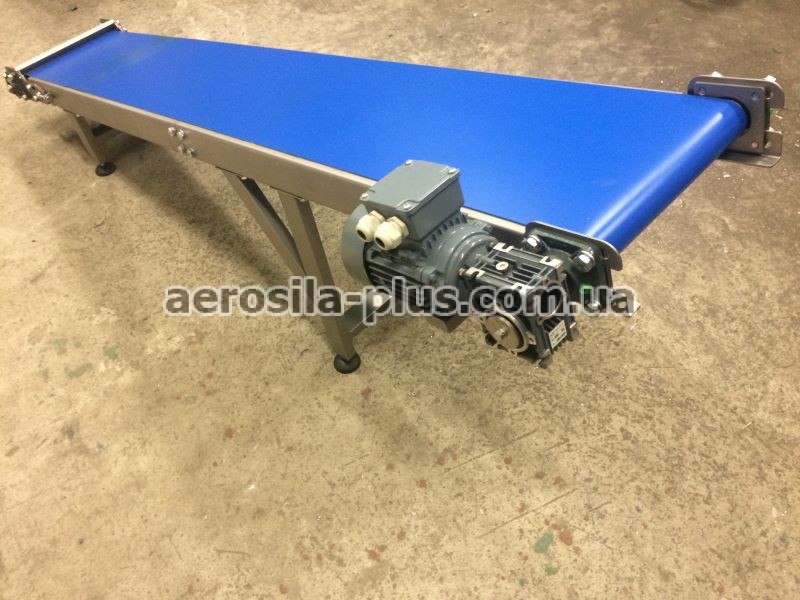
Structurally, a check-weigher is three short conveyors in one line:
- Infeed conveyor — receives the pack from the previous section, accelerates it to working speed and forms a gap between adjacent packs.
- Weighing conveyor — a short conveyor on a load-cell platform. While the pack is fully on it, the system records the weight.
- Outfeed conveyor with a rejector — passes weight-correct packs onward, while out-of-weight ones are dropped into a separate tray by a pusher or air nozzle.
The key point is that the pack must fully fit on the weighing conveyor and be the only one on it at the moment of measurement. So we calculate the section length and speed for the specific pack size.
The weighing platform works on load cells — they convert the deformation from weight into an electrical signal. The signal is unstable in the first fractions of a second after the pack enters, so the system waits for a “stabilisation window” when the oscillations die down, and only then records the value. The shorter this window, the higher the throughput, but the stricter the requirements for vibration isolation and signal filtering.
Accuracy and speed
| Parameter | Typical value | Note |
|---|---|---|
| Weighing range | 5 g – 6 kg | for light and medium packs |
| Accuracy | ±0.2–1 g | depends on weight and speed |
| Throughput | 60–250 packs/min | higher speed — lower accuracy |
| Belt speed | 0.3–1.2 m/s | coordinated with the line |
| Protection rating | IP54 – IP65 | IP65 for wet zones |
Accuracy and speed are always a trade-off: the faster the line runs, the less time the platform has to stabilise the signal. So when designing we start from the line’s real throughput, not the maximum stated in the datasheet.
Engineer’s tip. The biggest enemy of accurate weighing is vibration. We always mount the check-weigher on its own rigid frame with adjustable feet, separate from the frames of adjacent conveyors. If the platform “hears” vibration from the packaging machine’s drive, the error doubles — no filter setting fixes this.
Integration with the line
A check-weigher rarely works on its own. Usually it is part of the filling and packaging chain and exchanges signals with adjacent equipment:
- Receives a “pack at infeed” signal from a photo sensor.
- Passes the weighing result to the line accounting system.
- Gives the rejector a command to drop an out-of-weight pack.
- From deviation statistics it can correct the filling machine’s dose in feedback.
We lay out the weighing section together with the line’s conveyors and transporters, and the rejected stream with custom solutions such as accumulation trays or rotary tables. Integration with accounting is worked out at the line automation stage.
The rejector itself is set up separately. For light packs an air nozzle suits — a short jet of compressed air pushes the pack off the line. For heavier ones a mechanical pusher or a tilting belt segment is used. The rejector type is chosen by pack weight and line speed: a slow nozzle will not keep up on a fast conveyor, while a powerful pusher will damage a fragile pack.
Calibration and daily checks
A check-weigher’s accuracy is not set once and for all — it is maintained. The load-cell system is sensitive to temperature, belt contamination and support wear, so without regular calibration the error creeps.
The basic procedure we hand over to the customer together with the equipment:
- Zero check at the start of the shift — an empty weighing conveyor must read zero.
- Control with a reference weight of known mass once per shift.
- Cleaning the weighing belt of stuck product — buildup distorts the weight.
- Periodic full calibration with a set of weights across the whole range.
The rejector’s synchronisation is checked separately: a test pack of deliberately wrong weight must reliably go into the reject tray. If the check-weigher is integrated with the accounting system, check results are saved automatically — this both disciplines the staff and provides a document for the audit.
Conclusion
A check-weigher is total weight control that saves on overfilling and protects against underweight complaints. Its accuracy is determined by the weighing section length, the line speed and — most importantly — vibration isolation. If you are planning weight control on a packaging line, get in touch — we will design a check-weigher for your product and throughput.