Conveyor for unit loads: choosing the right solution
How to choose a conveyor type for boxes, crates and packages — speed, load, dimensions and selection criteria.
A unit load is an individual item: a box, crate, tray, package or can. Unlike bulk product, it has a definite geometry, weight and orientation requirements. So a conveyor for unit loads is selected by different criteria than for bulk. Let’s break down what to watch for.
What to consider when choosing
Before selecting a conveyor type, we collect five parameters with the customer:
- load dimensions — length, width, height of the smallest and largest item;
- weight — this determines drive power and belt class;
- throughput — how many units per minute pass the section;
- bottom type — flat, ribbed, soft (a bag);
- routing — straight run, turn, incline, accumulation.
These five parameters are interconnected. A heavy load requires a stronger belt and a more powerful drive, and a belt with a thick carcass bends worse on small drums and will not go around a sharp curve. Dimensions determine the mat width, and the bottom type determines whether a roller conveyor can be used at all. So we never choose a type “out of habit”: first we collect all five parameters, and only then does the intersection of requirements point to a suitable solution.
Conveyor types for unit loads
Four solutions are most often used for unit loads. Below are their application areas.
| Type | Best for | Feature |
|---|---|---|
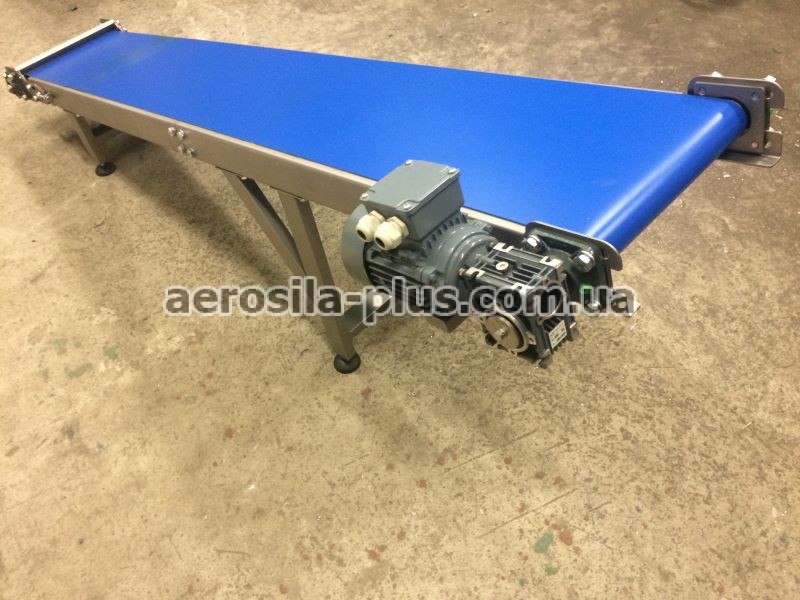
| Belt | Light and medium packaging | Universal, quiet running |
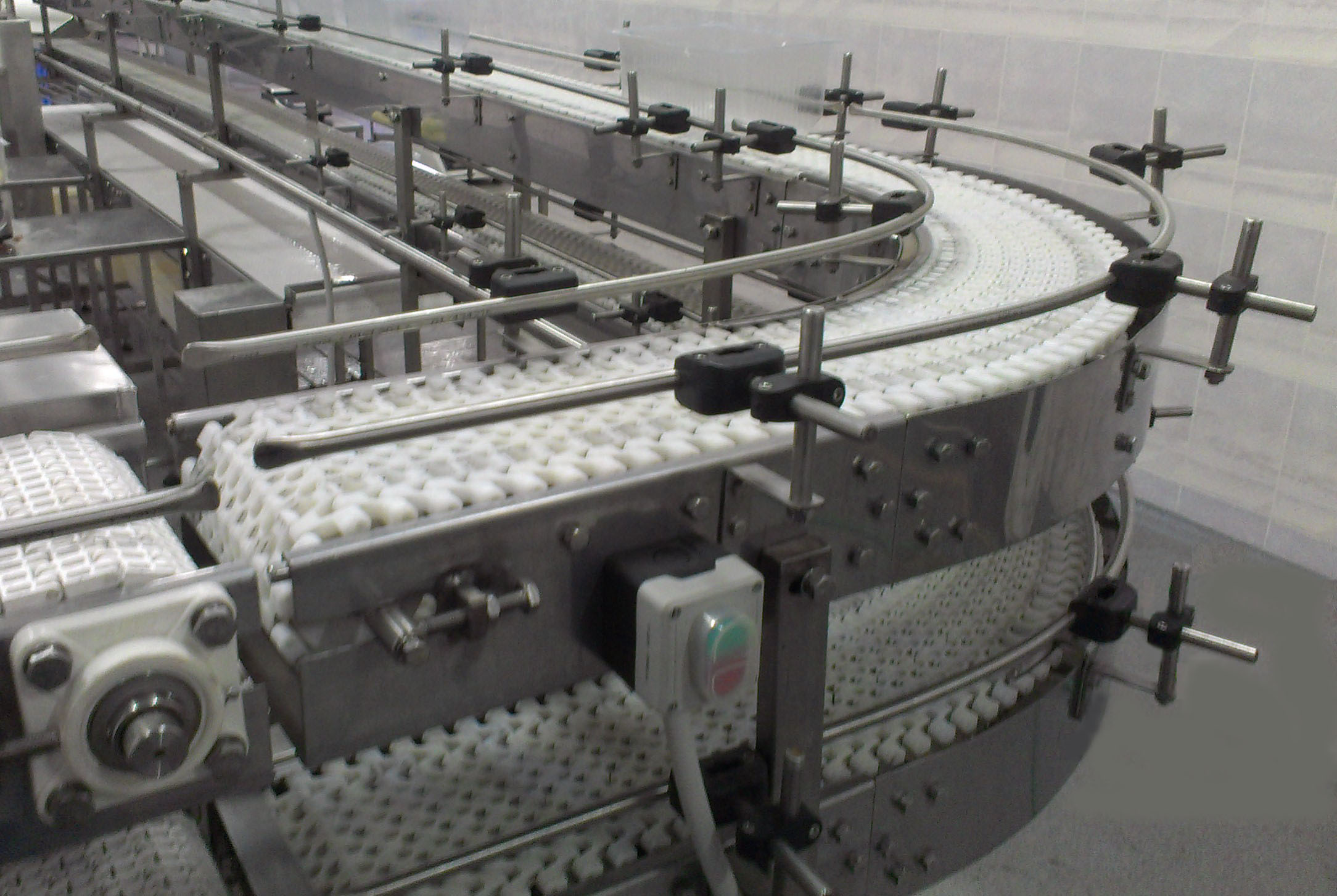
| Modular | Wet processes, turns | Disassemblable mat, easy cleaning |
| Roller | Heavy boxes with flat bottom | Accumulation, low energy use |
| Slat | Heavy crates, hot items | High load capacity |
Load orientation and accessory units
A unit load must not only be moved but also held in the right position. A box with a printed label must reach the scanner with a specific side facing it; a bottle must stand, not lie. For this, auxiliary units are built into the route. Guide rails keep the load from leaving the belt on turns and inclines. A turntable or diverter changes the item’s orientation by 90°. A screw spreader separates a dense flow of bottles into a single row. An accumulation section with a roller conveyor creates a buffer before a slower operation. All these units are coordinated with each other at the layout stage — otherwise the load jams at the junction of two sections.
Speed and line tempo
Conveyor speed is selected not at maximum but matched to the line tempo. If the packaging section outputs 40 boxes per minute, the conveyor must move so the boxes travel with a gap, without pile-up. Typical speeds for unit loads are 0.1–0.5 m/s. For a turn or incline the speed is always reduced.
Engineer’s tip. Don’t chase speed. A conveyor moving faster than the packaging tempo will only scatter the load around the turns. Always calculate speed from the throughput of the slowest operation on the line.
Modular belt for complex routes
When a route has turns, inclines or wash zones, the optimal solution is a modular belt conveyor. The rigid plastic mat holds the load on turns, does not stretch and disassembles easily for cleaning. For straight dry sections a belt conveyor is enough.
Transfer points between sections
The most vulnerable spot of any unit-load line is the junction where the load moves from one conveyor to another. If there is a gap between sections, a light box or package can tip over or jam. So transitions are designed with a minimum gap, and for small loads transfer bridges are added — passive plates or small-diameter rollers. The height difference between adjacent conveyors must not exceed a few millimetres. If an angled transition is needed, a knife-edge belt is used, bringing the load almost flush with the next mat. Well-designed transitions are the difference between a line that runs without operators and a line where someone is constantly adjusting the load. More on layout in the articles tagged conveyor.
How not to make a selection mistake
The most common mistake is to choose a conveyor “from a catalogue” for a similar task without accounting for the details. A belt conveyor is excellent for a straight dry route, but on a sharp curve a light box will slide off — here a modular belt with guide rails is needed. A roller conveyor is ideal for heavy boxes with a flat bottom, but a soft package will sag between the rollers. A slat conveyor withstands heavy hot crates but is excessive for light packaging and costs more. The second mistake is to forget about the smallest and the largest load at the same time: the section must reliably carry both. So we always begin the layout with a complete list of loads, not with an averaged “typical item”.
Conclusion
A conveyor for unit loads is chosen by dimensions, weight, tempo and routing — not “from a catalogue”. The right belt type and speed ensure a smooth flow without jams. To lay out a section for your packaging — get in touch.