Custom turning work: what the customer should know
Precision, materials, drawings, heat treatment — how to order a turned part without rework or extra cost. A practical customer guide.
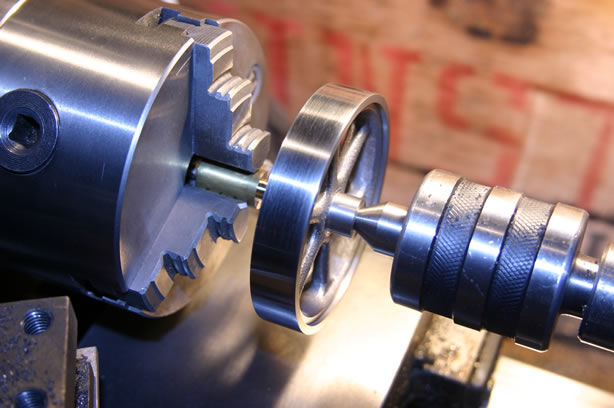
Turning work is the manufacture of rotational parts: shafts, bushings, axles, flanges, drums. For an equipment owner turning often sits on the critical path of a repair: a broken shaft stops the line and a new part must be made fast and accurately. In this article we explain how to order a turned part properly to avoid rework.
What turning is
Turning is the removal of metal with a cutting tool from a rotating workpiece. On a lathe you make anything with an axis of symmetry: shafts, axles, bushings, flanges, fittings, pulleys. Modern CNC lathes hold the geometry automatically, but part quality still depends on the clarity of the task.
Customers most often come to us in two cases: an urgent repair (a part has broken, the line is down) and manufacturing a batch for new or upgraded equipment. In the first speed matters, in the second repeatability.
What you need to provide for an order
To make a part without rework we need a full set of input data:
- A drawing or a sample. Ideally a drawing with dimensions and tolerances; if there is only a broken part, we will take the dimensions ourselves.
- Material. Structural steel, AISI 304/316L stainless, brass, bronze, polyamide — this affects both machining and price.
- Precision grade. Where the part fits: a free dimension or a bearing seat.
- Surface roughness. Especially for mating and sealing surfaces.
- Heat treatment. Whether hardening, normalising or nitriding is needed.
The more complete the task, the fewer clarifications and the more accurate the part on the first try.
Precision and tolerances
The precision grade is the main thing that determines both the complexity and the cost of a part. Do not order high precision where it is not needed: it raises the cost without benefit. Below is a guide on which grade suits which task.
| ISO grade | Tolerance (Ø50 mm) | Typical application |
|---|---|---|
| IT11–IT12 | ±0.08…±0.12 mm | free non-working dimensions |
| IT9–IT10 | ±0.03…±0.05 mm | general engineering |
| IT7–IT8 | ±0.012…±0.02 mm | bearing seats, pulleys |
| IT6 | ±0.008 mm | precision shafts, spindles |
Engineer’s tip. Specify a tight tolerance only on surfaces that actually work in a fit. A part with every dimension ordered to IT6 costs three times as much as a functionally equivalent one where precision is set only on the two seating journals.
Material and heat treatment
The choice of material is a balance of strength, corrosion resistance and price. For parts in contact with food product we choose AISI 304 stainless steel, and in an aggressive environment 316L. For loaded shafts — structural steel with subsequent hardening. If a part works under friction, its surface is hardened.
Turning is rarely a standalone service — more often it is part of a full cycle together with milling and welding work. A complex assembly we make comprehensively: turn the shaft, mill the keyways, weld the support elements.
Surface roughness: where it is critical
Besides dimensional precision, the drawing should specify surface roughness — the Ra parameter. This matters especially for three types of surface. Bearing seating journals: too rough a surface quickly breaks down the inner ring, too smooth a one does not retain lubricant. Sealing surfaces under lip seals and packings: here a polished surface of Ra 0.4–0.8 µm is needed, otherwise the seal leaks. Surfaces in contact with food product: smoothness is needed not for mechanics but for hygiene — product lodges in the micro-relief of a rough surface.
For the rest, non-working surfaces, high finish is not needed — and should not be ordered. As with tolerances, every extra roughness requirement is an additional tool pass and additional cost.
Urgent repair vs planned batch
Two ordering scenarios call for different approaches. In an urgent repair the line is down, so the priority is speed. We take dimensions directly from the broken part, agree the material and make an analogue. Here it is important not to “improve” the design but to accurately reproduce the working part.
A planned batch for new or upgraded equipment has different logic. Here there is time for a drawing, the choice of an optimal material and process preparation. For a batch we build in repeatability from the start: a single machine setup for the whole batch, inspection of every fifth part. This guarantees the tenth part does not differ from the first — critical when the parts go into an assembly.
Conclusion
A quality turned part starts not with the lathe but with a clear task: drawing, material, realistic tolerances and heat-treatment requirements. A customer who sets precision thoughtfully gets the part faster and cheaper. Need a turned part for your equipment? Get in touch — we’ll accept a drawing or take dimensions from a sample. More on manufacturing services under the tag services.