
Pop-up cross profile for delicate products
How a pop-up cross profile reduces damage to wafers, biscuits and frozen berries on inclined sections of a conveyor belt.
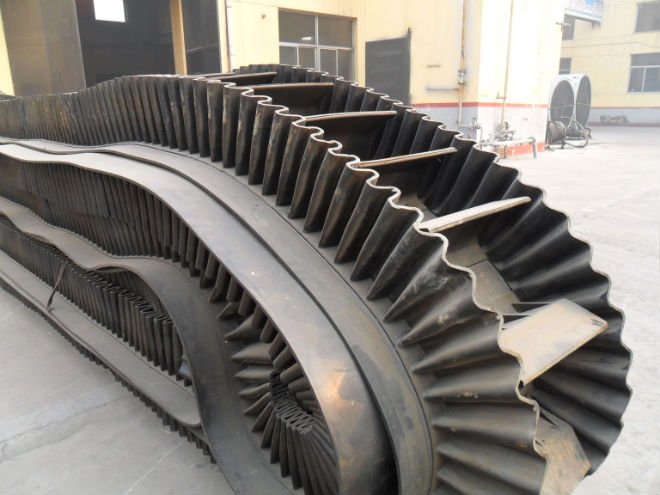
Lifting a delicate product on an inclined belt is a classic engineering problem. A regular cross profile holds the product from sliding but injures it on entry into the lift zone. A pop-up profile resolves this conflict. This article breaks down how it is built and where its use is justified.
The problem of lifting delicate products
On a flat belt without a profile, a product on an incline above 15–18° simply slides back down. The limit depends on the friction coefficient of the “product–mat” pair: for dry biscuits on textured PVC it is about 18°, for frozen berries on a smooth mat — only 10–12°. To lift the product higher, cross profiles are added to the belt — transverse cleats that support the product and effectively turn the incline into a series of steps.
But for delicate products — wafers, biscuits, frozen berries, fragile confectionery — a regular profile creates a new problem. In the horizontal loading zone the rigid cleat, 30–40 mm high, protrudes above the mat and strikes the product as it enters the belt at 0.3–0.6 m/s. The result is chips, cracks, breakage. On a wafer line the scrap rate from such an impact easily reaches 3–5%, which means direct loss of raw material and rework.
The principle of the pop-up profile
The pop-up profile resolves the conflict elegantly: it changes its height depending on its position along the route. In the horizontal loading zone the profile is pressed against the mat or fully recessed — the product lies on a flat surface without impact. When the belt enters the inclined zone, the profile automatically “pops up”, rises above the mat and starts supporting the product.
At product discharge, in the unloading zone, the profile lowers again — the product comes off smoothly, without catching.
The actuation physics is simple: when the belt wraps a drum or a route bend, the outer radius lengthens, and the profile, fixed by its base to the mat, opens up or rises. On a straight horizontal section there is no deformation — the profile stays folded. This is exactly why a pop-up profile needs no drive or control: the conveyor geometry itself “controls” it. This is a key advantage — the system has no additional moving parts that could fail.
Design and materials
The pop-up profile is implemented in several ways: on elastic hinges, on spring elements, or through the special geometry of the profile itself. Actuation is provided by the route shape: on the horizontal section the profile is folded, on the incline — open.
| Parameter | Value |
|---|---|
| Profile material | food-grade PU or PVC |
| Certification | EU 1935/2004 |
| Incline angle with profile | up to 60° |
| Profile height when active | 20–60 mm |
| Temperature range | -20 °C … +80 °C |
| Colour | blue (for detection systems) |
| Profile pitch | 80–250 mm |
| Base mat | PVC or PU, 2–3 plies |
The blue colour of the profile is not aesthetics but a food-safety requirement: a blue shade does not occur in natural products, so a profile fragment is reliably detected by a metal detector with an optical channel or by visual inspection.
Profile geometry and installation pitch
The effectiveness of a pop-up profile is determined by three parameters: height, pitch and cross-section profile. Height is taken with a 30–50% margin over the product height: a 12 mm tall wafer is confidently held by a 20 mm profile. Pitch — the distance between adjacent cleats — is chosen so that on the inclined section the product rests on at least one cleat and does not “fall through” between them; for small berries this is 80–120 mm, for biscuits — 150–250 mm. Cross-section: for delicate products we choose a profile with a rounded or sloped working edge, without sharp corners.
Separately we calculate the length of the transition zone — the section where the profile changes from folded to working state. If the transition is too sharp, the profile opens with a jerk and still tosses the product. So the route bend radius is taken no less than 400–600 mm depending on mat stiffness.
Which products need it
A pop-up profile is not always justified — it is a solution for a specific class of tasks. It is needed when two conditions are met at once: the product is delicate and the route must be lifted at a steep angle.
Typical products where the profile delivers an effect:
- wafers and wafer sheets;
- biscuits and crackers;
- frozen berries and fruit pieces;
- fragile confectionery, marshmallow;
- chips and snacks.
Engineer’s tip. Before ordering a belt with a pop-up profile, check whether a steep incline is really needed. It is often simpler and cheaper to lengthen the route and reduce the incline angle to 15–18°, where a regular belt without a profile is enough. The pop-up profile is justified exactly when there is nowhere to lengthen the route.
Advantages over a regular profile
The main advantage of the pop-up profile is reduced breakage of delicate product. On our projects, switching from a regular profile to a pop-up one reduced the scrap rate from chips and cracks by a factor of 2–3. An additional effect is even loading: the product lies on the flat belt neatly, without tipping or piling up against the cleat.
The profile also eases washing: in the horizontal position the folded belt cleans almost like a flat one. For more on choosing belt elements, see the articles tagged belts.
Combining with sidewalls and typical mistakes
On a steep incline a pop-up profile almost always works together with longitudinal corrugated sidewalls: the profile holds the product from sliding down, the sidewalls — from coming off sideways. The sidewall height is taken 10–20 mm above the product. This combination allows delicate product to be safely lifted at an angle up to 60°, whereas without sidewalls the practical angle is limited to about 40°.
The most common mistakes on our projects: too small a bend radius, causing the profile to open with a jerk; insufficient cleat pitch, when small product falls through between cleats; and choosing a profile with a sharp edge where a rounded one is needed. Another typical mistake is saving on mat quality: a pop-up profile loads the attachment zone in bending, and a cheap single-ply mat quickly cracks at the cleat base. That is why under a pop-up profile we always use a two- or three-ply conveyor belt.
Conclusion
A pop-up cross profile is an engineering solution for the steep lifting of delicate products. It supports the product in the inclined zone and does not injure it during loading, reducing breakage several times over. The solution is justified where a steep angle is needed and the product is sensitive to impacts. Planning a line with delicate product lifting? Get in touch — we’ll select the belt and profile type for your product.
