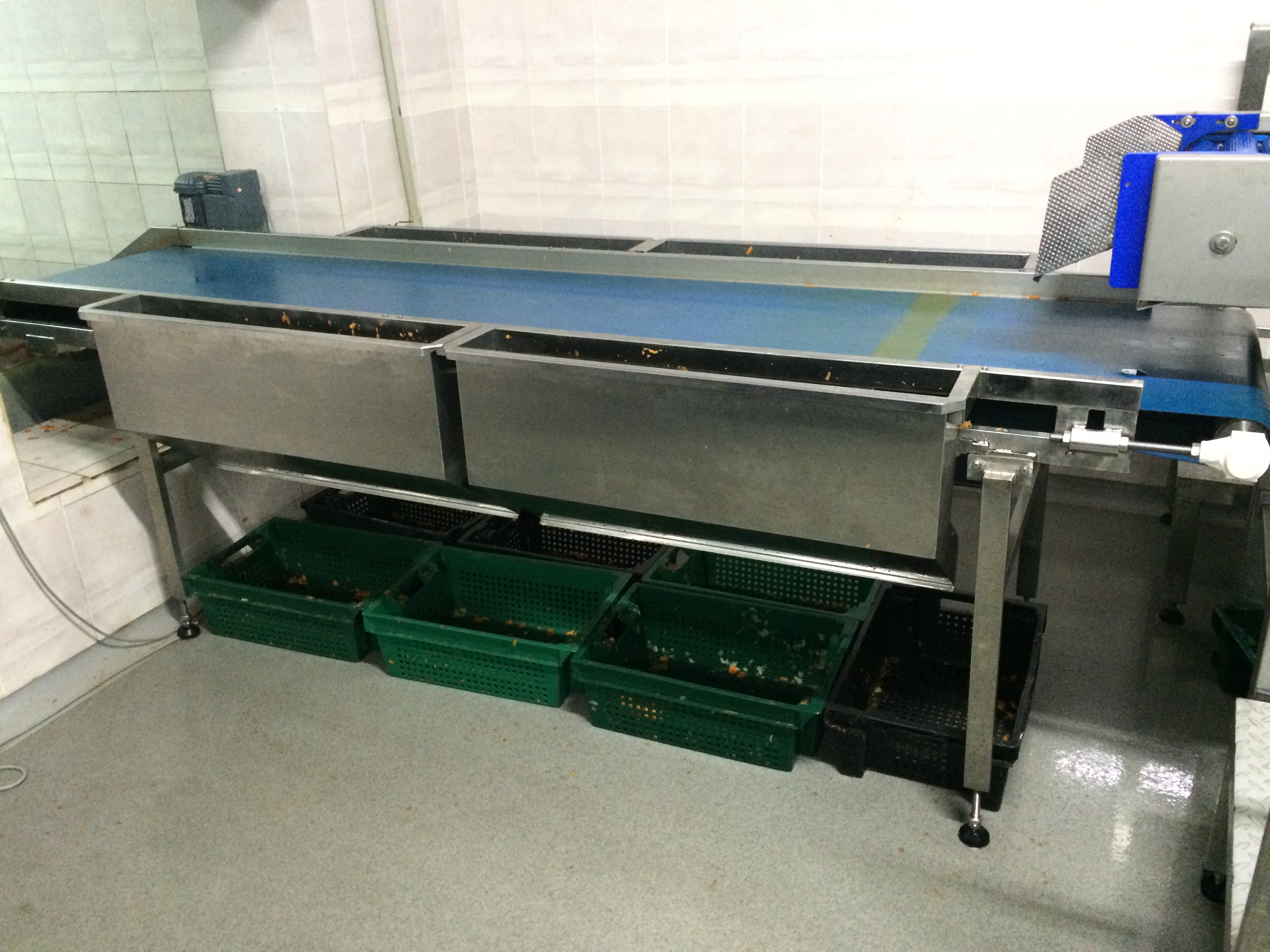
Quick line stop without product loss
Scenarios for an emergency and a planned conveyor line stop: how to keep product in the production zone and avoid scrap during a sudden stop.
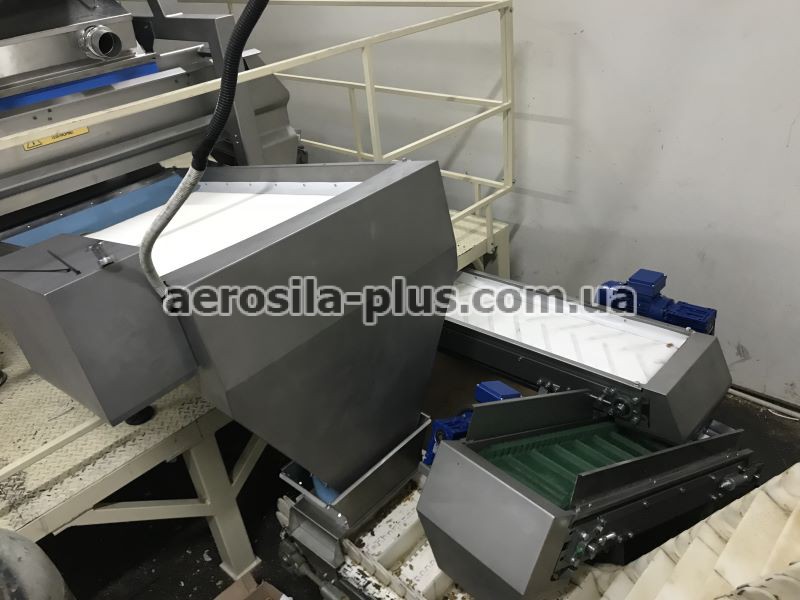
Stopping a line is not a pressed button but a whole procedure. A sudden stop with no scenario leaves product in heat treatment, washing or on inclines — and that is a direct loss. In this article we break down how an emergency stop differs from a planned one and how to stop a line without losing the product.
Why a stop is a procedure, not a button
A conveyor line is a sequence of sections with different processes. At the moment of a stop the product is everywhere at once: in the oven, in the washing bath, on cooling, on an inclined conveyor. If you simply de-energise everything at once, product in the heat zone overheats, in the wash gets soaked, and on an incline slides down.
That is why a competent stop is a sequence of actions in the right order. It must be thought out in advance and written down, not improvised in a moment of stress.
Two types of stop
An emergency and a planned stop have different goals and a different order of actions. Confusing them is dangerous.
| Parameter | Emergency | Planned |
|---|---|---|
| Stop trigger | Threat to a person or equipment | End of shift, changeover |
| Speed | Instant | Step by step |
| Priority | Person’s safety | Product preservation |
| Product on the line | Losses possible | Losses minimised |
| Command | E-stop, any worker | Shift leader per procedure |
In an emergency stop the priority is one — the safety of the person, and product losses are disregarded. In a planned one it is the opposite: there is time to run the line so that product does not remain in critical zones.
Planned stop scenario
A planned stop we always do “tail to head” — first we stop the raw-material feed, then let the line empty.
- Stop the raw-material feed at the line entrance.
- Let the product run off all sections — the line runs “empty” until it clears.
- Stop the heat zones separately — product must not remain in a hot oven.
- Clear the washing and baths — product in water quickly loses quality.
- Stop the inclined sections last, having made sure nothing is on them.
- De-energise the drives per procedure and apply lockout.
Engineer’s tip. The biggest losses during a stop are not on conveyors but in heat zones and washing. Build into the line design the ability to quickly remove product from the oven and drain water from the baths separately from the general stop. On our projects we provide separate controls for these zones — it saves the batch in any unplanned stop.
What to do in an emergency stop
An emergency stop triggers instantly — the product stays where it was. The task after an E-stop: first eliminate the cause and confirm safety, then assess the product condition in critical zones. Product from the oven and the wash often has to be scrapped — this is a normal price for safety. The rest of the line, after the cause is removed, is started by the planned start-up scenario. Emergency stop buttons are part of the mandatory conveyor safety system, and every worker must know where they are.
After an emergency stop it is important not to rush the restart. First the root cause of the trigger is determined, recorded and eliminated. A “blind” start, with no understanding of what happened, can lead to a repeated accident — this time with worse consequences.
Technical means for a soft stop
A competent stop relies not only on a procedure but also on the line’s design. A few technical solutions we build in already at the design stage make a planned stop safer for the product:
- Frequency converter — provides smooth drive braking over 2–5 seconds instead of an abrupt stop; product on the belt does not shift or fall.
- Zone control — each process section has its own starter, so a heat zone or washing can be stopped separately from the rest.
- Backstop brake on inclined conveyors — holds the belt from sliding down under product weight after the drive stops.
- Buffer accumulators between sections — they take in product that “did not manage to run off” and prevent it piling up.
A different logic applies to the emergency circuit: here the stop must be instant and independent of the automation. E-stop buttons break the drive power directly, through a hardware safety circuit of category 3 to ISO 13849, not through a programmable controller. This guarantees operation even if the electronics fail.
Staff training
A stop scenario works only when the shift knows it. We include both scenarios — emergency and planned — in the operator training programme and practise them hands-on. An operator must act automatically: at a threat — an E-stop without thinking, at a planned stop — in a clear order. The scenarios should be repeated in training once a quarter.
It is useful to have the scenarios as a short diagram near the panel too — in a stressful situation memory fails even an experienced operator. A clear sequence of steps in a visible place reduces the risk of error and speeds up the correct reaction. For more on organising safe operation, see the articles tagged safety.
Conclusion
A quick line stop without product loss is a scenario written down in advance, not an improvisation. An emergency stop prioritises the person’s safety, a planned one — product preservation through the correct order of actions. The key is separate control of heat zones and washing and a trained shift. Planning a line or want to write down stop procedures for an existing one? Get in touch — we will help compile scenarios for your production.