Screw conveyor for bulk products: how to choose
How to select a screw conveyor for a bulk product: screw diameter, flight pitch, rotation speed, trough type and throughput.
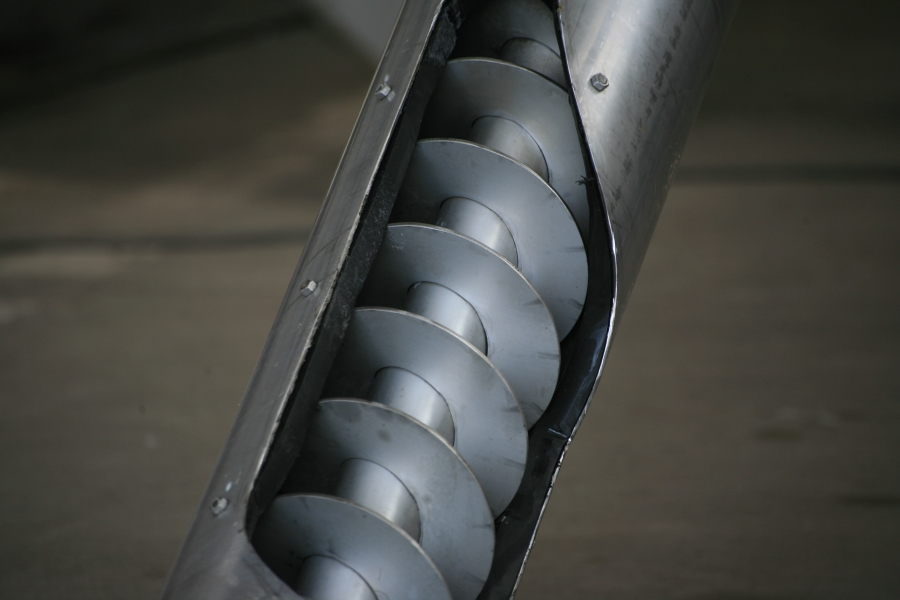
A screw conveyor moves bulk product by rotating a helical flight inside a closed trough or tube. It is a compact solution where flour, sugar, seeds or pellets need to be moved a short distance, including at a steep angle or vertically. In this article we look at how to select screw parameters for a specific product and a given throughput.
Operating principle and applications
A screw is a shaft with a helical flight rotating in a trough. As it rotates, the flight pushes the product along the axis. Because the product is fully enclosed by the trough, a screw does not raise dust or spill material — its main advantage for flour, spices and fine seeds.
A screw conveyor is indispensable for three types of task: dosed feeding of bulk product from a bunker, short-distance transport without transfer points, and lifting product at angles up to 90°. It also has limits: a screw partly grinds fragile product and is not suitable for delicate whole berries or in-shell nuts.
Key selection parameters
A screw is designed for the product across five parameters:
- Screw diameter — sets the flow cross-section and base throughput.
- Flight pitch — the distance between adjacent flights; usually equal to the diameter (full pitch), reduced for steep inclines.
- Rotation speed — from 20 to 150 rpm depending on product and abrasiveness.
- Trough fill factor — 0.40–0.45 for free-flowing products, 0.25–0.30 for heavy and abrasive ones.
- Incline angle — a horizontal screw is the most productive; throughput drops as the angle grows.
An error in even one parameter changes throughput severalfold, so we run the calculation comprehensively.
Indicative throughput by diameter
Screw throughput is roughly proportional to the cube of the diameter. Below are indicative values for a horizontal full-pitch screw on a free-flowing product (flour, fine seeds).
| Screw diameter | Rotation speed | Indicative throughput |
|---|---|---|
| 100 mm | 100 rpm | 1.5–2.5 t/h |
| 160 mm | 90 rpm | 5–8 t/h |
| 200 mm | 75 rpm | 10–14 t/h |
| 250 mm | 60 rpm | 18–25 t/h |
| 320 mm | 50 rpm | 35–45 t/h |
Trough, drive and materials
The trough comes in two forms: a U-shaped open trough (a tray on top) or a closed tubular one. The tubular type is mandatory for dusty products and vertical transport. For food lines the trough and flight are made of AISI 304 stainless steel, and for contact with salt or an acidic environment — AISI 316L.
The drive is a gear motor selected by power with the starting torque in mind: a screw filled with product after a stop starts harder than an empty one. So we take motor power with a 20–25% margin. To adjust throughput on the run we add a frequency converter. A screw pairs well with bunkers and vibrating chutes — a typical combination for dosed feeding of bulk product into a line.
Screw types for different tasks
The flight design also changes for the product. A solid spiral flight is the basic option for most bulk products. A ribbon flight (without a central shaft) is used for sticky and fibrous materials that cling to the shaft. A paddle screw with an interrupted flight transports and mixes the product at the same time — useful for dosed mixing of components. For delicate products an increased-diameter screw with a low rotation speed is chosen: it moves raw material “gently”, with minimal grinding.
Vertical and steeply inclined screws stand apart. At inclines above 45° throughput drops non-linearly, so the flight is made with a reduced pitch while the rotation speed, conversely, is raised — centrifugal force helps press the product against the tube wall. This is the classic way to lift flour or pellets to a second-tier height without a bulky bucket elevator.
Common selection mistakes
In practice most screw problems come down to three mistakes. The first is underestimating the starting torque: the screw is designed for the running regime and will not start under a blockage of product. The second is ignoring abrasiveness: a flight of ordinary steel on sand or husk wears out within months. The third is a mismatch of flight pitch to incline angle: a full pitch on a steep screw causes the product to spill back over the flight.
Engineer’s tip. For abrasive products (sand, pellets, husked seeds) reduce the rotation speed by 30–40% from the table value and build in replaceable wear-resistant flight overlays. This doubles or triples the screw’s service life.
Conclusion
A screw conveyor is a compact, clean solution for bulk products where dosing and dust-free operation matter. The key is correctly selecting the diameter, pitch and rotation speed for the specific raw material, since an error here directly hits throughput. Need a screw for your product? Get in touch — we’ll calculate the spec and throughput. More on bulk transport under the tag conveyor.