Conveyor safety systems: E-stop and guarding
The minimum conveyor safety set: emergency stop buttons, pull-cord switches, light curtains, nip-point guards.
A conveyor is moving components, nip points and a torque sufficient to injure a person. That is why the safety system is not an option but a mandatory part of the project. The article covers the minimum set of safety devices we build into every line and the logic of their operation.
Where the hazardous zones on a conveyor are
Before fitting protection you need to know exactly where a person can be hurt. The classic hazardous zones of a conveyor:
- Belt run-on points at the drum — entanglement of fingers and clothing.
- Sprocket-and-chain engagement — on slat and chain conveyors.
- Transfer zones between conveyors — pinching of a hand while clearing a jam.
- Drive and rotating shafts — winding-in of clothing, hair.
- Sharp frame edges — cuts during maintenance.
Each of these zones needs its own protective device — there is no universal solution.
Emergency stop: E-stop and pull-cord switch
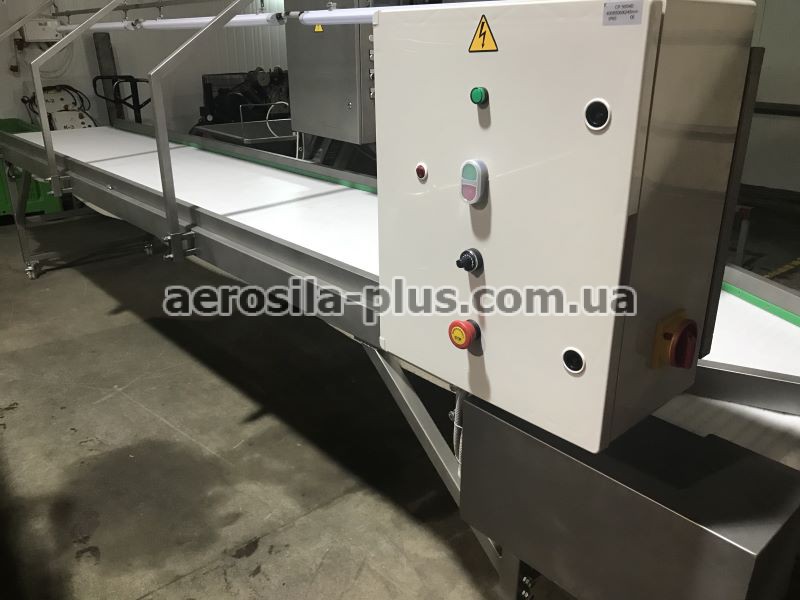
The basic element is the emergency stop system. A mushroom E-stop button is fitted at every operator workstation within arm’s reach — a practical guideline is no more than 600 mm from the working position. For long conveyors buttons are not enough: per EN ISO 13850, on a route over 10 m we fit a pull-cord switch along the whole length. By pulling the cord at any point, a worker instantly de-energises the drive; a cord break also causes a stop. The cord is tensioned with bracket spacing of 2.5–3 m and a trip force of about 125 N. The emergency stop must stop the conveyor with category 0 or 1 and not allow an automatic restart without manual reset.
Parameters of the safety devices
| Device | Protected zone | Action | Standard |
|---|---|---|---|
| E-stop button | Operator workstation | Drive stop, manual reset | EN ISO 13850 |
| Pull-cord switch | Whole route length | Stop from any point | EN ISO 13850 |
| Light curtain | Entry/exit zone | Stop on beam crossing | EN 61496 |
| Interlocked guard | Drive, sprockets | Stop on door opening | EN ISO 14119 |
| Fixed guard | Nip points | Physical access barrier | EN ISO 14120 |
Light curtains and guards
Where the operator’s hands regularly approach a hazardous zone — for example at loading or inspection — we fit a light curtain. Crossing the beam instantly stops the conveyor. The curtain resolution is chosen by the object to protect: 14 mm for fingers, 30 mm for a hand, 90 mm for body-passage monitoring. An important nuance is the safe distance: the curtain is positioned so that a person cannot reach the hazardous zone while the conveyor is still stopping. This distance is calculated per EN ISO 13855, accounting for the curtain response time and the drive coast-down. For zones that need access only during maintenance, a fixed guard or a cover with an interlock switch is enough: open the door and the drive stops.
Engineer’s tip. The emergency button must be bright yellow-red, protrude above the panel and have no other controls around it. If, in a panic, the operator spends an extra second searching for the button, the protection has already failed to act in time. Placement matters more than quantity.
Safety level and stop category
Not all safety devices are equal. The EN ISO 13849-1 standard introduces the concept of Performance Level (PL): from PLa for minor risks to PLe for zones where a protection failure leads to a severe injury. For a typical food conveyor we design the emergency circuit to PLd with architecture category 3 — this means duplicated channels and self-diagnostics, where a single fault does not disable the protection.
A separate distinction is the stop categories to EN 60204-1. Category 0 is instant de-energising of the drive, the load stops by coasting. Category 1 is controlled braking followed by de-energising; we choose it where a sharp jerk could throw off product or damage the belt. Category 2 is not used for emergency functions. The category choice is always a compromise between stopping speed and preserving the product, and we resolve it for the specific line.
Checking and maintaining the safety system
A safety device that is not checked gradually turns into a prop. A pull-cord switch with a sagging cord will not trigger on a light pull, dirty light-curtain optics give false stops, and a jammed mushroom button will not return to its initial state. That is why we build in a schedule: a functional check of every E-stop button by pressing it every shift, a check of the cords and curtains every week, a full test of the emergency circuit with a report once a year.
Safety when upgrading old conveyors
A separate category of tasks is conveyors already running in the workshop without modern protection. Here you cannot simply “screw on a button”: retrofitting requires a re-assessment of the risks of the whole machine. We start with a survey — recording the real hazardous zones, the actual drive coast-down, the state of the electrics. Often the old drive does not support controlled braking and the E-stop button cannot deliver category 1 — then a new variable frequency drive with a safe braking function is needed, and single-channel safety relays are replaced with dual-channel ones. The upgrade is documented: an updated risk assessment and a test report make the line fit for further operation.
Safety logic and documentation
Safety devices are not separate parts but a system with a single logic. All signals — E-stop, pull-cord switch, curtains, door interlocks — are fed into a safety relay or a safety controller that guaranteed de-energises the drive. The contacts of emergency devices are always positively driven: even if a contact “welds”, the button mechanics break the circuit. All this is recorded in the risk assessment — we wrote about it in the article exporting equipment and CE marking. Correctly organised safety is part of our engineering and design consultations.
Conclusion
Conveyor safety is built not from a single button but from a system: emergency stop, pull-cord switch, light curtains, interlocked guards — each device for its zone. They must be built in at the design stage, not “caught up” later. Need a safety audit or a line project? Get in touch — we will assess the risks and select the protection set.