Rotary table for packaging lines
How to choose a rotary table for accumulating product before packaging: diameter, drive type, speed control and tabletop material.
A rotary table is a rotating disc platform that receives product from a conveyor and accumulates it before packaging. It smooths the speed difference between the production line and the packaging section and gives the operator time without stopping the line. In this article we break down how to select a rotary table by diameter, drive and speed.
Why a rotary table is needed
A production line works evenly, but packaging is cyclic: the operator takes a batch, packs it, takes the next. Without a buffer any pause at the packaging section stops the whole line. A rotary table solves this: product leaving the conveyor moves around the tabletop, accumulates and waits for the operator to take it.
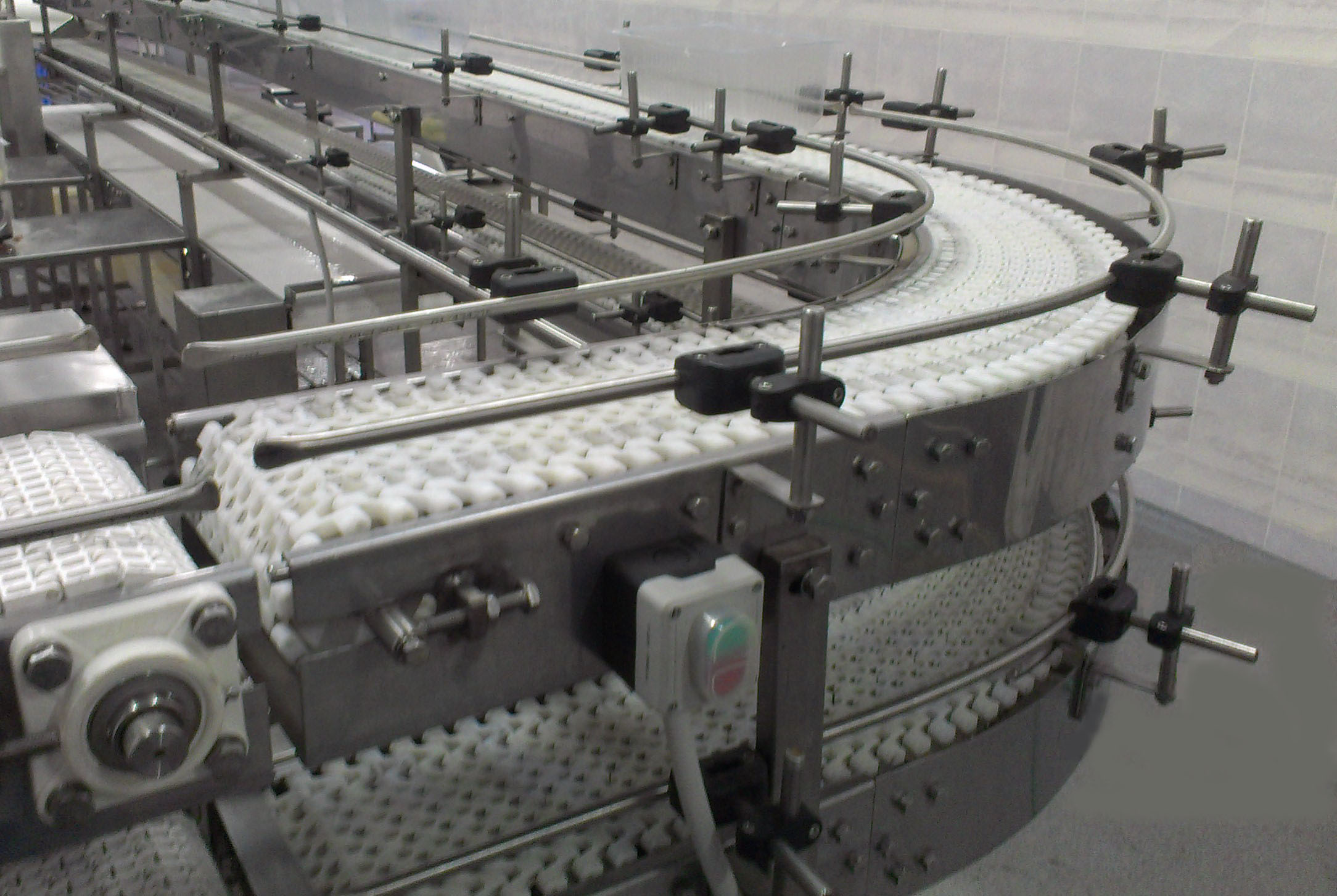
A disc table is compact — it takes up less space than a straight accumulation conveyor of the same capacity, because product moves in a circle, not a straight line. This makes it a convenient solution for small workshops where every square metre counts.
Where rotary tables are used
On our projects rotary tables appear in several typical scenarios:
- Before manual packaging — a buffer of bottles, jars, packs that lets the operator work at their own pace.
- After a filling machine — accumulation of filled but not yet closed containers.
- At a labeller outlet — collecting finished product before stacking into boxes.
- As a distribution node — two or three operators around one table sort a single flow.
- Before shrink wrapping — grouping product into batches before feeding into the tunnel.
A rotary table is especially effective where the packaging tempo is uneven — and it is almost always uneven with manual operations.
How to select parameters
The key table parameters are tabletop diameter, drive type and speed range. The diameter determines the buffer capacity: the larger it is, the more product fits on the circle. Below are indicative characteristics of standard sizes.
| Tabletop diameter | Buffer capacity | Drive | Power |
|---|---|---|---|
| 800 mm | 15–25 units | Gear motor | 0.18 kW |
| 1000 mm | 25–40 units | Gear motor | 0.25 kW |
| 1200 mm | 40–60 units | Gear motor with converter | 0.37 kW |
| 1500 mm | 60–90 units | Gear motor with converter | 0.55 kW |
For tables from 1200 mm we recommend a drive with a frequency converter — it allows smooth adjustment of rotation speed to the packer’s real tempo, without abrupt starts that shift the product.
Engineer’s tip. We make the rotary tabletop from AISI 304 stainless steel with a matte surface. A glossy tabletop looks nicer, but product slips on it during rotation. A matte one provides exactly as much friction as needed for the pack to move with the table without “sticking” to the rim.
Design solutions
The tabletop rotates on a central bearing unit or on perimeter rollers — the second option is more stable for large diameters. Along the table edge we fit a fixed rim that holds product from sliding off, and at the dispensing point we make a break in the rim through which the operator removes product.
We place the drive below, under the tabletop, in an IP65-rated version — the table often stands in wet zones and is washed with water. For food sections all contact surfaces are made to hygienic design principles, with no dead zones. We design a rotary table as part of custom equipment for a specific line, not as a universal product. We coordinate the tabletop height with the height of the adjacent conveyor and operator ergonomics: a typical value is 850–900 mm from the floor, so the worker removes product without bending their back throughout the whole shift.
Integration into the line
A rotary table is coordinated with the speeds of adjacent sections. The feed conveyor must bring product in tangentially to the table circle — so the pack smoothly enters the motion without tipping. The rotation speed is selected so that in one revolution the operator manages to remove the accumulated batch. If the packaging tempo fluctuates, the converter lets the operator adjust the table to themselves with a button.
We separately account for product stability. Tall narrow containers — bottles, vials — on a rotating table are prone to tipping, especially at start-up. For such product we lower the acceleration ramp via the converter and, if needed, add an inner divider ring that keeps containers from bunching into a cluster. For heavy product we check the drive torque: a fully loaded large-diameter table must start moving without a jerk, otherwise an uneven start shifts the whole accumulated batch. We work out these details already at the design stage, relying on the real dimensions and weight of the customer’s container.
Conclusion
A rotary table is a simple and effective buffer that resolves the conflict between an even production line and cyclic packaging. The key selection parameters are diameter for the required capacity, a drive with a converter for large tables, and a matte stainless tabletop. If your packaging section is becoming a bottleneck — get in touch, and we will select a rotary table for your line. More on the topic under the tag packaging.