
Roller conveyor: driven and non-driven
Gravity or driven roller conveyor — under which conditions to choose each type and where roller conveyors are used.
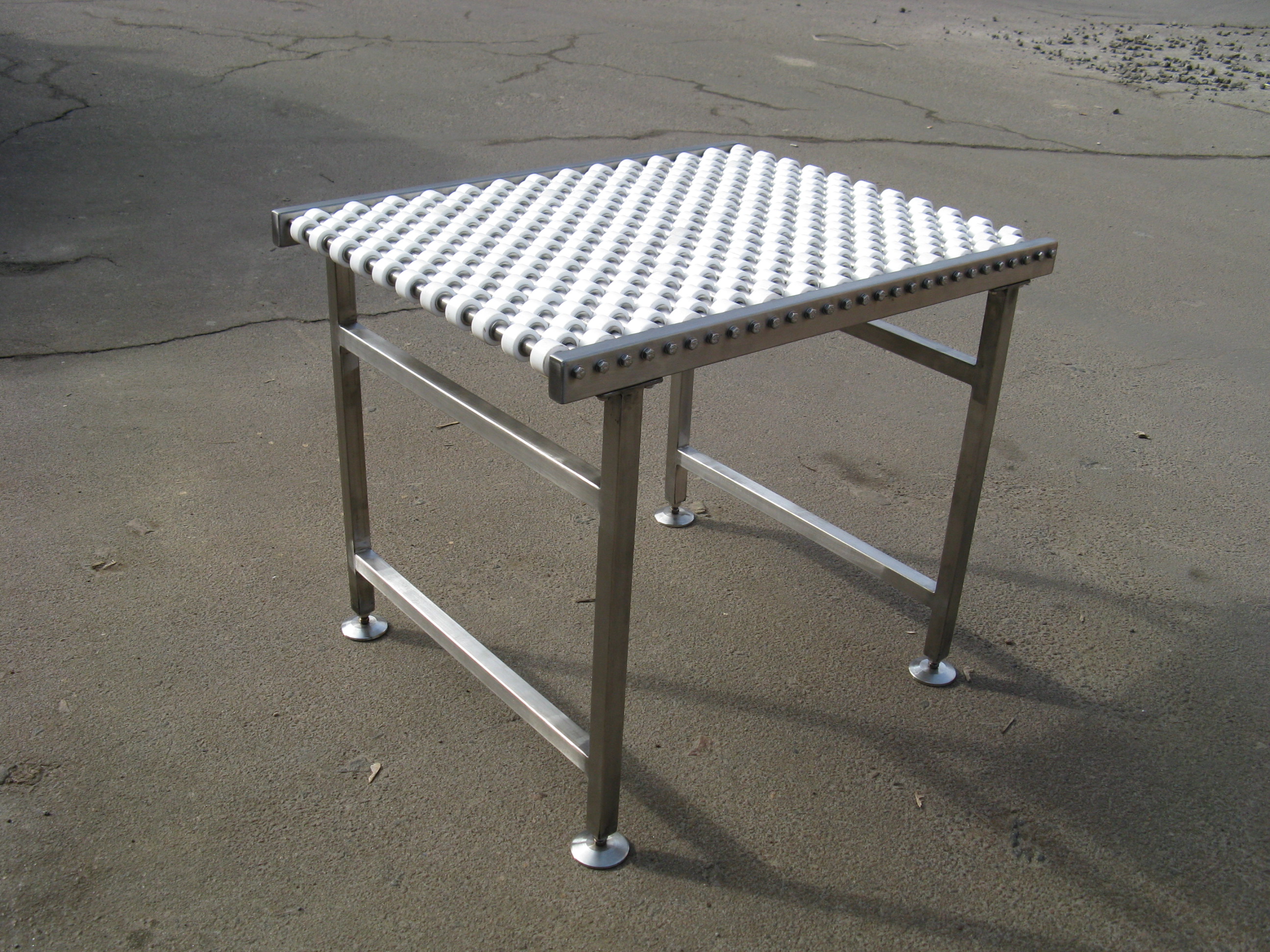
A roller conveyor is a frame with a row of parallel rollers along which a unit load rolls. The solution is simple and reliable but comes in two fundamentally different versions: gravity and driven. Let’s break down when to choose each, how to select the roller pitch and where a roller conveyor proves its worth.
How a roller conveyor works
The load moves along the top generatrix of the rollers. The main requirement is a flat and rigid bottom: a box, crate, tray or pallet. Each item must rest on at least three rollers at once, so the roller pitch is chosen for the smallest load: usually 1/3 of its length. A soft bag, sack or item with a rounded bottom cannot be transported on a roller conveyor — it sags between the rollers and jams.
The roller itself is a steel or polyamide tube with bearings and a fixed axle. For food workshops the tubes are made of AISI 304 stainless steel, for dry warehouses, of galvanised steel. The roller diameter is matched to the load weight: Ø50 mm for boxes up to 30 kg, Ø60–89 mm for heavy crates and pallets. The bearings are sealed so that water and dust do not get into them. The roller pitch is a key routing parameter: too sparse a pitch, and the load nose-dives between the rollers; too dense, and the structure becomes needlessly expensive. So the pitch is always calculated from the shortest load on the line.
Gravity roller conveyor
A gravity (non-driven) roller conveyor moves the load by a slight slope — from 1.5 to 5% depending on the weight and bottom material. Advantages: no energy consumption, simplicity, minimal maintenance. Disadvantages: a height difference is required and speed cannot be precisely controlled.
Selecting the slope is the most delicate part of designing a gravity roller conveyor. Too small a slope, and the load stops in the middle of the track; too large, and the box accelerates to a dangerous speed, hits the end and may tip over. The slope is affected not only by weight but also by the load’s bottom material: smooth plastic slides more easily than cardboard or wood. So at the end of long gravity tracks brake rollers or a damper are often fitted to absorb the speed before the accumulation zone.
Typical use:
- accumulation sections before packaging;
- unloading and receiving zones;
- descents between workshop floors;
- buffer zones at the line outlet.
Driven roller conveyor
In a driven roller conveyor the rollers rotate from a motor — via chain, belt or motor-roller. Speed and direction are controlled; horizontal transport and load accumulation with or without pressure are possible. This is the basis of automated sections with scanners and sorting.
The method of transmitting rotation determines the conveyor’s behaviour. A chain drive is the most robust, handles heavy loads, but is noisy and needs lubrication. A belt drive is quiet and clean, suitable for food workshops. A motor-roller is a separate roller with a built-in motor, from which belts transmit rotation to neighbouring rollers within one section; such sections are easy to zone for zero-pressure accumulation, where each zone stops independently. It is exactly this zero-pressure accumulation that saves fragile or heavy loads from impacts during a jam.
Comparison of types
| Parameter | Gravity | Driven |
|---|---|---|
| Energy consumption | none | yes |
| Installation angle | slope 1.5–5% | horizontal |
| Speed control | no | yes |
| Cost | low | higher |
| Automation integration | limited | full |
Engineer’s tip. For a gravity roller conveyor always test the slope with the real load. An empty box and a box with product roll differently, and an excessive slope causes impacts at the end of the track.
Curved sections and switches
A roller conveyor is rarely just a straight track. To change the flow direction, additional units are built into the route. A curved section at 30°, 45° or 90° has tapered rollers or rollers of varying length — this equalises the linear speed of the outer and inner edges of the load so the box is not skewed. Cross rollers in the switch zone divert part of the flow to a side branch. Lift sections with ball transfer units allow the load direction to be changed manually at a track intersection. On driven roller conveyors these units are integrated with automation — a scanner reads the label and the load is diverted to the right branch without operator involvement.
How to choose the solution
If you simply need to move a load between two points with a height difference — a non-driven roller conveyor is enough. If the section is horizontal, tempo control or automation integration is needed — choose a driven roller conveyor. Both types are often combined on a single line: receiving and accumulation are made gravity-fed, while scanning and sorting zones are driven. More on unit-load transporters in the articles tagged conveyor.
Conclusion
A roller conveyor is an economical and durable solution for unit loads with a flat bottom. The gravity version wins on simplicity, the driven one on controllability. To select the roller pitch and drive type for your load — get in touch, we’ll design a roller conveyor for your task.
