Roller inspection conveyor: the advantages
Why a roller inspection conveyor beats a belt one: the product rotates on rollers and the inspector sees it from all sides.

On an ordinary belt inspection conveyor the product lies still and shows the operator only one side. Whatever is underneath stays invisible. A roller inspection conveyor solves this: rotating rollers slowly turn each item, and the inspector sees it from all sides. Let us look at how this works and when such a solution is justified.
The problem with belt inspection
Inspection is manual sorting, where the operator removes rejected product from the flow: rotten, bruised, unripe items, foreign objects. On a belt conveyor the product is stationary relative to the belt. An apple or tomato shows only the side it landed on.
A defect on the hidden side the operator simply will not see. To inspect the product fully, a second inspector after a turner or a repeat pass is needed. Both mean extra workplaces and floor space.
How a roller inspection conveyor works
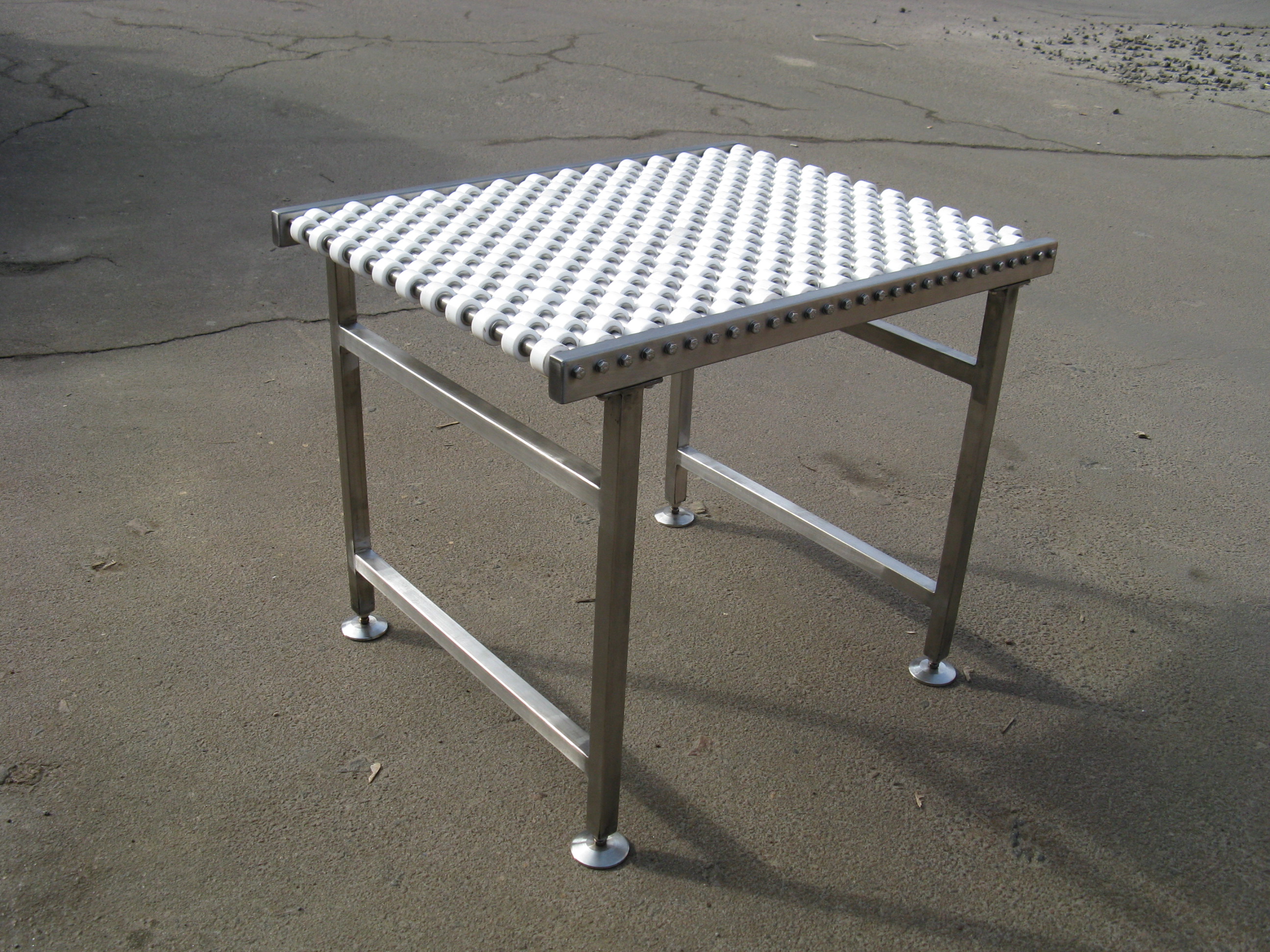
Instead of a continuous belt there is a row of parallel rotating rollers. The product lies in the troughs between rollers. The rollers rotate around their axis and at the same time slowly turn the item resting on them. Over the inspection section each item makes several full turns.
Technically, roller rotation is provided by a separate drive: all rollers are coupled by a common chain or toothed belt and receive torque from one gear motor. The linear travel of the product along the conveyor is set by a second, independent drive of the roller mat. It is precisely this separation of the two motions that gives the key flexibility: linear travel speed and roller rotation speed are regulated separately through two frequency converters. Rotation can be slowed for thorough inspection without changing the line throughput, or, conversely, the turning of small product — which rotates slower than large — can be sped up.
The inspector sees the product in motion, from all sides, at a single workplace. For full inspection an item must make at least 1.5–2 turns during its pass through the inspection zone — this is built into the calculation of section length for a given throughput.
Comparison with a belt conveyor
| Parameter | Belt | Roller inspection |
|---|---|---|
| Product inspection | one side | all sides |
| Workplaces for 100% inspection | 2 + turner | 1 |
| Line speed | 0.1–0.3 m/s | 0.05–0.2 m/s |
| Product rotation | none | adjustable |
| Suitable for | flat items, packaging | round items |
| Drainage after washing | limited | free between rollers |
| Equipment cleaning | belt hard to remove | rollers washed all round |
Where roller inspection is justified
A roller inspection conveyor is not always needed — it has clear strong points:
- Sorting round items: apples, tomatoes, potatoes, onions, citrus.
- Lines where 100% inspection of every item without rejects is critical.
- Sections after washing — water drains freely between the rollers.
- Grading and packaging lines with high marketable-appearance requirements.
For flat products, packaging and boxes roller inspection makes no sense — there the product does not roll, and the rotation advantage disappears.
Engineer’s tip. We select the roller diameter and pitch strictly for the item size. If the gap between rollers is wider than a small item, the product falls through and jams the line. On our projects, for a flow of mixed calibre, we fit rollers with a smaller pitch and compensate with rotation speed — so the line works with both small and large product.
Materials and hygienic design
A roller inspection conveyor is in contact with open food product, so materials are selected to food-safety requirements. The frame and structure we make of AISI 304 stainless steel — it withstands washing with alkalis and acids. The rollers themselves are made either of stainless tube or of food-grade polymer: high-density polyethylene, polypropylene, Delrin. Polymer rollers are lighter, quieter and gentler on the item; stainless ones are stronger and withstand hot sanitation.
For delicate items — tomatoes, berries, soft apple varieties — a food-grade silicone or polyurethane sleeve is fitted over the rollers. It cushions impacts, keeps the item from sliding and reduces bruising. All roller bearings we take in stainless design with IP65 seals: water and washing solution must not get inside. We design the structure so the rollers come off easily for washing and no dead cavities where product accumulates remain under the working zone.
Integration into a processing line
A roller inspection conveyor is a separate type of custom equipment built into a line after washing and before grading or packaging. We make the working surface height ergonomic — 850–950 mm so the operator does not bend over all shift. We take the inspection table width so operators on both sides reach the middle of the flow without strain — usually 800–1200 mm. We allow no less than 750 lux of inspection-area lighting without glare, at a colour temperature of 4000–5000 K — close to daylight, so colour defects are visible. The rest of the line is built on ordinary conveyors and transporters — roller inspection is needed only on the inspection section.
Conclusion
A roller inspection conveyor gives the key advantage — inspection of the product from all sides at a single workplace thanks to rotation on rollers. It is justified for round items and lines with 100% quality control. The key to reliable operation is roller pitch matched to product calibre. If you are planning an inspection section on a processing line, get in touch — we will select a conveyor design for your product.