Gravity roller conveyors: when they are enough
When a simple non-driven gravity roller conveyor replaces an expensive driven one: incline calculation, roller pitch, load capacity.
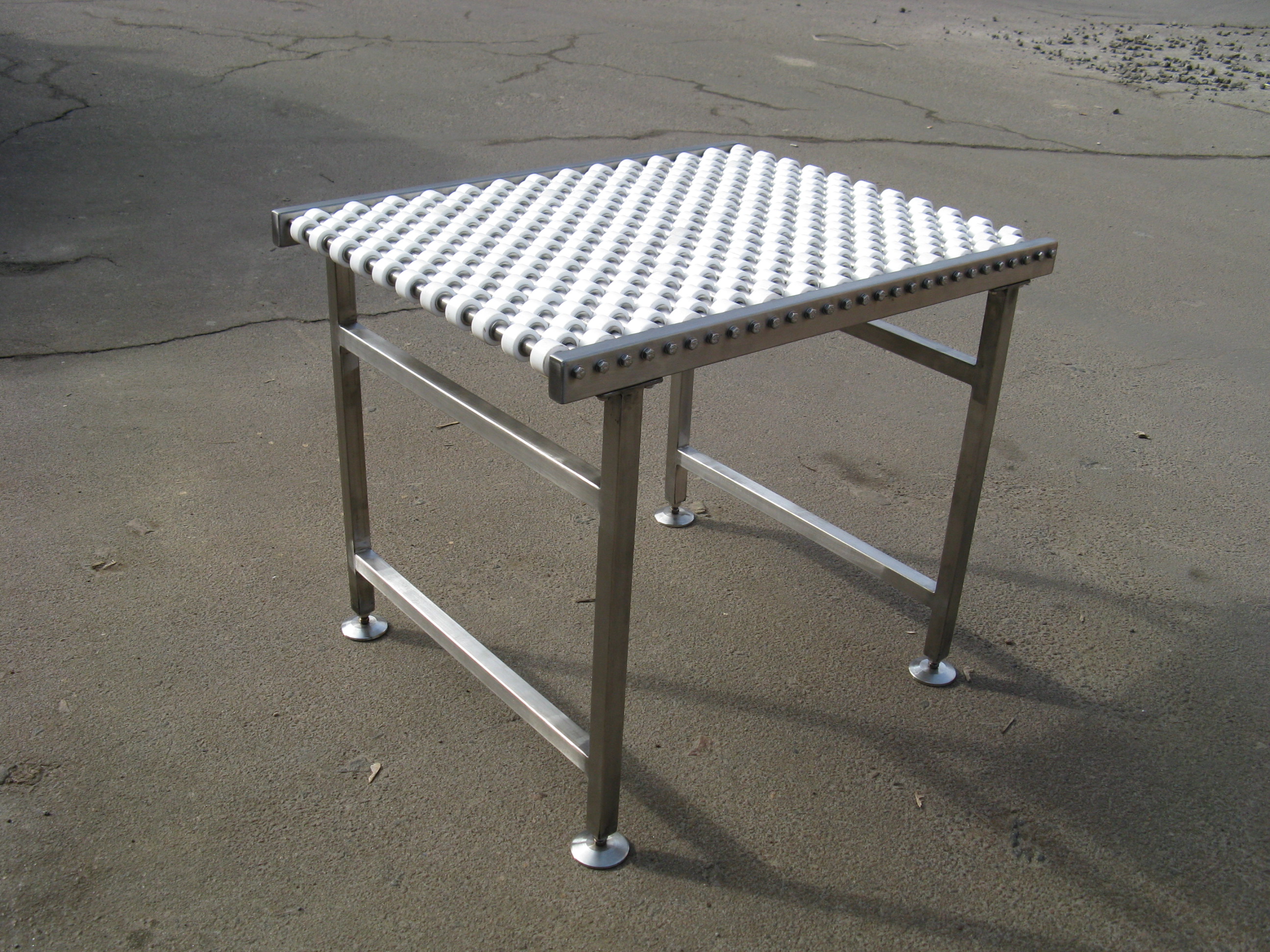
Not every line section needs a motor. A gravity roller conveyor moves a unit load by its own weight — a small route incline is enough. This is the cheapest way to transport boxes, crates and pallets where precise synchronisation is not required. The article covers when a gravity roller conveyor is enough and when it is better not to economise.
How it works without a drive
The mat of a gravity roller conveyor is a row of freely rotating rollers on a frame set at a small incline. A load with a flat stable bottom rolls down under gravity, overcoming the resistance of the roller bearings. No motor, no electricity — only geometry and the right roller choice. That is why such sections practically never break and need no maintenance beyond periodic bearing lubrication.
The key element is the roller itself. It consists of a tube, an axle and two bearings at the ends. The ease of rotation is determined by the bearing class: the lower the breakaway torque, the smaller the incline needed to start the load. For food zones we use AISI 304 stainless steel rollers, for dry storage — galvanised ones, for light loads — plastic. The roller diameter is matched to the weight: a heavy pallet requires a thick-walled tube, a light box rolls calmly on a thin roller.
When a gravity roller conveyor is enough
A gravity solution works if several conditions are met:
- The load has a flat rigid bottom — box, crate, pallet, tray.
- No precise synchronisation of speed with the adjacent section is needed.
- The route allows an incline in the required direction.
- The load is heavy enough to overcome rolling resistance.
Classic tasks are accumulation buffers before packaging, finished-product dispatch zones, lowering crates floor to floor, manual loading and unloading sections.
Incline and roller pitch calculation
The two key parameters of a gravity roller conveyor are the route incline and the pitch between rollers. The incline is matched to the load’s weight and bottom type: light boxes need a larger incline, heavy pallets move from a minimal one. The roller pitch must be such that the load’s bottom always rests on at least three rollers — otherwise the load “punches” the gaps and jams.
| Load | Recommended incline | Roller pitch |
|---|---|---|
| Cardboard box up to 10 kg | 3–5% | 75–100 mm |
| Plastic crate 10–30 kg | 2–3% | 100–150 mm |
| Wooden pallet 30–80 kg | 1.5–2.5% | 150–200 mm |
| Metal container over 80 kg | 1–2% | 200–250 mm |
Engineer’s tip. Do not set the incline “with a margin” — on too steep a route the load accelerates and hits the stop at the end of the section. Better an exact calculation plus a braking roller or a damper in the stop zone.
Accumulation and speed control
On a long route a gravity roller conveyor is easily turned into an accumulator. The simplest way is braking rollers every 1.5–2 m: a centrifugal clutch inside the roller limits the rolling speed to roughly 0.3–0.5 m/s regardless of load weight, so boxes do not accelerate and do not hit one another. For delicate product this is enough to keep the whole queue moving smoothly.
If the queue must be held under zero pressure — when the front box must not push against the following ones — zone accumulators are used. Each zone, 1–1.5 m long, has a mechanical or pneumatic stop that blocks the rollers while the previous zone is occupied. This way even a gravity route implements the “zero-pressure” scheme usually considered the prerogative of driven roller conveyors. It matters for glass containers and soft packaging, where even a light push from the neighbouring box leaves a dent or a micro-crack.
Limits of the gravity scheme
A gravity roller conveyor is not all-powerful. It does not transport upward, does not hold a stable speed and does not stop the flow on command — the load rolls as long as there is an incline. If a precise tempo, reverse, lift or accumulation with pressure control is needed, a driven version is required. We covered torque selection for driven roller conveyors in detail in the article driven roller conveyors. In practice a line is often built as a combination: driven sections where control is needed, gravity ones on simple runs.
Curve sections and branching
A gravity scheme is easy to make not only straight. Curve sections with tapered rollers allow the route to turn 45° or 90° without a drive — a tapered roller rolls the load’s outer edge faster than the inner one, and the box turns smoothly. Diverter switches direct the flow onto two routes. This makes a gravity roller conveyor a flexible warehouse-layout tool, not just a straight descent.
How to order correctly
Before ordering we clarify the load’s weight and dimensions, its bottom type, the heights of the entry and exit points, the available route length. From these data we calculate the incline, pitch and roller type — galvanised steel, AISI 304 stainless for food zones or plastic for light loads. A ready roller conveyor integrates into the line without electrical work, which shortens commissioning times. Special attention goes to the stop zone: at the end of the route we fit a stop with a damper or a braking roller so the load does not hit and bounce off.
Conclusion
A gravity roller conveyor is an example of how simple engineering saves money: no motor, minimal maintenance, low price. The main thing is to accurately calculate the incline and roller pitch for the specific load. Not sure whether a gravity scheme will fit? Get in touch — we will assess your task and propose the optimal option.