Motor reducer for conveyor: types and efficiency
Helical, bevel and worm gearboxes for a conveyor: how to choose the type by efficiency, gear ratio and drive layout.
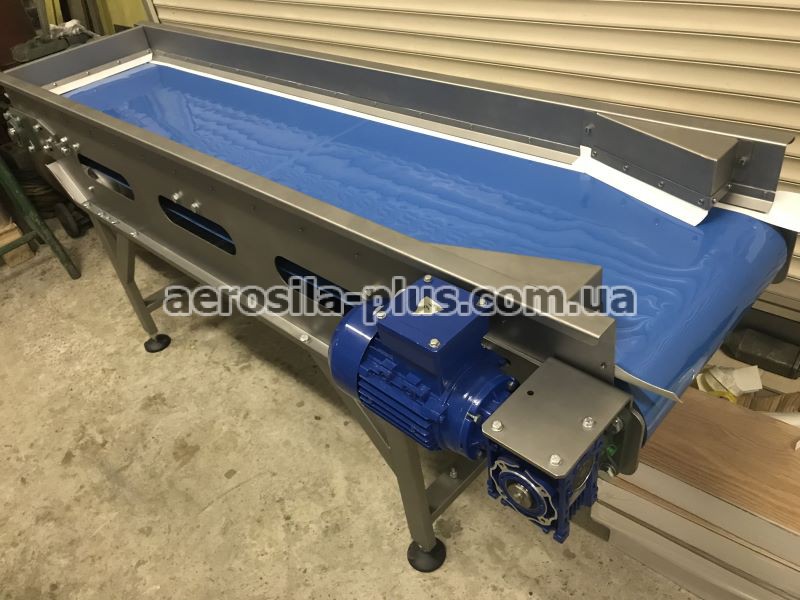
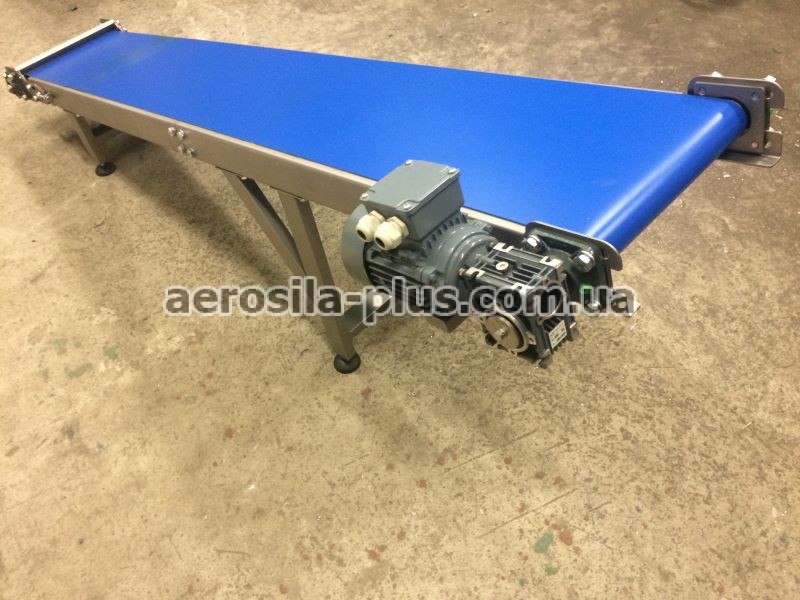
A motor reducer is the heart of a conveyor drive. It converts the high speed of an electric motor into the low speed and high torque needed to move the belt. The reducer type determines drive efficiency, compactness and lifespan. In this article we break down the three main reducer types and explain how to choose the right one for a specific conveyor.
Why a conveyor needs a reducer
A standard asynchronous motor rotates at about 1400–2800 rpm. A conveyor drum must rotate much slower — tens of revolutions per minute — and with high torque to move a loaded belt. A reducer lowers the speed and proportionally increases the torque. The gear ratio shows by how much: a ratio of 30 means the output shaft rotates 30 times slower than the motor, but the torque grows almost 30-fold.
Without a reducer a direct drive would have to use an expensive low-speed motor. A motor reducer is a ready-made compact “motor plus gearbox” unit in one housing, which we fit on the vast majority of conveyors.
Three main reducer types
The reducer type is determined by the gear meshing scheme. Each has its niche:
- Helical — gears with parallel shafts. The highest efficiency, quiet running, input and output shafts on one line. The base choice for straight conveyors.
- Bevel-helical — combines a bevel and a helical stage, the output shaft at 90° to the motor. Convenient when the motor must be placed to the side.
- Worm — a worm and a worm wheel. Very compact, gives a high gear ratio in one stage, shaft at 90°, but has lower efficiency due to sliding friction.
- Planetary — several planet gears around a central sun gear. The highest torque at small dimensions, for heavy conveyors.
The choice is a balance of efficiency, layout and price. We covered drive calculation in general in our articles on conveyors and transporters.
Efficiency and gear ratio
Reducer efficiency is the share of power that reaches the drum from the motor. Losses go to friction in the mesh and bearings. Below are indicative characteristics of reducer types.
| Reducer type | Efficiency | Gear ratio | Shaft arrangement |
|---|---|---|---|
| Helical | 96–98% | 3–250 | On one axis |
| Bevel-helical | 94–97% | 8–400 | At 90° |
| Worm (single-stage) | 70–90% | 8–100 | At 90° |
| Planetary | 95–98% | 3–1000 | On one axis |
Engineer’s tip. A worm reducer is attractive for its compactness and low price, but its efficiency drops to 70% at high gear ratios. On a conveyor running round the clock, those 25–30% of losses are a constant overpayment for electricity. For intensive lines we almost always choose a helical or bevel-helical reducer: the higher price is paid back by energy savings.
How we select a reducer
Reducer selection starts with the conveyor’s input data: required belt speed, drive drum diameter, tractive force. From the speed and drum diameter we calculate the required output shaft speed, and from that the gear ratio. Then from the tractive force we determine the required torque and check whether the chosen reducer size withstands it.
We separately account for the duty cycle. A conveyor with frequent starts under load creates shock loads on the gear train, so for such lines we take a reducer with a torque margin. For food sections we choose an IP65-rated version with food-grade lubricant approved for product contact.
An important parameter that is often underestimated is the permissible radial load on the output shaft. If the conveyor drum is mounted directly on the reducer shaft, the entire drum weight and belt tension press on the reducer bearings. Exceeding the permissible load kills the bearings within months. So for heavy drums we either choose a reducer with a reinforced output shaft or move the drum onto separate supports and connect the reducer to it with a coupling. The reducer’s service factor is also not a trifle: for round-the-clock operation with shock loads we take a factor of no less than 1.5, then the reducer works out its full design life without premature wear.
A worm reducer feature: self-locking
A worm reducer has a useful property — at a high gear ratio it self-locks: the output shaft cannot rotate the input one. For inclined conveyors this is a plus — a belt with a load will not slide back when the motor is switched off, with no additional brake. A helical reducer has no such property, so for steep inclines a separate brake is added to it. But it should be remembered that self-locking should not be treated as a substitute for a safety system: for conveyors with a large incline angle we still fit a mechanical brake as backup protection in case the worm pair wears.
Conclusion
A motor reducer determines the efficiency, compactness and lifespan of a conveyor drive. Helical and planetary reducers win on efficiency, a bevel one is convenient for layout, a worm one for compactness and self-locking but loses on energy efficiency. The choice is dictated by speed, torque, duty cycle and layout. If you need to select a drive for a conveyor — get in touch, and we will calculate a motor reducer for your task. More on the topic under the tag conveyor.