Bait container for vegetables and fruits
How a bait container works, where it is used in vegetable and fruit processing lines and what its design features are.
A bait container is an accumulating buffer vessel at the start of a vegetable and fruit processing line. Its task is to take in the uneven feed of raw material from transport or a loader and deliver it to the line in an even, controlled flow. Let us look at how it is built, where it is needed and how it differs from an ordinary bunker.
Why a bait container is needed
Raw material rarely reaches a line evenly. Vegetables arrive in batches, tipped out of crates or big bags — an uneven, pulsed flow. The processing line, on the other hand, works at a steady throughput. Between these two paces a buffer is needed.
The bait container is exactly such a buffer. The operator loads raw material into it in large portions, while the product comes onto the line in measured doses. The container “baits” the raw material out of the uneven flow and releases it steadily — hence the name.
How it is built
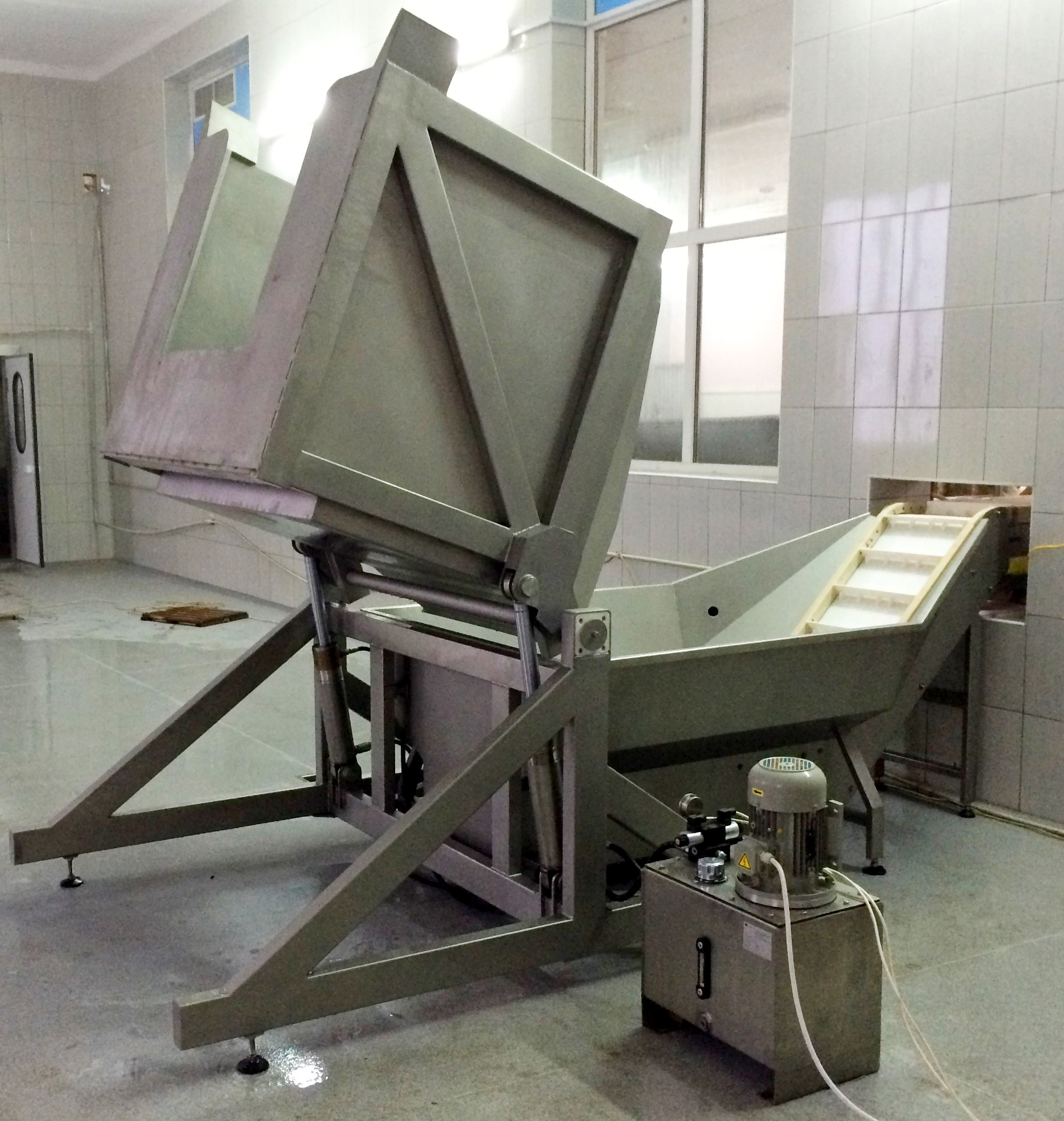
Structurally, a bait container is an inclined vessel with a sloping bottom and a discharge unit at the bottom. The main elements:
- Body of AISI 304 stainless steel with sloping walls for gravity flow.
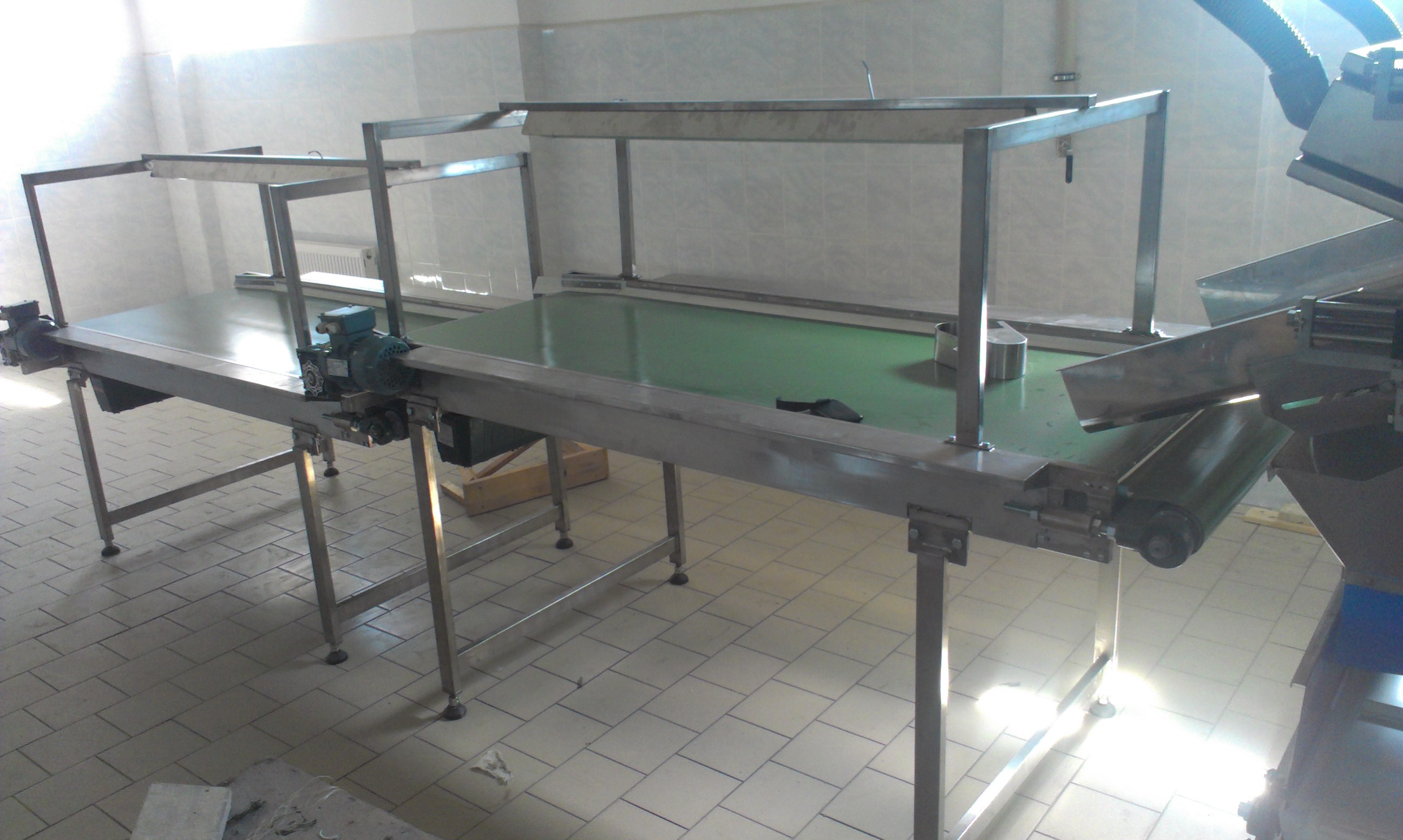
- Discharge conveyor at the lower part — sets the feed pace onto the line.
- Adjustable gate on the discharge window — limits the layer thickness.
- Sidewalls and loading grate — hold back coarse impurities and foreign objects.
The wall slope angle is calculated for the specific product: for smooth apples 35° is enough, for rough carrots or potatoes 45° and more is built in to prevent bridging. As a guide, the angle must exceed the raw material’s angle of repose by at least 10–15°. We make the inner surfaces with no horizontal shelves or pockets, all weld seams continuous and ground flush, because soil lodges in a seam pit and microbiological contamination begins.
How to calculate the buffer volume
The volume of a bait container is not a “bigger is better” matter. Too small a buffer does not smooth the pulse and the line still “breathes”; too large a one takes up workshop space and holds raw material too long, which is critical for ripe fruit. The rough calculation is simple: the buffer must hold at least one full loading portion plus a reserve for the cycle time. If a loader tips 0.8 m³ per bucket and returns in 4 minutes, while the line consumes 0.3 m³ in that time, we take the container’s working volume at around 1.2–1.5 m³ — the portion plus a reserve.
We also account for the dead volume separately: product in the cone below the level of the discharge window does not reach the line. So the useful volume is always less than the geometric one, and we build this difference — usually 15–25% — into the calculation in advance.
Parameters for different products
| Product | Wall angle | Container volume | Feed to line |
|---|---|---|---|
| Apples, tomatoes | 35–40° | 0.5–2 m³ | 2–8 t/h |
| Potatoes, carrots | 45–50° | 1–3 m³ | 3–10 t/h |
| Onions, beetroot | 40–45° | 1–2.5 m³ | 2–7 t/h |
| Berries, delicate | 30–35° | 0.3–1 m³ | 0.5–3 t/h |
Where it is used
A bait container is placed at the line start, before washing or grading. Typical scenarios:
- Loading from a forklift — the bucket tips raw material in a large portion, the container smooths this pulse.
- Receiving from crates — paired with a container tipper that empties the crate into the bait container.
- Buffer between sections — compensates for the difference in pace of two adjacent line units.
Engineer’s tip. For delicate products — berries, ripe tomatoes — the main threat is not the container itself but the drop height during loading. We build cascade shelves or a water cushion inside the structure: the product descends in steps rather than falling from full height. That is the difference between marketable appearance and purée at the bottom.
Materials and structural hygiene
A bait container contacts unwashed raw material — it carries soil, sand, plant residue. So the requirements for material and geometry are strict. We make the body of AISI 304 stainless steel 2–3 mm thick; for more aggressive environments (pickling, brines) we switch to AISI 316 with resistance to chlorides. The product-contact surfaces comply with regulation EU 1935/2004 on materials for food contact.
We subordinate the geometry to the principle of full drainage: all inner corner radii at least 3 mm, the bottom sloped to a drain point, no blind pockets where water or product can stagnate. Stiffening ribs are moved to the outside of the body. We design the structure so that washing can be done with a pressure jet without dismantling — this shortens the sanitary break between batches and removes the risk of cross-contamination.
The container and the rest of the line
A bait container is not a standalone unit — it is coordinated with the rest of the line. A container tipper almost always works in pair with it, feeding raw material from transport crates. The product then goes on to washing and grading. We design this line inlet unit as a single complex so the loading pace and processing throughput are matched. Related material on processing lines under the tag equipment.
We also account for sanitation separately: the container contacts unwashed raw material, so we make the structure such that it can be fully rinsed with a jet without stagnant zones.
Conclusion
A bait container is a buffer at the inlet of a processing line that smooths the uneven feed of raw material. The key parameters are the wall slope angle for the product, buffer volume and adjustable feed to the line. For delicate products the loading height is critical. If you are designing the inlet unit of a vegetable or fruit processing line, get in touch — we will calculate a bait container for your raw material and throughput.