Turning conveyor: design and applications
How to make a 30, 45 or 90 degree route turn: turning conveyor design, mat types, advantages and limitations of the layout.
A real workshop rarely lets a line run straight: columns, gates and neighbouring equipment force the route to turn. A turning conveyor changes direction without transferring the product and without breaking the flow. This article breaks down how it is built, which angles are achievable and where this layout is justified.
Why a turning conveyor is needed
The simplest solution for a route turn is to place two straight conveyors at an angle and transfer the product from one to the other. But every transfer is an impact, breakage of delicate product, a jam risk and an extra service point. A turning conveyor removes the transfer: the product travels on a continuous mat along an arc, keeping its orientation and integrity.
This is especially important for packs that must reach a labeller or packer in a fixed position. At a transfer the pack rotates, slides aside, sometimes tips over — and the machine will not accept it. A turning conveyor keeps the orientation the product had at the entry to the arc. The second important effect is fewer service points: instead of two drives, two tension units and a transfer zone you have one continuous route.
Design of a turning conveyor
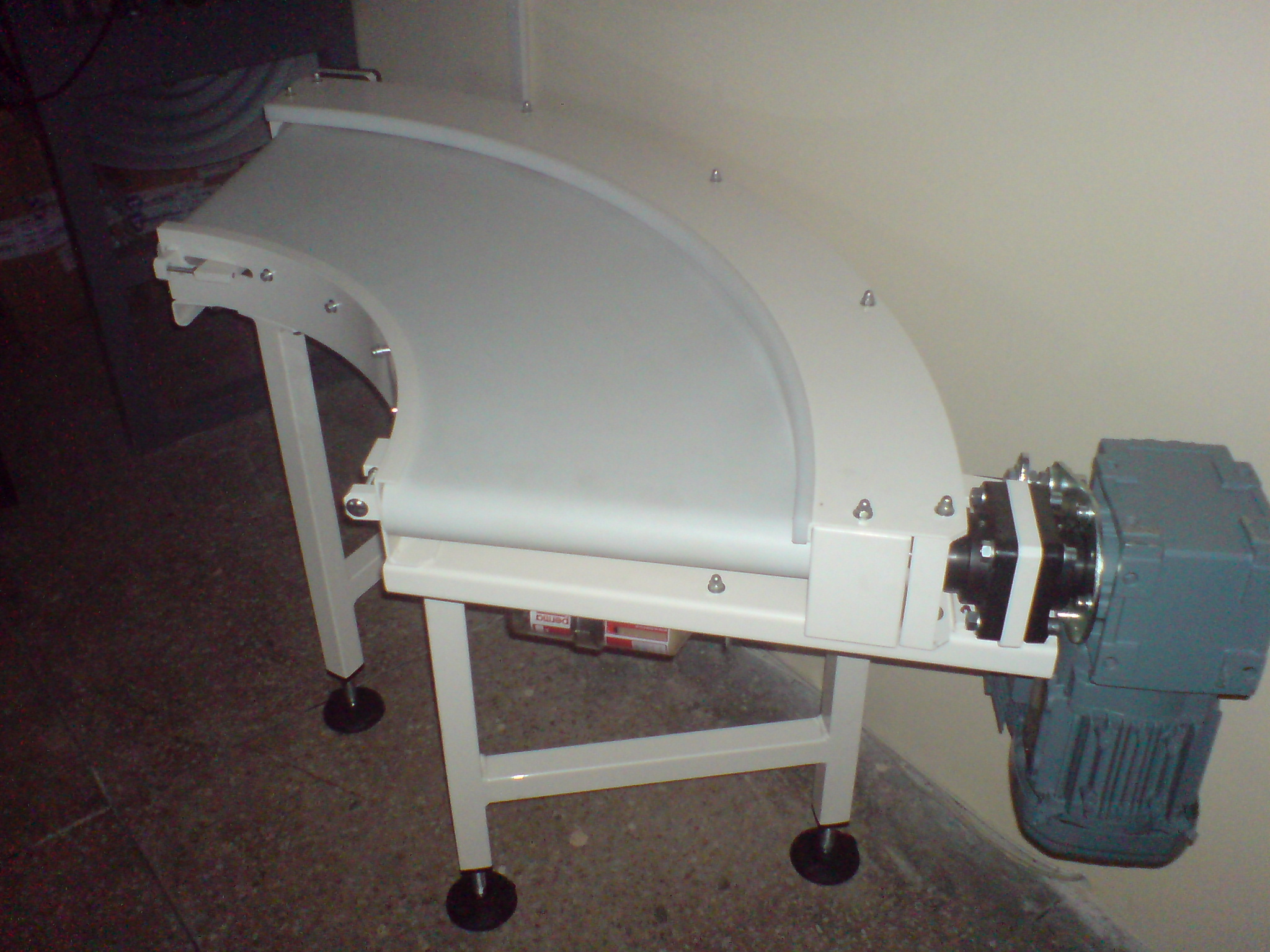
Structurally a turning conveyor consists of the same units as a straight one, but adapted to motion along an arc. The mat here is special — a radius modular belt whose sections can compress on the inner side of the arc and stretch on the outer. Thanks to this, the belt passes the turn without wrinkles or skew.
The drive is usually placed on the outer radius, where linear speed is at its maximum. Side guides hold the product from sliding to the inner radius under centrifugal force. A radius modular belt is made of food-grade polypropylene or polyacetal (POM); the inner edge of the mat moves slower than the outer, and this difference grows the smaller the arc radius.
Instead of a radius belt on the arc, a flat modular belt with conical idlers is sometimes used, but for delicate product this is worse: on the inner radius the belt still buckles. So on food turning conveyors we almost always fit a dedicated radius belt, and the frame is bent from AISI 304 stainless profile to an exact arc template — even a small geometry deviation causes the mat to ride up against the guide.
Which angles are achievable
A turning conveyor makes turns over a wide range. Below are typical variants we design.
| Turn angle | Typical application | Feature |
|---|---|---|
| 30° | smooth direction correction | minimal radius, compact |
| 45° | bypassing equipment | universal variant |
| 90° | route turn at a workshop corner | most common |
| 180° | flow reversal, U-shaped route | saves workshop length |
| up to 360° | spiral accumulators | combines turn and holding |
Mat types for turns
Two main mat types are used for a turn:
- Radius modular belt — universal for food lines, easy to clean, holds the arc geometry.
- Conical rollers — for unit loads with a flat bottom; rollers have a variable diameter that sets motion along an arc.
The choice depends on the product: for open foods and wet processes we almost always choose a radius modular belt. Conical rollers are justified only for heavy unit loads in boxes or trays, where breakage is impossible by definition.
Engineer’s tip. The smaller the turn radius, the higher the speed unevenness between the inner and outer edges of the mat. For delicate products set a turn radius of at least 1.5–2 mat widths — this reduces product slippage and side load on the guides.
Radius calculation and installation mistakes
The arc radius is the main parameter of a turning conveyor, and it is exactly where mistakes most often happen. Every radius-belt manufacturer specifies a minimum allowable radius for a particular belt series: usually 1.8–2.4 of the belt’s inner width. You cannot go below this limit — the sections on the inner radius jam, the mat “humps”. We, on the contrary, take the radius with a margin: 2–2.5 widths for unit loads and no less than 2.5 for delicate open product.
Typical installation mistakes of a turning conveyor: an uneven frame setup off the horizontal, causing the mat to shift towards one guide; an overly tight tension of the radius belt, which, unlike a straight one, works almost without tension; and the absence of a mat hold-down on the inner radius, where the belt tends to lift. Separately we check the guide joint at the arc entry and exit — any step here catches the product. A correctly installed turning conveyor runs silently and leaves no friction marks on the guides.
Advantages and limitations
The main advantage of a turning conveyor is a continuous flow without transfers, which keeps the product and the orientation of packs intact. It saves workshop space, letting the route fit the real room geometry, and reduces the number of drives compared to a two-straight-conveyor scheme.
There are limitations too: a radius belt is more expensive than a straight one, the minimum turn radius is limited by mat width, and on tight arcs the side load grows. So for simple routes a turning conveyor is not always justified — sometimes a transfer is cheaper.
Where a turning conveyor is used
On our projects turning conveyors most often work in packing and portioning lines where packs must reach a machine in a fixed position. They are also indispensable where a workshop has complex geometry and a straight route is impossible: a 90° arc lets the route bypass a column or a gate without breaking the flow. Spiral turning conveyors we use as accumulators and holding zones — the product passes several 360° turns, accumulating the required cooling or proofing time on a minimal footprint.
A separate scenario is merging two parallel lines into one: two 90° arcs bring the flows into a single route to a shared packer. For more on line layout, see the articles tagged conveyor.
Conclusion
A turning conveyor is an engineering solution for changing route direction without transferring the product. It keeps the load intact and oriented, saves space and reduces the number of units, but requires the right choice of radius and mat type. Need to fit a line into complex workshop geometry? Get in touch — we’ll design a route with turning sections for your room.