Plate conveyor for heavy loads
How a plate conveyor is built, what load capacity it handles, where it is used. We break down steel plates on a chain and heavy-load applications.
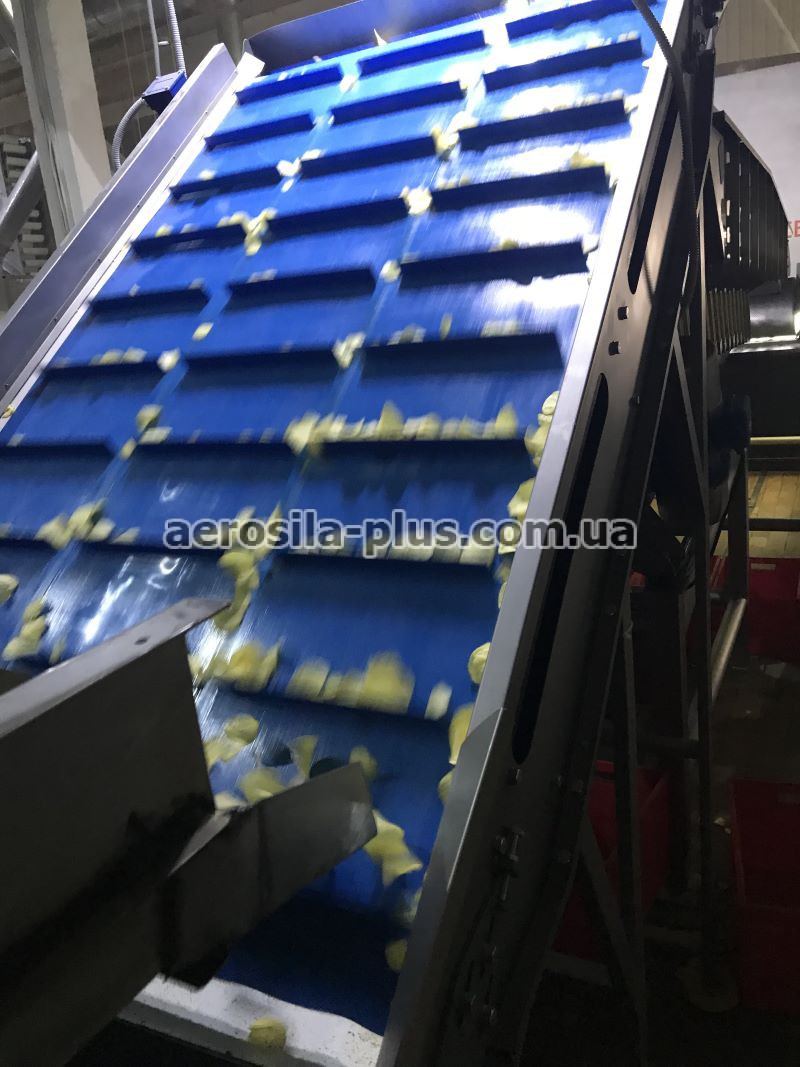
When a belt conveyor cannot cope — the load is too heavy, sharp or hot — a plate conveyor takes over. Instead of a flexible belt, the working surface here is assembled from steel or plastic plates fixed to a traction chain. This article breaks down the design of a plate conveyor, its load capacity and the tasks where it is indispensable.
Why a plate conveyor
A belt is an elastic material and has its limits. Sharp edges of rolled metal cut the rubber, hot castings burn it, and a concentrated load from a heavy part presses it through. A plate conveyor is free of these limits: steel plates absorb impacts, are not afraid of abrasives and withstand temperatures up to 600 °C. That is why it is used where a belt would last weeks, not years.
Design: plates on a traction chain
Structurally a plate conveyor is two parallel strands of traction chain to which plates are bolted or welded, forming a continuous surface. The chain runs on sprockets on the drive and tension shafts. The main units:
- Traction chain — bush-roller plate type, pitch 100–250 mm, rated for a breaking force up to 250 kN.
- Plate deck — steel, stainless steel or wear-resistant plastic, with or without sidewalls.
- Drive — a geared motor with sprockets, often with a frequency converter for speed control.
- Load-bearing frame — reinforced, from channel or structural tube, rated for peak loads.
- Support guides — the chain rollers run along them, taking the weight of deck and load.
Load capacity and configurations
Plate conveyors are classified by plate material and task. Below are the typical configurations we design.
| Configuration | Plate material | Load | Typical use |
|---|---|---|---|
| Light food | Stainless AISI 304 | up to 50 kg/m | Packing, washing lines |
| Medium | Steel S235, painted | up to 150 kg/m | Workshop, unit loads |
| Heavy | Steel, 6–10 mm thick | up to 500 kg/m | Metal, castings |
| Heat-resistant | Heat-resistant steel | up to 300 kg/m, +600 °C | Hot parts, slag |
Engineer’s tip. For heavy plate conveyors we keep speed low — 0.05–0.3 m/s. At high speed a heavy load creates impact loads on the chain at loading points, and chain life drops several times. A wider deck with slow travel beats a narrow fast one.
Where it is used
In the food industry a plate conveyor is used to transport heavy containers, crates of finished product, and in zones with hot processes — at oven outlets. For these tasks we use stainless plates and combine the unit with conveyors matched in speed to adjacent sections. Outside the food industry plate conveyors are the backbone of mining and metallurgical processing: ore feeding, slag removal, transport of hot castings.
A separate case is a conveyor for heavy castings in a foundry. Here a deck of 8 mm steel plates moves at 0.1 m/s, taking parts weighing up to 80 kg at around 400 °C. A belt conveyor in such conditions would burn out within a shift, while a plate conveyor works for years given scheduled chain maintenance.
Traction chain maintenance
The weak point of a plate conveyor is the traction chain. It stretches over time, so tension must be checked and corrected regularly with the tensioning device. The chain is lubricated on schedule, and worn rollers and bushings are replaced before play appears. On heat-resistant configurations a high-temperature lubricant or chains with self-lubricating bushings are used. Drive sprockets are inspected for tooth wear — a worn sprocket accelerates chain wear.
A separate indicator to watch is the evenness of deck travel. If one chain strand has stretched more than the other, the deck skews, the plates rub against the frame and the load shifts sideways. So the tension of both strands is adjusted in sync. Timely chain maintenance is the cheapest way to extend the life of a plate conveyor: replacing the whole chain costs several times more than regular lubrication and tension control.
How a plate conveyor is selected
Selecting a plate conveyor starts with characterising the load: its weight, temperature, abrasiveness and the presence of sharp edges. Next the throughput is determined — how many tonnes or units a section must pass per hour, from which the deck width and speed are calculated. The traction chain is selected for the total load from the weight of deck, load and motion resistance, with a safety margin. The drive power is calculated separately: for inclined conveyors it is noticeably higher than for horizontal ones, because the motor additionally overcomes the lifting of the load. An error at this stage results in either a short-lived chain or motor overheating under load.
Conclusion
A plate conveyor is the solution for tasks where a belt does not survive: heavy, sharp, abrasive and hot loads. The key to longevity is the right choice of traction chain, a reinforced frame and moderate speed. If you need a conveyor for heavy loads or hot processes, get in touch — we’ll calculate the design and select the traction chain for your load.