Feeder conveyor for bunkers: model selection
Which feeder conveyor type to choose for a bunker: belt, scraper, screw. Throughput regulation and matching the feed rate.
A feeder conveyor is the link between a bunker and the rest of the line. Its task is not just to move the product but to deliver it in an even, controlled flow. A mistake in choosing the feeder leads either to “starving” the line or to a jam on the next section. Let us look at which type to choose for a specific bunker and product.
Why a feeder conveyor is needed
A bunker on its own only accumulates product. If you open its gate, the product pours out in an avalanche — unevenly and uncontrollably. A feeder conveyor stands under the bunker’s discharge window and turns this chaotic flow into an even one.
The second task is matching the pace. The line after the bunker works at its own throughput, and the feeder must deliver exactly as much product as the next section can take. That is why a feeder conveyor is almost always made with adjustable speed.
There is a third, less obvious function — the feeder “unlocks” the bunker. Without controlled withdrawal, product in the conical part of the bunker is prone to hang-ups: an arch forms when the material supports itself, or a rathole forms when product flows out only through the centre. A feeder that evenly takes product across the whole width of the window prevents an arch from forming and makes the bunker empty in “mass flow” rather than “funnel flow”.
Types of feeder conveyors
Several fundamentally different solutions are used under a bunker:
- Belt feeder — a short conveyor with a flat or troughed belt. Universal for bulk and small unit products, gentle on the product.
- Scraper feeder — a chain with scrapers drags the product along the bottom. For heavy, abrasive and sticky materials.
- Screw feeder — for fine and dusty products, providing tightness and accurate feeding.
- Vibrating tray — for fragile product where mechanical grinding is unacceptable.
How to choose for the product and bunker
| Feeder type | Product | Throughput | Regulation |
|---|---|---|---|
| Belt | bulk, small unit | 1–30 t/h | belt speed |
| Scraper | heavy, abrasive | 2–40 t/h | chain speed |
| Screw | floury, dusty | 0.5–15 t/h | screw rpm |
| Vibrating tray | fragile, delicate | 0.3–10 t/h | vibration amplitude |
We take the feeder width no narrower than the bunker’s discharge window — otherwise product spills past the belt. We choose the speed so the product layer on the belt is even, without humps.
Throughput regulation
Feed accuracy is provided in three ways, which are often combined:
- Speed regulation — a frequency converter on the feeder drive smoothly changes the feed pace.
- Gate on the bunker window — limits the thickness of the product layer dropping onto the belt.
- Weight feedback — load cells under the bunker or a check-weigher on the line correct the speed automatically.
Engineer’s tip. The most common mistake is fitting the feeder hard against the bunker with no gap for a gate. Without layer-thickness regulation the conveyor delivers either too much or too little, and you have to keep “catching” the pace with speed. Allow for an adjustable gate from the start — it is a cheap part that saves the whole feeding logic.
Design details of a belt feeder
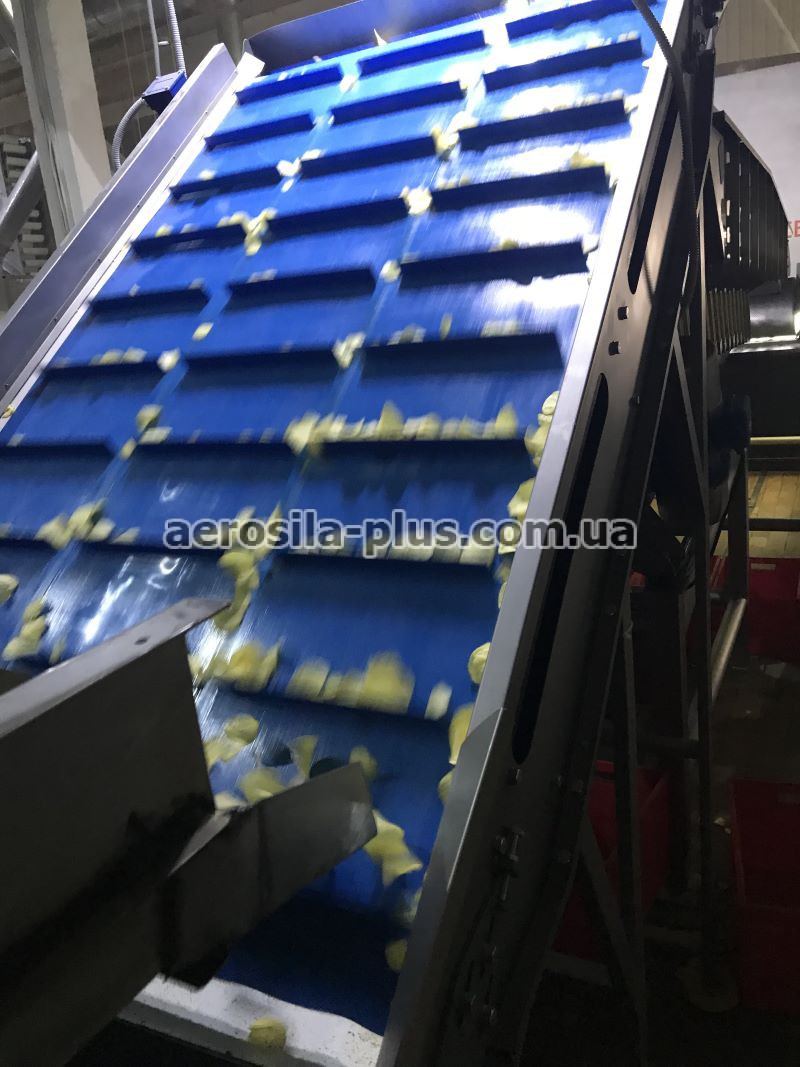
A belt feeder looks like an ordinary conveyor but works in a harder regime: a column of product from the bunker presses constantly on the belt. So its execution is different too. We take a thicker, stiffer belt — for abrasive bulk it is PVC 4–5 mm or fabric-carcass rubber, while delicate food product runs on PU or modular mat. Along the zone under the bunker we fit skirt boards with polyurethane strips that keep product from spilling over the belt edge.
We make the feeder drums of a larger diameter than on an ordinary conveyor of the same width — to withstand the increased tension. We support the frame under the loading zone with a solid deck rather than idler rollers: point rollers under the weight of the product column quickly push through the belt. We calculate the drive with a margin for starting torque under a fully loaded bunker — it is exactly the start “from under the load” that is the hardest regime for the motor.
Common feeding problems and how to avoid them
In practice most failures of a bunker-feeder unit come down to three scenarios. The first is product hang-up (an arch or a rathole): product does not reach the belt and the line “starves”. This is cured by the correct bunker cone angle (no less than 60–65° to the horizontal for floury products) and, if needed, a vibrator or aerator on the bunker wall. The second is pulsating feed: product comes off in batches. The cause is usually too large a gate gap and too high a belt speed; an even thin layer is more stable than a thick one. The third is wet product sticking and freezing onto the belt and gate. Here a cleaning scraper on the return run and an anti-adhesion belt coating help. Each of these problems is cheaper to design for at the start than to rework a finished unit.
Integration with the line
A feeder conveyor does not work on its own — it is synchronized with the bunker and the next section. On our projects the feeder and the bunker with a vibrating tray are designed as a single unit: the window geometry, drop height and belt angle are coordinated. The feed onward along the line is picked up by a standard transporter — we wrote about choosing them separately in material under the tag conveyor.
Special attention goes to the drop point from the feeder onto the next conveyor. Delicate product gets bruised there, bulk product gets dusted. We keep the drop height minimal and, if needed, fit a slowing chute.
Conclusion
A feeder conveyor is chosen by three criteria: product type, required throughput and regulation method. A belt feeder is universal, a scraper one for heavy materials, a screw for dusty ones, a vibrating tray for fragile ones. The key to an even feed is adjustable speed and a gate on the bunker window. If you are designing a bunker-feeder unit, get in touch — we will select the feeder type and calculate the feed for your line.