Bearings in a conveyor: choice and maintenance
Conveyor bearing types, lubricant selection, maintenance intervals and signs of wear. A practical guide for the production line mechanic.
A bearing is an inconspicuous conveyor unit — until it fails. A seized drum bearing stops the line instantly, and replacing it without preparation drags on for half a shift. In this article we look at which bearings work in a conveyor, how they are selected, what they are lubricated with and what signs catch wear before it becomes a failure.
Where bearings work in a conveyor
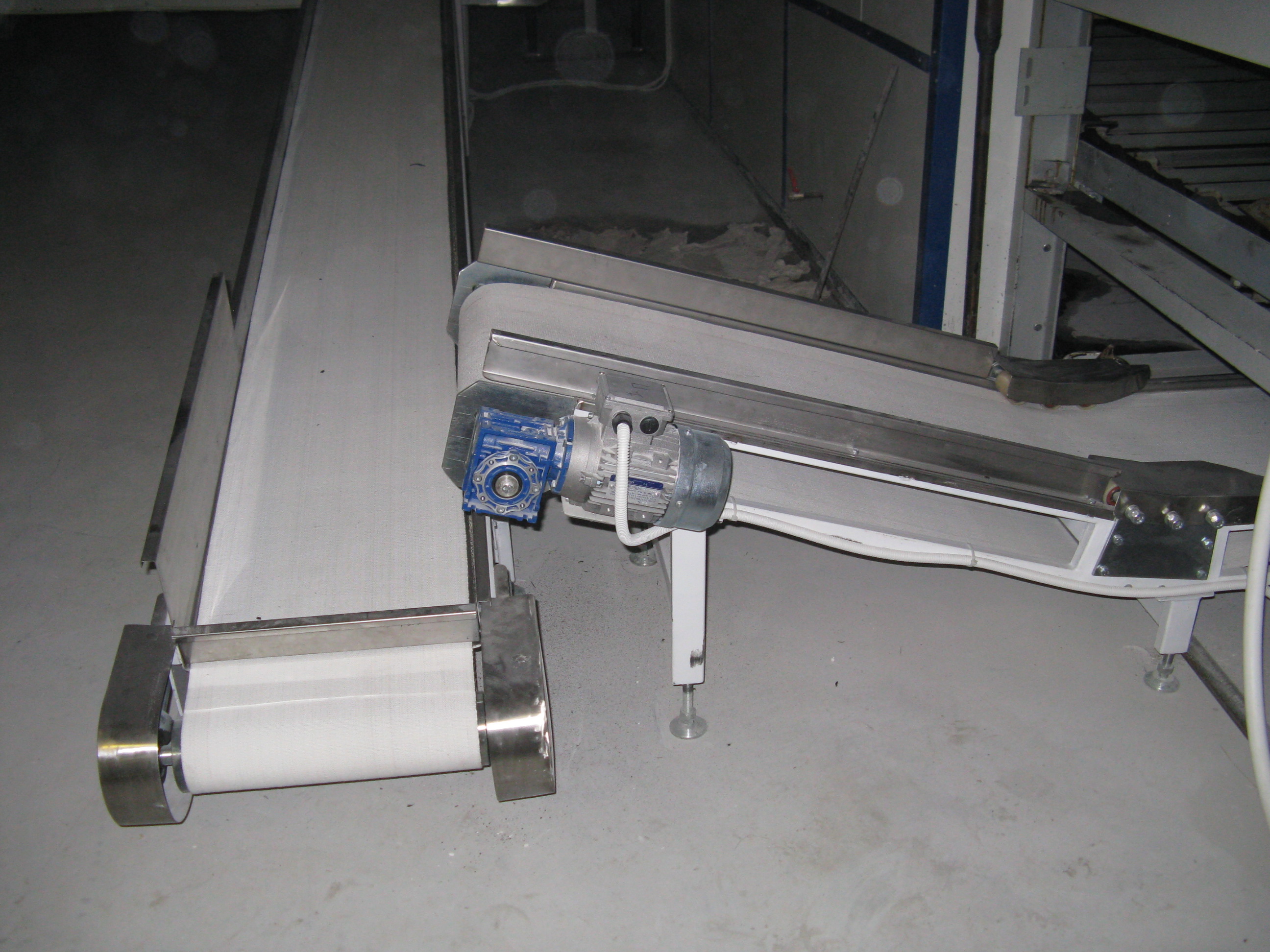
In a belt conveyor, bearings are in several units: on the shafts of the drive and tension drums, in idler rollers, in intermediate shaft supports. Each location has its own conditions — load, speed, contamination, humidity. A drum bearing carries the full belt tractive force, a roller bearing only the weight of product on a short section.
So there is no single “conveyor bearing”: for each unit the type and class are selected separately.
Bearing types and where they are used
In conveyor equipment three types are mostly used:
- Radial ball bearings — universal, for moderate loads and high speeds; fitted in idler rollers and light shafts.
- Radial roller bearings — greater load capacity at the same dimensions; for heavily loaded drums.
- Housed bearings (UCP, UCF) — ball bearings in a cast iron or stainless housing with ready-made mounting; convenient for drum shafts because they install easily and have built-in seals.
For food lines we choose stainless steel or thermoplastic housings and bearings with reinforced seals against water ingress.
Lubricant and maintenance intervals
About 40% of premature bearing failures result from wrong or untimely lubrication. The lubricant is selected by speed, temperature and environment. Below are indicative maintenance regimes for conveyor bearing units.
| Unit | Lubricant type | Lubrication interval |
|---|---|---|
| Drum shaft | lithium grease NLGI 2 | every 1000–1500 h |
| Idler rollers | sealed-for-life | not serviced |
| Unit in wet zone | water-resistant calcium grease | every 500–800 h |
| High-temperature zone | grease with MoS₂ or PTFE | every 400–600 h |
Engineer’s tip. Over-greasing is more harmful than under-greasing: excess grease in a bearing causes it to overheat. Pack the unit with enough grease to fill 30–50% of the free volume, no more. For idler rollers use sealed-for-life bearings — they need no lubrication at all.
Signs of wear: how to catch it in time
A bearing almost never fails suddenly — it warns. The first sign is a change in sound: an even rustle turns into a hum, a grinding or periodic clicking. The second is housing heating above +70 °C to the touch. The third is increased vibration felt by the hand on the housing. The fourth is shaft play, noticeable on rocking.
Systematic tracking of these signs is part of scheduled maintenance. On our projects we recommend a weekly walk-round checking the noise and heating of bearing units — a cheaper way to avoid an emergency stop than waiting for failure.
Service life calculation and size selection
A bearing is selected not “by eye” but by calculated service life. Bearing manufacturers specify a basic L10 rating life — the number of revolutions 90% of a batch of bearings will withstand before fatigue spalling appears. For a conveyor this calculation is converted into operating hours, based on the shaft rotation speed.
In practice we always take a bearing with a life margin: the calculated L10 must exceed the planned overhaul interval by at least a factor of two. This compensates for real conditions — shock loads at start-up, shaft misalignment, contamination. Saving on bearing size leads to its replacement mid-season, which is always costlier than a small upfront overpayment.
Installation: where a new bearing gets broken
It is a paradox, but a significant share of bearings fails not from wear but from installation errors. The most common is driving a bearing onto a shaft via the outer ring: the shock load passes through the rolling elements and leaves micro-dents on the raceways, from which destruction later begins. The correct way is to press only on the ring that is mounted with an interference fit.
The second error is misalignment when seating into a housing. A bearing seated askew works with increased friction, heats up and fails quickly. The third is contamination during installation: a grain of sand that gets inside a clean bearing acts as an abrasive. So we install a new bearing only at a clean workstation and unpack it right before fitting.
Conclusion
A bearing is a unit that serves long if it is correctly selected, lubricated on time and listened to. Most failures are predictable: a change in sound and heating give a few weeks of margin for a scheduled replacement. Need help selecting bearing units or a maintenance schedule? Get in touch. More on equipment operation under the tag maintenance.