Selecting an electric motor for a conveyor: 5 steps
Calculating power, throughput, torque and choosing a gear motor for a conveyor — a step-by-step guide for the engineer.
The electric motor is the source of conveyor motion. A motor that is too small overheats and stalls under load; one that is too large means wasted money and suboptimal efficiency. Selecting the drive correctly is an engineering calculation, not a “by eye” choice. Let’s go through it step by step: from line throughput to a specific gear motor model.
Where the calculation begins
Before sizing the motor, two starting parameters of the line are fixed — throughput and speed. Throughput is set by the customer: how many tonnes of bulk or units of unit load the conveyor must pass per hour. The belt speed is derived from the throughput and the linear loading: the denser the load lies, the slower the belt can run. Only knowing the speed and the load mass on the route do we move to the force calculation. A mistake here shifts all subsequent steps: if the speed is overstated, the motor will have to be taken more powerful with no real need.
Step 1. Determine the tractive force
Tractive force F (N) is the force the drive must apply to the belt. It consists of the resistance to moving the load, the resistance to the belt’s own motion and the additional force for lifting if the conveyor is inclined. Basically: F = (m_load + m_belt) × g × μ + m_load × g × sin α, where μ is the resistance coefficient (0.02–0.05 for idler rollers), α is the incline angle.
Step 2. Calculate power at the shaft
Power at the drive drum: P = F × v, where v is the belt speed (m/s). The result is in watts. This is the “useful” power without accounting for losses in the gearbox. The formula clearly shows the dependence: doubling the speed at the same force doubles the required power. That is exactly why an overstated belt speed hits the drive cost directly — and it is one more argument for calculating speed strictly from throughput, not “with a margin”.
Step 3. Account for efficiency and margin
Divide the power by the gearbox efficiency (η = 0.85–0.95) and add a margin for start-up and load unevenness.
| Conveyor type | Margin factor |
|---|---|
| Uniform load | 1.15–1.25 |
| Start-up load, unit load | 1.3–1.5 |
| Frequent starts/reversing | 1.5–1.8 |
A margin is not “over-insurance” but an allowance for real phenomena: starting torque, load unevenness, friction in a cold gearbox in winter. But an excessive margin is also harmful: a motor running at 40% of its power has worse efficiency. The optimal loading of an asynchronous motor in the working mode is 70–90% of the rated value.
Step 4. Select the gear ratio
Calculate the required drive drum speed: n = (v × 60) / (π × D), where D is the drum diameter. The gearbox ratio i = n_motor / n_drum. A standard asynchronous motor gives 1400 or 900 rpm.
Step 5. Choose the gear motor
By power, speed and torque we select a specific gear motor. Types:
- helical — for inline drive placement;
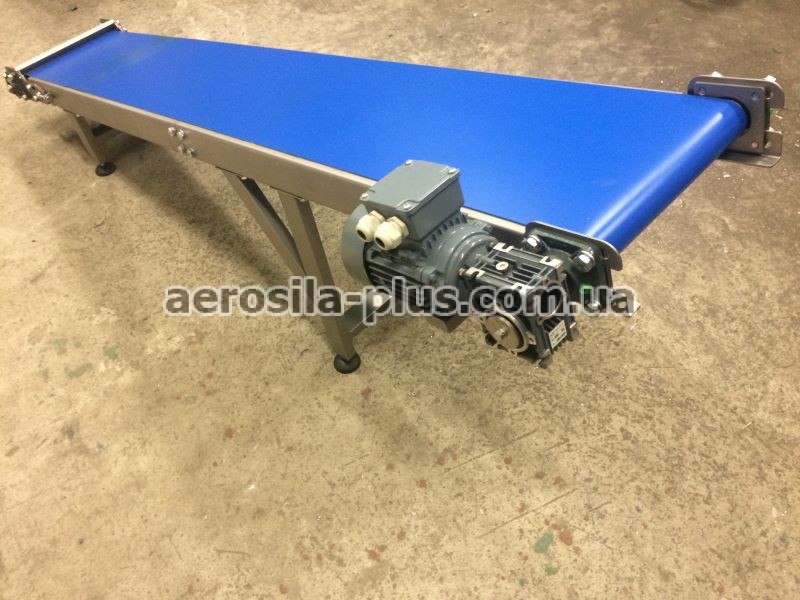
- worm — compact, with an angled shaft output, with a self-braking effect;
- bevel-helical — for high torque and angled output.
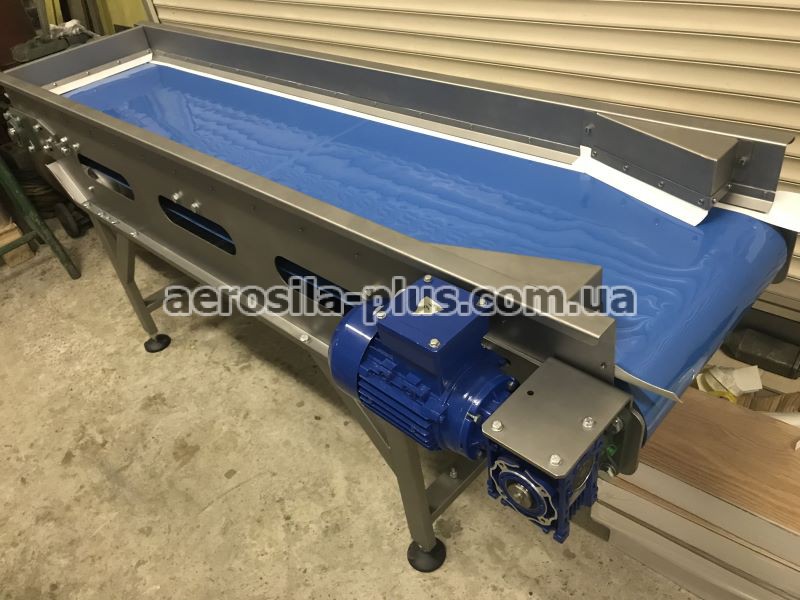
For food conveyors we also consider IP65 protection class and washability. Our engineering department will help select a drive for your conveyor.
Variable-frequency speed control
A separate solution, planned at the design stage, is a variable-frequency drive (inverter). It allows the conveyor speed to be smoothly changed without replacing the gearbox, which is critical for lines where the tempo depends on adjacent operations. The inverter also provides a soft start: instead of a jolt with a starting torque two to three times higher than working torque, the motor accelerates gradually. This reduces the load on the belt, gearbox and bearings, extending their service life. For conveyors that stop under load, a soft start via an inverter often saves the need to take a motor with a large margin.
Engineer’s tip. The biggest mistake is sizing the motor for the rated load and forgetting about start-up. At the moment of start under full load the torque is two to three times higher than working torque. Always check the starting torque, especially for conveyors that stop under load.
Typical selection mistakes
From project experience we single out several recurring mistakes. First — a motor “with a giant margin”: an oversized motor runs at low loading, has worse efficiency and power factor, and costs more. Second — ignoring the duty cycle: a motor for rare starts and a motor for a conveyor starting every minute are different machines by heat-resistance class. Third — a mismatched gearbox: a worm gearbox is compact but has an efficiency of only 0.7–0.8 against 0.95 for a helical one, and on a long line that is a noticeable loss. Fourth — a forgotten protection class: an IP54 motor on a line with washing fails within months. More on selecting conveyor components in the articles tagged conveyor.
Conclusion
Motor selection is five steps: tractive force, power, margin, gear ratio, gearbox type. An error at any stage costs overheating or overpayment. To calculate the drive for your conveyor — get in touch.