Workplace safety on a conveyor line: briefing
How to organize workplace safety on a conveyor line: briefings, prohibited actions, PPE, logbook. Practical experience of safe operation.
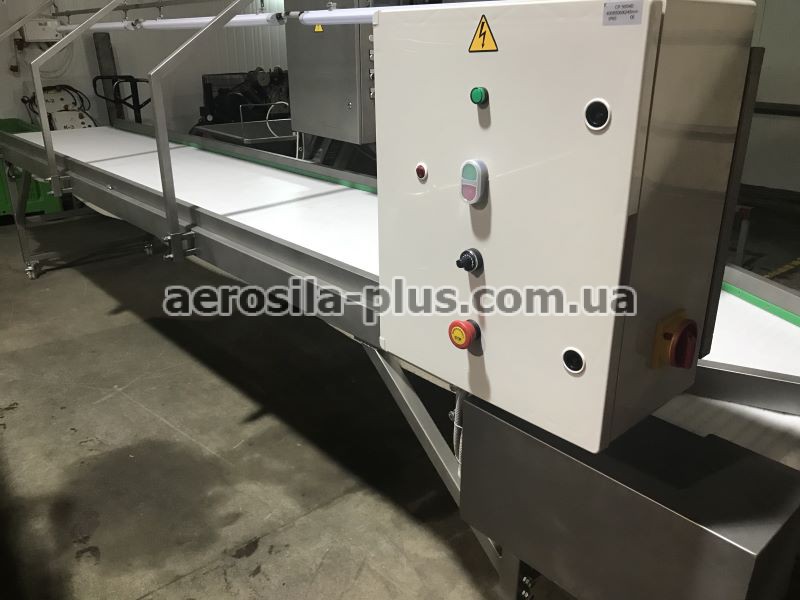
A conveyor line is high-hazard equipment: rotating components, nip points, moving parts. Most line injuries are the consequence not of equipment failure but of a person breaking the working rules. Let us look at how to organize workplace safety so the line runs safely: briefings, prohibitions, protective equipment.
Why people get hurt on a conveyor
An analysis of accidents on conveyor lines gives a simple picture. The most dangerous zone is the point where the belt runs onto the drum — the so-called nip point. The gap between mat and drum narrows to zero, and any object that gets there is pulled in by the drive force — a person has no time to pull free. It draws in clothing, gloves, hair and then a limb. The second source of injury is an attempt to clear a jam or adjust product while the line runs.
Almost all these cases share one thing: the person worked on moving equipment instead of stopping the line. So the basis of workplace safety is a firm rule: any intervention in line components only with the line fully stopped. In practice we classify a conveyor’s hazardous zones into three categories: nip points (drums, rollers, sprockets), crush zones (between mat and stationary frame) and impact zones (transfer points). Each category needs its own type of guarding.
The LOTO rule and start-up lockout
The global standard of safe maintenance is the LOTO procedure (lockout/tagout). Its essence is simple: before any intervention in a component, the line is not just switched off but physically locked against accidental start-up. The power isolator is locked with an individual padlock, whose key stays with the person doing the work. While the lock is in place, nobody can start the line — not even from another control panel.
Without LOTO a typical injury scenario is this: one worker clears a jam, not knowing that a second is at that moment starting the line from the main panel. We build provision for padlocks on isolators into the line design. For long lines with several panels this is the only reliable protection against a start-up “under a person”.
The briefing system
A briefing is not a formality with a signature but real training. A proper system includes several levels:
- Induction briefing — for all new staff, the plant’s general rules.
- Primary at the workplace — specific to this line, showing all hazardous zones.
- Repeat — periodically, no less than once every six months, refreshing knowledge.
- Unscheduled — after an incident, equipment change or violation.
We always advise giving the primary briefing right by the line — showing the emergency stop buttons and the nip points.
Prohibited actions on the line
Each prohibition below is not an abstract rule but the consequence of a real accident investigation. In the table, next to the action, the specific injury mechanism is given so the worker understands not just “you must not” but “why”.
| Prohibited action | Why it is dangerous |
|---|---|
| Clearing a jam while running | hand drawn into the drum zone |
| Removing guards during operation | open access to moving parts |
| Working with unbuttoned clothing | fabric caught by the belt |
| Leaving the line unattended | uncontrolled accident development |
| Cleaning the belt by hand | cut, entanglement |
| Stepping over the conveyor | fall onto the moving belt |
| Servicing a unit without LOTO | line started by another worker |
| Standing under a suspended load | container fall on breakage |
Personal protective equipment
The basic PPE set for line work depends on the section, but the general logic is this:
- Workwear with no loose elements — buttoned up, no scarves, ties, open sleeves.
- Headwear — hair fully tucked away, especially near open components.
- Footwear with a protective toe — on sections with heavy loads and containers.
- Hearing protection — in zones with elevated noise from drives and vibrating machines.
We stress separately: gloves on a section with open rotating components are not protection but an extra risk — a glove is easier to draw into the drum zone than to pull a bare hand back out.
Engineer’s tip. The most reliable protection is built in not by a briefing but by the design. We design lines so that all nip points are physically closed by guards and the emergency stop buttons are within arm’s reach at every workplace. If clearing a jam forces a worker to reach into a component, that is a design mistake, not a staff one.
Structural safety means of a conveyor
The most effective level of protection does not depend on a person’s attentiveness. These are engineering solutions built into the line design:
- Pull-cord emergency switches — a cord stretched along the conveyor that stops the line on a jerk at any point of the route.
- Fixed nip-point guards — covers over drums and sprockets, removable only with a tool.
- Interlocked access-door guards — opening a door de-energises the drive.
- Mushroom-type emergency stop buttons — within arm’s reach at every workplace.
All protective devices are checked before every shift. A faulty emergency switch is more dangerous than its absence — the staff rely on protection that is no longer there.
Documentation and responsibility
Workplace safety rests on documents: a briefing log with signatures, safety instructions for each line, a protective-equipment inspection log, LOTO procedure cards. In an incident it is exactly these records that show whether the system was working. A separate log of detected violations is kept: the recurrence of one and the same mistake is a signal that the problem lies in work organisation, not in a particular worker.
We build in the structural part of safety back at the design stage. More on technical conveyor safety systems in material under the tag safety. The conveyors and transporters themselves we supply already with a full set of protective devices.
Conclusion
Workplace safety on a conveyor line rests on three pillars: real briefings, the firm rule “intervention only when stopped”, and structural protection of components. Most injuries are preventable if the staff are trained and the line is properly designed. If you need a safety consultation for your line, get in touch — we will assess the risks and suggest solutions.