Multi-level conveyor for small workshops
How a multi-level conveyor saves floor space without losing throughput: design, typical schemes, limitations and areas of application.
Floor space costs money, and there is often not enough of it. A multi-level conveyor solves this problem: it moves the transport flow into the vertical and frees up the floor. This article breaks down how a multi-level conveyor is built, which schemes are used and where this layout really works — and where it does not.
The principle of a multi-level layout
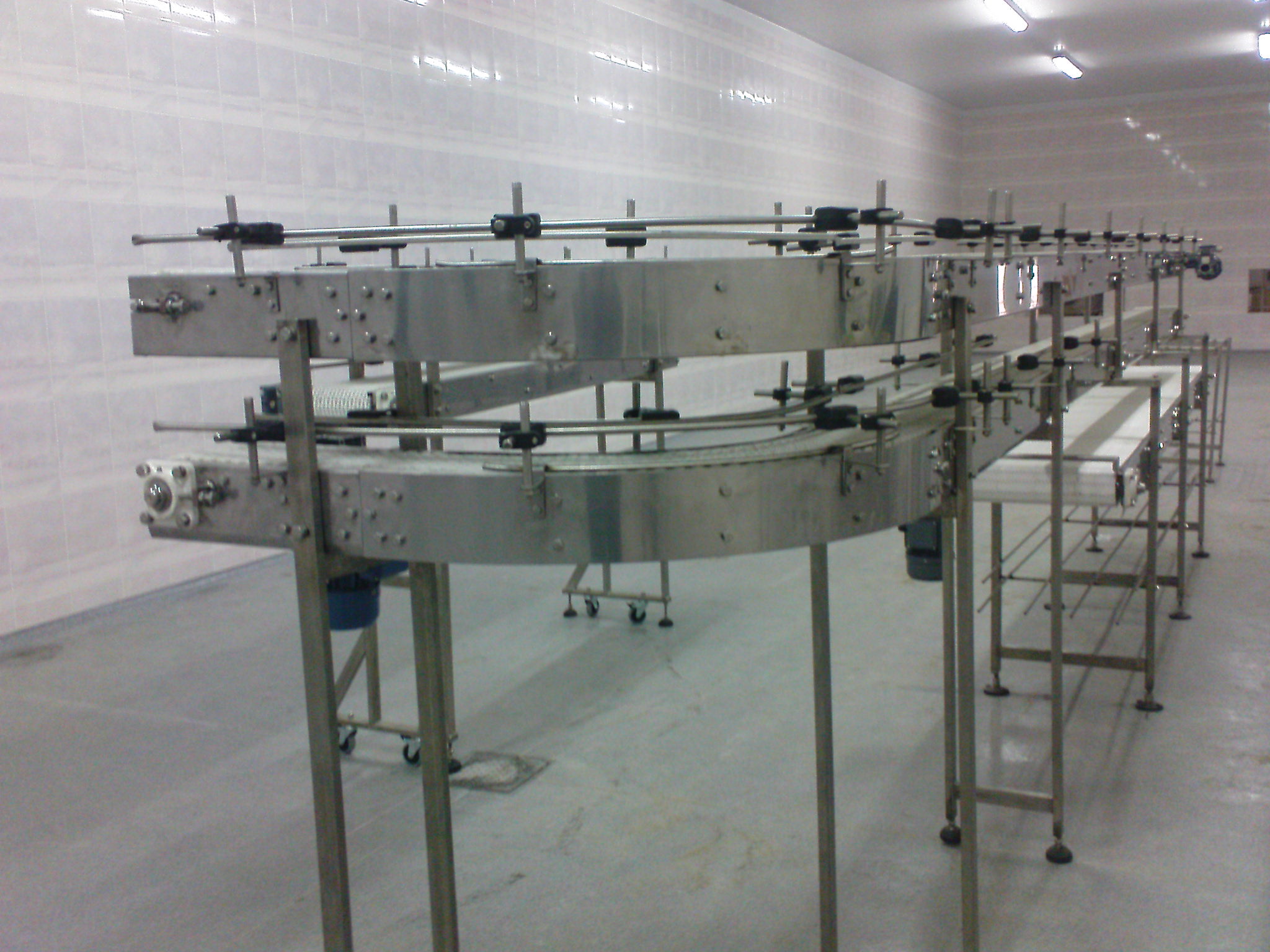
A classic conveyor occupies the floor along its entire route length. A multi-level conveyor places several transport levels one above another in a shared frame. The product moves from tier to tier through transfer sections or inclined parts, and the total route length “folds” into a compact vertical rack.
The result is the same transport distance on an area 2–4 times smaller. For example, a 60 m cooling line at a speed of 0.1 m/s gives 10 minutes of holding time. As a single-level route this is 60 running metres of floor; over six tiers — only 10 m long. For a small workshop this is often the only way to fit a full line without expanding the room.
Structurally a multi-level conveyor is built in two ways. The first — a separate traction element on each tier with its own or a shared drive. The second — a spiral solution, where one endless mat is wound as a helix up the vertical. For food workshops we more often use the first scheme: it is more repairable and lets tiers be stopped independently.
Typical schemes of multi-level conveyors
On our projects three main schemes are used:
- Accumulation — tiers work as a buffer, the product accumulates between operations, smoothing tempo differences.
- Vertical transport — the conveyor raises or lowers the product between floors or workshop levels.
- Process — on each tier the product undergoes a separate operation: holding, cooling, drying.
Most often tiers combine functions: they raise the product and at the same time let it hold for the required time. The direction of travel on adjacent tiers is made opposite — the product runs in a “snake”: left on the first tier, right on the second, and so on to the exit. This lets product entry and exit be placed on one side of the frame and avoids running the return route across the whole workshop.
Technical specifications
Below are reference parameters of the multi-level conveyors we design. Specific values depend on the product and the task.
| Parameter | Value |
|---|---|
| Number of tiers | 2–6 |
| Tier pitch | 250–600 mm |
| Belt speed | 0.05–0.5 m/s |
| Frame material | AISI 304 stainless steel |
| Mat type | modular belt or mesh |
| Floor space saving | 2–4× vs a single-level route |
| Mat width | 300–1200 mm |
| Product holding time | 2–30 min depending on the route |
Drive and tier synchronisation
The trickiest part of a multi-level conveyor is matching tier speeds and the operation of transfer sections. If the lower tier feeds product faster than the upper one receives it, a jam forms at the transition; if slower — the product is torn apart in the flow. So we bring all tiers under a single control logic. On simple schemes we use a shared drive via a chain transmission — speeds are rigidly linked mechanically. On process lines, where tiers need different speeds (for example, slower where the holding is longer), each tier gets its own gear motor with a frequency converter.
Frequency converters also provide soft starting: a simultaneous start of 4–6 loaded tiers creates a starting torque 1.5–2 times the running one, and without smooth acceleration this hits the transmissions. Transfer sections are equipped with short transition segments or inclined chutes so the product passes from tier to tier without free fall.
Where the multi-level scheme works best
A multi-level conveyor is most effective where holding time for the product is needed under limited floor space. The classic example is a cooling line for baked or confectionery goods: the product must hold for several minutes, and instead of a long single-level conveyor we fold the route into the vertical.
The scheme also suits dough proofing, glaze drying and intermediate accumulation before packing. Wherever the operation takes time rather than space, the vertical layout gives an advantage. On a cooling line the vertical rack also brings an extra process bonus: warm air rises naturally, so if product is loaded onto the bottom tier and removed from the top, product travel runs against the heat flow — this speeds up heat removal.
Engineer’s tip. Set the tier pitch accounting not only for product height but also for cleaning and service access. Tiers that are too tight cannot be properly washed and inspected — in practice the minimum comfortable clearance above the product is 150–200 mm.
Limitations of the multi-level layout
The multi-level scheme is not universal. Its weak points:
- harder access to upper tiers for washing and service;
- transfer sections between tiers — potential breakage points for delicate product;
- higher structural complexity and therefore price compared to a simple conveyor;
- workshop ceiling height limits.
So for simple transport “from point A to point B” a single-level conveyor often turns out both cheaper and more convenient.
How we design a multi-level conveyor
Design begins with a workshop survey: ceiling height, existing utilities, product entry and exit points. The usable height for the rack is calculated by subtracting 300–400 mm for the lower support frame and the clearance to the ceiling for servicing. Then we calculate the required holding time or route length and determine the number of tiers by the formula “route length = holding time × belt speed”. Separately we work out the transfer sections — they decide whether the product stays intact. For delicate products we use smooth inclined transitions instead of dropping from tier to tier.
The frame is designed from AISI 304 stainless profile with access to each tier: pull-out idler-roller segments or hinged guard panels ease washing and replacement of the conveyor belt. For more on choosing a conveyor type, see the articles tagged conveyor.
Conclusion
A multi-level conveyor is an engineering solution for workshops where floor space is scarce and the product needs holding time. It saves floor space 2–4 times over but requires well-thought-out service access and careful transfer sections. Need to fit a line into a limited workshop? Get in touch — we’ll design a multi-level layout for your room.