Machine vision for conveyor inspection
How machine vision works for product inspection on a conveyor: cameras, AI models, lighting, rejection and the rough cost of implementation.

Machine vision replaces the human where the eye tires: monotonous inspection of product moving along a conveyor at tens of units per minute. A camera captures every object, an algorithm compares it with a reference, and an actuator ejects the reject. In this article we break down the components of such a system, how the camera and lighting are selected, and what implementation costs.
How machine vision works on a line
A machine vision system is four linked elements. The camera captures the product image as it passes the inspection zone. The lighting provides a stable picture regardless of workshop light. The controller or industrial PC processes the frame and makes the “pass / reject” decision. The actuator — a pneumatic pusher, diverter or valve — physically removes the defective unit from the flow.
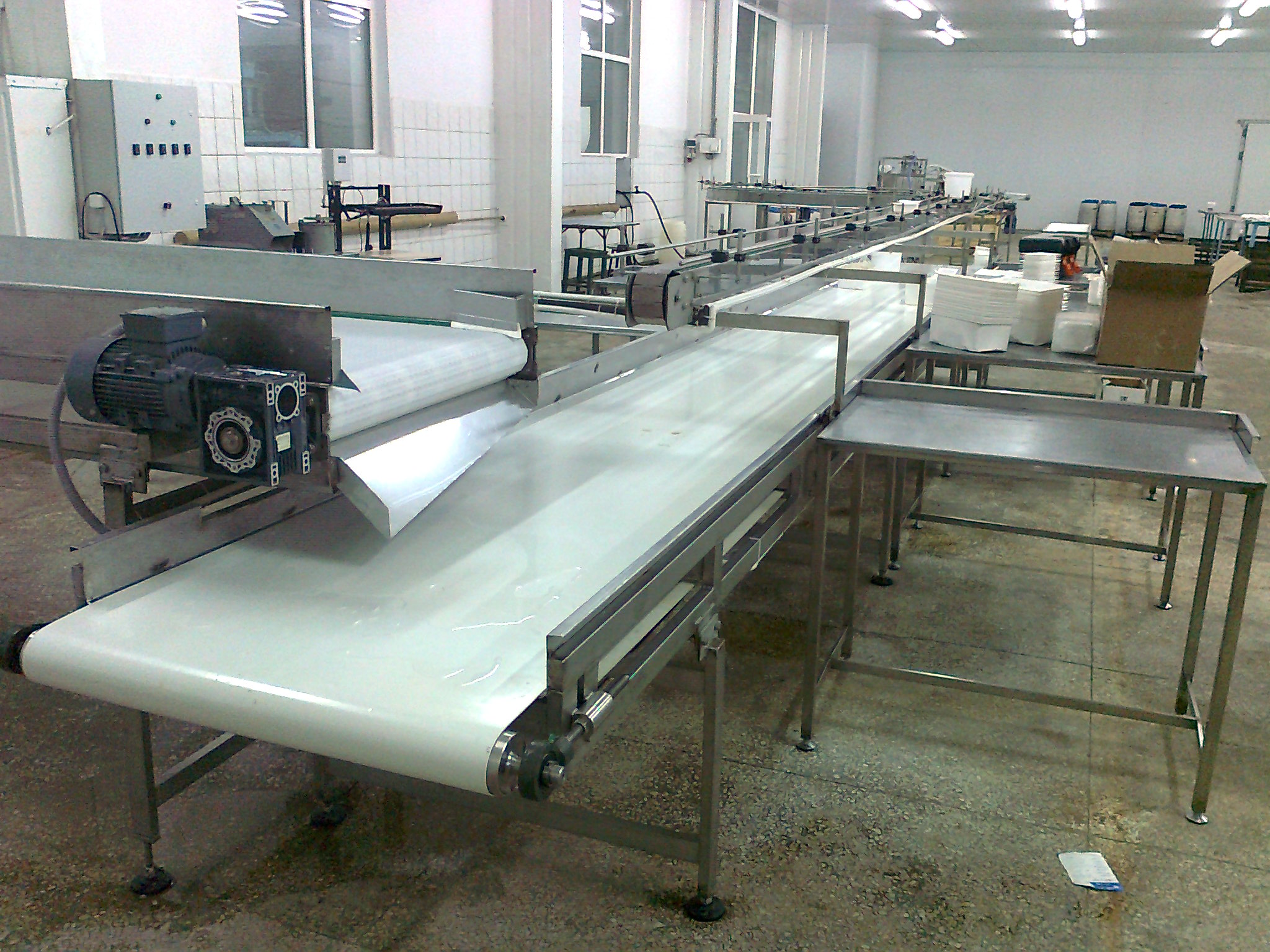
The key condition for correct operation is stability. The product must pass the camera in a predictable position, at constant speed and lighting. That is why the camera is almost always mounted over a dedicated inspection conveyor rather than an arbitrary line section. Before the control zone a unit is often added to spread the product into a single layer or single row — otherwise objects overlap and the algorithm cannot see each one separately.
The second condition is synchronisation. The system must know exactly when an object is under the camera. For this a presence sensor or an encoder tied to the drive is fitted to the conveyor. The encoder gives the system a belt “coordinate”, and the camera triggers exactly when the product is in frame, while the ejector fires exactly when the rejected unit reaches it.
Camera and lighting: how they are selected
The camera type is determined by the defect to be caught. A colour camera is needed to check vegetable ripeness or roast colour. A higher-resolution monochrome camera sees geometry and foreign inclusions better. For small defects on a fast flow, global-shutter cameras are used to avoid motion blur.
The lens and working distance are selected separately. The lens sets the field of view and depth of field: on a fast line with product of uneven height, a depth-of-field margin is needed, otherwise some objects come out blurred. This is resolved at the layout stage, since changing camera height after installation can be difficult.
Lighting is often more important than the camera itself. Unstable light is the main cause of false triggers: the same unit looks different under different lighting, and the algorithm gets confused. On our projects we use:
- Diffuse light — for matte products without glare;
- Directional side light — to emphasise relief, cracks, dents;
- Backlighting — to inspect silhouette and contour;
- Infrared — to detect inclusions invisible in the visible spectrum.
The lighting is also shielded from workshop light by a hood — this removes the influence of sun through windows and the switching of lamps in the workshop.
AI models for classification
Classic machine vision works on rigid rules: size, colour, area within set limits. It is reliable for simple tasks — checking cap presence, reading the date, verifying a dimension. Such a system is deterministic: under the same conditions it always gives the same result, it is easy to set up and verify.
More complex tasks — grading vegetables by quality, detecting rot, classifying nuts — require machine learning models. A neural network is trained on thousands of labelled “pass” and “reject” images, after which it generalises and recognises defects hard to describe with rules. The accuracy of a working model under stable lighting is 95–99%.
It is important to understand: an AI model is not “smart” by itself — it is exactly as accurate as the training set is well assembled. If a certain defect type was not in the training data, the model will not recognise it. So we always build in a retraining period on the real flow: in the first weeks of operation the system accumulates borderline cases, the operator labels them, and the model is refined for the specific customer’s product.
Engineer’s tip. Do not start with AI where rules suffice. If the task is to verify a label is present, a classic system costs three times less, is configured in a day and needs no retraining when the batch changes.
Technical parameters of inspection systems
| Parameter | Classic system | AI system |
|---|---|---|
| Camera resolution | 2–5 MP | 5–12 MP |
| Flow speed | up to 60 units/min | up to 300 units/min |
| Classification accuracy | 90–95% | 95–99% |
| Lighting | LED, white | LED + IR |
| Batch setup time | 1–2 hours | 15–30 minutes |
| Operating temperature | 0…+40 °C | 0…+40 °C |
Flow speed depends not only on the camera but also on conveyor tempo and ejector throughput. So the inspection section is designed as a single unit: the inspection conveyor, optics and actuator must be matched in tact.
What implementation costs
The system budget has three parts: equipment (camera, lighting, controller, ejector), mechanics (an inspection conveyor under the camera) and setup with model training. A simple presence or date-check system pays back fast — it removes one operator from the shift. An AI system for quality grading costs more, but it works where a person physically cannot keep up with the flow and delivers a stable result without end-of-shift fatigue.
Typical payback on our projects is 8 to 18 months, depending on the number of shifts and the cost of the rejects the system catches before dispatch. The calculation should include not only the operator’s wage but also the cost of complaints: a single batch that reaches the customer with a defect often costs more than the whole inspection system.
Another factor is quality stability. A human inspector works with different attentiveness at the start and end of a shift; machine vision holds the same rejection threshold around the clock. For productions that undergo quality audits this is a separate argument: the system provides documented and reproducible control.
Conclusion
Machine vision is not a “smart camera” but a coordinated system of optics, lighting, algorithm and reject removal. Start with a clear description of the defect to catch: that determines the choice between the classic approach and AI. Planning an inspection section or an upgrade to an existing line? Get in touch — we will select a machine vision configuration for your product and line tempo.