Case: a marinades and sauces filling line
A marinades and sauces filling line project: container prep, dosed filling, capping, labelling — configuration, data and launch results.
A marinades and sauces manufacturer came to us with a task: replace semi-manual filling with a continuous line for glass jars of 0.3–0.7 l. In this case we describe how we designed and launched the filling line, which decisions we made and what results we achieved.
The customer’s task
The workshop produced three product groups: vegetable marinades with a hot fill, tomato sauces and mustard dressings. Filling was done by hand with a ladle — 8 operators produced about 900 jars per shift with uneven fill levels and frequent glass breakage at capping. The task: reach 2500 jars per shift, stabilise the dose and cut product losses.
A separate requirement was flexibility. The customer did not want three separate lines for three products — workshop space is limited and the volumes of each SKU are small. One line was needed that quickly changes over between products with different viscosity and fill temperature.
Line configuration
We built the line from five sequential modules joined by a transport system:
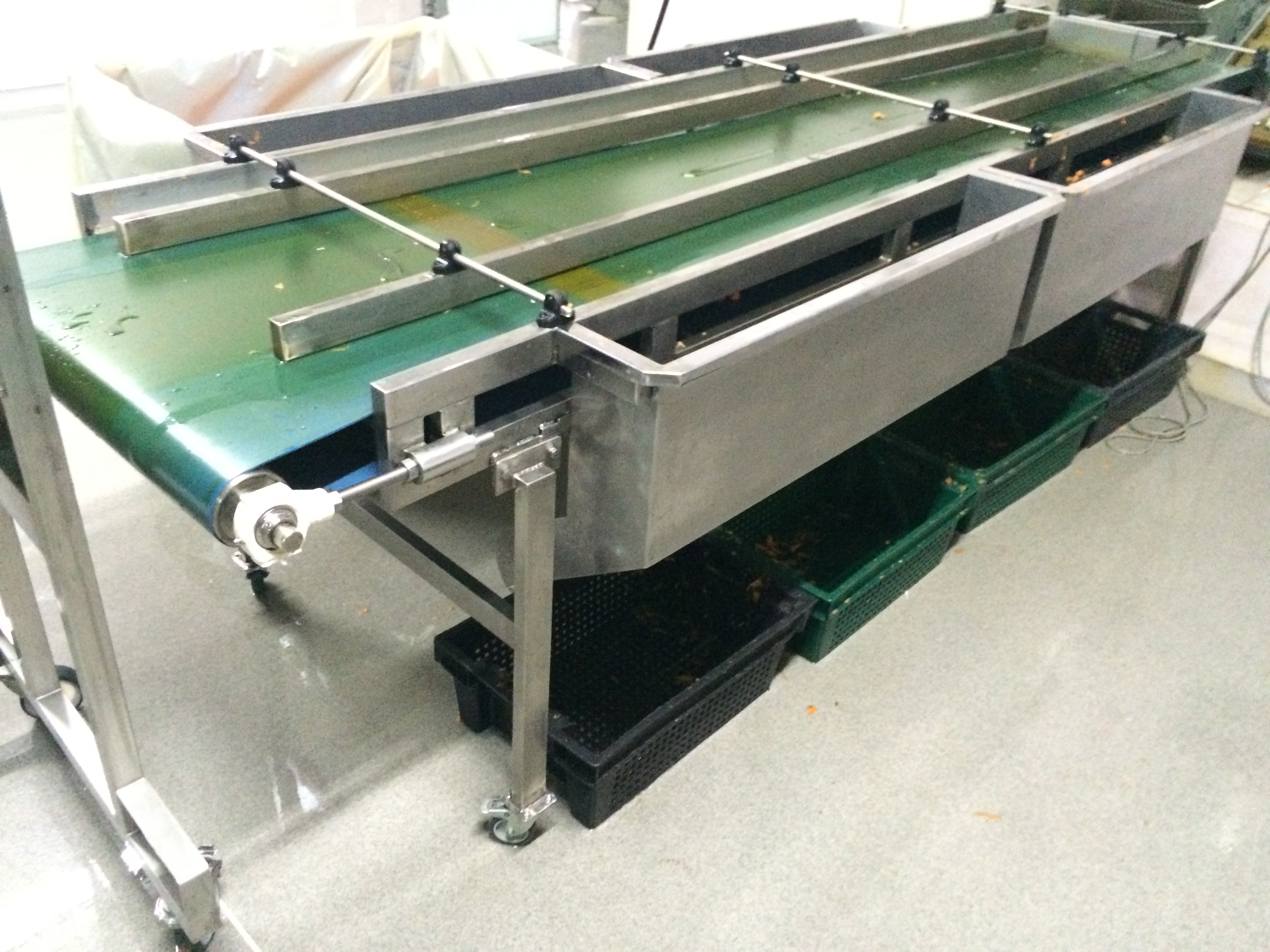
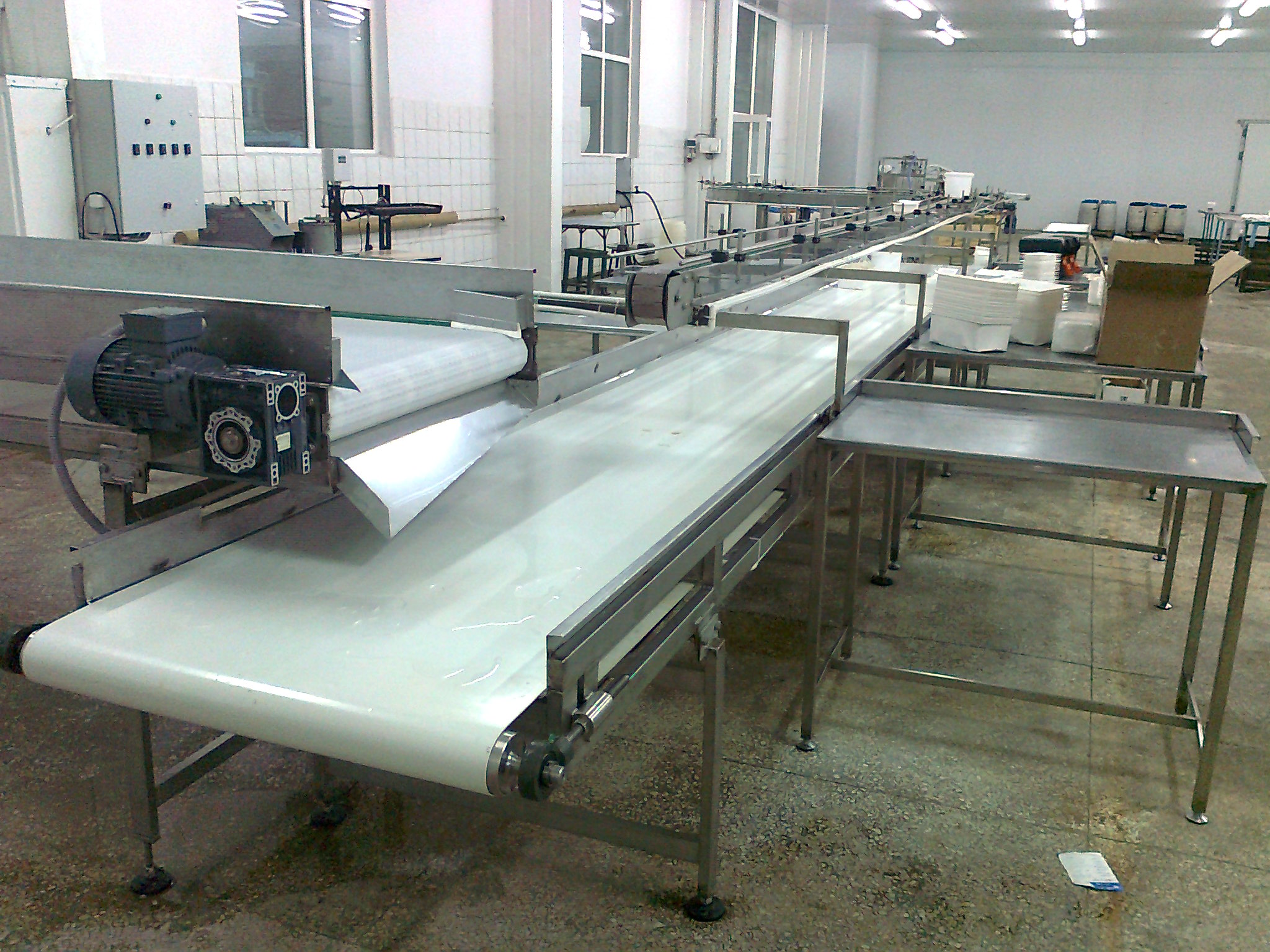
- Depalletising and container feed — an accumulation table and a modular-belt conveyor feed empty jars.
- Container rinsing — turning the jar upside down, air blow-off and hot-water rinse.
- Dosed filling — a 6-head piston doser with product heating to 85 °C for the hot fill.
- Capping — a capping machine with lid feed from an orienting hopper.
- Labelling and accumulation — a wrap-around labeller and a rotary table before packing.
Technical parameters
Below are the main specifications agreed with the customer at the design stage.
| Parameter | Value |
|---|---|
| Throughput | 2500 jars/shift (up to 45 jars/min) |
| Container volume | 0.3 / 0.5 / 0.7 l |
| Dosing accuracy | ±1.5% of nominal |
| Hot-fill temperature | 80–88 °C |
| Contact surface material | AISI 316L |
| SKU changeover time | 25–35 min |
The doser’s contact surfaces are made of AISI 316L stainless steel — the acidic environment of marinades is more aggressive than usual, and grade 304 would serve noticeably less here.
Engineer’s tip. On a hot-fill line the critical factor is not the temperature itself but its stability. A fill spread of more than 8–10 °C gives a different vacuum level in the jar after capping — some lids fail to draw in. We installed a buffer tank with thermostatic control, and the capping reject rate fell from 6% to under 1%.
Challenges and solutions
The main challenge was the switch between three different products. A sauce is thicker than a marinade, mustard has even higher viscosity — one doser had to work with all of them. We chose a piston doser with adjustable stroke and interchangeable nozzles: the switch between SKUs took 25–35 minutes including sanitary washing of the path.
The second task was glass breakage at capping due to uneven feed. It was solved by a rotary table with buffer accumulation: it smooths flow pulsations before the capping machine.
The third challenge was line start-up and shutdown. At the start of a shift the first 10–15 jars came underfilled while the path warmed up. We added an idle warm-up mode with product recirculation through the buffer tank: by the moment containers are fed, temperature and pressure in the path are already stable.
Hygiene and sanitary cleaning
Marinades and sauces are an acidic, viscous medium that leaves deposit on the path walls. So we designed the whole line for washing without disassembly under CIP logic: the doser path, nozzles and buffer tank are cleaned by circulating a 1.5–2% alkaline solution, then an acidic one, then rinsed with hot water.
In design terms this means several decisions: no blind pockets or threaded joints in the product zone, radius transitions instead of sharp corners, a 2–3° slope of all horizontal surfaces for self-draining. Welds in the contact zone are dressed and polished to a roughness of Ra ≤ 0.8 µm — product does not cling to such a surface and a bacterial film does not form. This directly affects the microbiological safety of the finished product and passing retail-chain audits.
Results
After launch and a two-week commissioning the line reached its design figures. Throughput rose from 900 to 2500 jars per shift while the crew shrank from 8 to 3 operators. The ±1.5% dosing accuracy removed product overfill — raw-material savings of about 4% on each batch. Glass breakage at capping fell sixfold.
Equally important was a stable fill level. Previously jars of one batch differed noticeably — this spoiled the product’s shelf appearance and raised questions from retail chains. After the line launch the fill level became uniform and the jar vacuum stable, which positively affected shelf life. The customer separately noted the reduced load on personnel: manual hot-product filling with a ladle is hard and hazardous work, and automation removed that factor. For more on similar projects, see the articles tagged production-line.
What we would account for in advance
Every project teaches lessons. In this case we would immediately build in a wider container range: half a year after launch the customer wanted to add a 0.9 l jar, and the doser had to be fitted with extended nozzles. A built-in piston-stroke reserve would have solved this without rework.
The second is a throughput reserve. The line was calculated exactly for 2500 jars, while real demand grew 20% over a year. We recommend building a 15–20% reserve into the doser and transport system: it barely raises the starting price but removes the need for a subsequent upgrade.
Conclusion
A marinades and sauces filling line is always a compromise between flexibility for different products and dose stability. In this project the key decisions were a piston doser with interchangeable nozzles, a thermostatic buffer tank and a rotary accumulation table. Planning a filling line? Get in touch — we’ll design a configuration for your products and containers.