Conveyors in postal logistics: speed and sorting
How main and distribution conveyors for postal and courier services are designed: speed, sorting by direction, peak load handling.
A postal sorting centre lives on parcels: tens of thousands of items per shift, each with its own destination. The conveyor system here solves two tasks at once — move the flow fast and route it correctly by address. In this article we break down how main and distribution conveyors for postal and courier services are built.
Two levels of a postal system
Any sorting logistics is built on two conveyor levels. Main sections are fast transit lines that move the flow between unloading, sorting and dispatch zones. Distribution conveyors are sorting lines that, on a system command, divert a specific item into the right chute or tray by destination.
The main line is optimised for speed, the distribution zone for diverting accuracy. A mistake here means not a line stop but an item that went to the wrong city.
Speed and flow tempo
On a postal conveyor speed directly determines throughput. Main sections run at 1.5–2.5 m/s — several times faster than food lines. But speed cannot be raised indefinitely: at high speeds light parcels “float”, and diverting mechanisms cannot trigger accurately.
So the flow is broken into controlled tacts. Before the sorting zone a synchronisation section is placed that levels the intervals between items — so each parcel hits the calculated “window” for the ejector to fire.
Sorting by direction
Sorting is the heart of a postal centre. Each item is scanned, the system determines the destination and commands the distribution mechanism. Several schemes are used:
- Pushers — a simple pneumatic ejector for small flows;
- Inclined slide chutes — the parcel slips into a side chute by gravity on a tilt;
- Cross-belt sections — short transverse belts on carriages that actively discharge the load;
- Turning rollers — change the item’s direction without stopping the flow.
The choice of scheme depends on the nature of the flow. Pushers are simple and cheap but deliver a side impact to the item — they are not suitable for fragile loads. Cross-belt sections are the fastest and gentlest, but it is the most expensive solution with its own mechanics on every carriage. On our projects we often combine: main sorting by large destinations on a cross-belt, and final distribution to small legs by simple pushers or inclined chutes. This way the budget is spent where it is really needed.
Engineer’s tip. Size the sorting zone throughput by peak, not average, flow. At the post office the pre-holiday peak is two to three times the norm, and a system calculated “for average” becomes the bottleneck of the whole centre in December.
Technical parameters of postal conveyors
| Parameter | Main | Distribution |
|---|---|---|
| Speed | 1.5–2.5 m/s | 0.5–1.2 m/s |
| Throughput | up to 10,000 units/h | up to 6,000 units/h |
| Item weight | 0.05–31.5 kg | 0.05–31.5 kg |
| Mat width | 600–800 mm | 500–700 mm |
| Mat type | belt | modular belt |
| Operating regime | up to 22 h/day | up to 22 h/day |
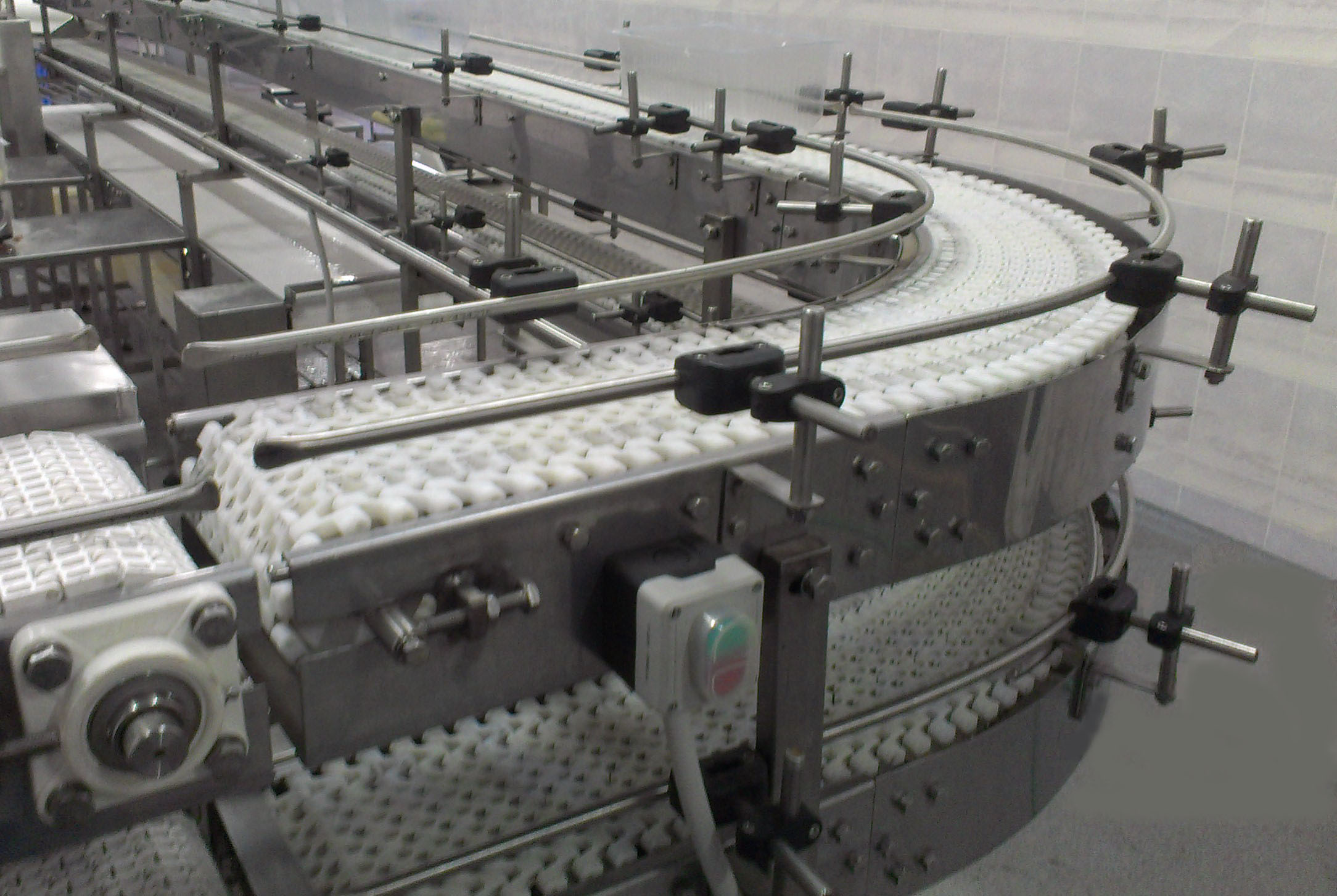
Distribution sections are often made on a modular belt — it withstands the side load from pushers and does not stretch, which matters for positioning accuracy.
Peak loads and reserve
Postal logistics is the clearest example of uneven demand. Pre-holiday weeks bring a multiple flow rise, and the system must withstand it without collapse.
We design postal centres with a modular reserve: extra sorting branches switched on at peak, and main lines with a width margin for future volume growth. This approach is more expensive at the start but cheaper than an emergency centre rebuild two years later. For more on layout logic, see articles tagged logistics.
Scanning and item identification
A sorting conveyor is correct exactly as far as the address label is reliably read. A scanner tunnel is placed over the main line, seeing the barcode from several sides at once — otherwise a parcel lying label-down drops out of the automatic logic and requires manual handling.
The mechanics here directly affect read quality. If the item bounces or rotates on the belt, the scanner cannot focus. So before the scanner tunnel a stabilisation section is built: a flat continuous mat, no joints, constant speed. The distance from scanner to diverting zone is calculated so the system has time to process the data and issue the ejector command before the parcel reaches the chute.
Mat wear on high-speed routes
A main line at 2.5 m/s wears out its resource several times faster than a food conveyor. The belt passes the drums millions of cycles per year, so postal routes use a mat with reinforced joints — vulcanised, not the mechanical fasteners that break first at speed.
Drums and rollers get separate attention: an imbalance unnoticeable at 0.5 m/s produces vibration at 2.5 m/s that destroys bearings. So high-speed sections use balanced drums, and a roller replacement schedule is set by running hours rather than by failure — a break on the main line stops the whole centre.
Conclusion
A postal conveyor is a two-level system: a fast main line and a precise distribution zone. The key to reliable operation is flow synchronisation before sorting and a throughput margin for the pre-holiday peak. Planning a sorting centre or a logistics hub upgrade? Get in touch — we will calculate the conveyor system configuration for your volumes.