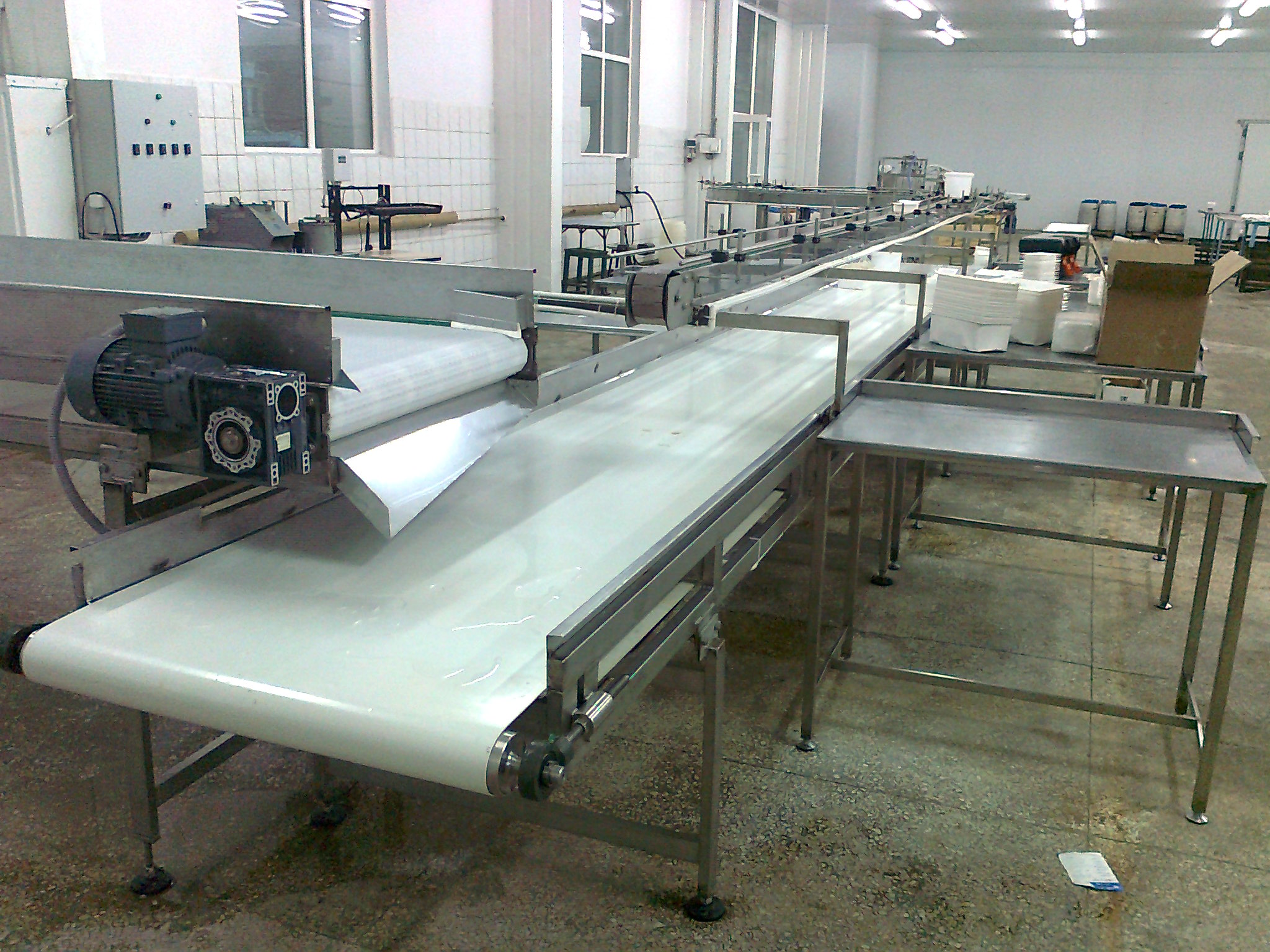
Cooling line for finished products
Parameters of a cooling line after heat treatment: mesh belts, air volume, temperature. We break down how cooling of finished product is designed.
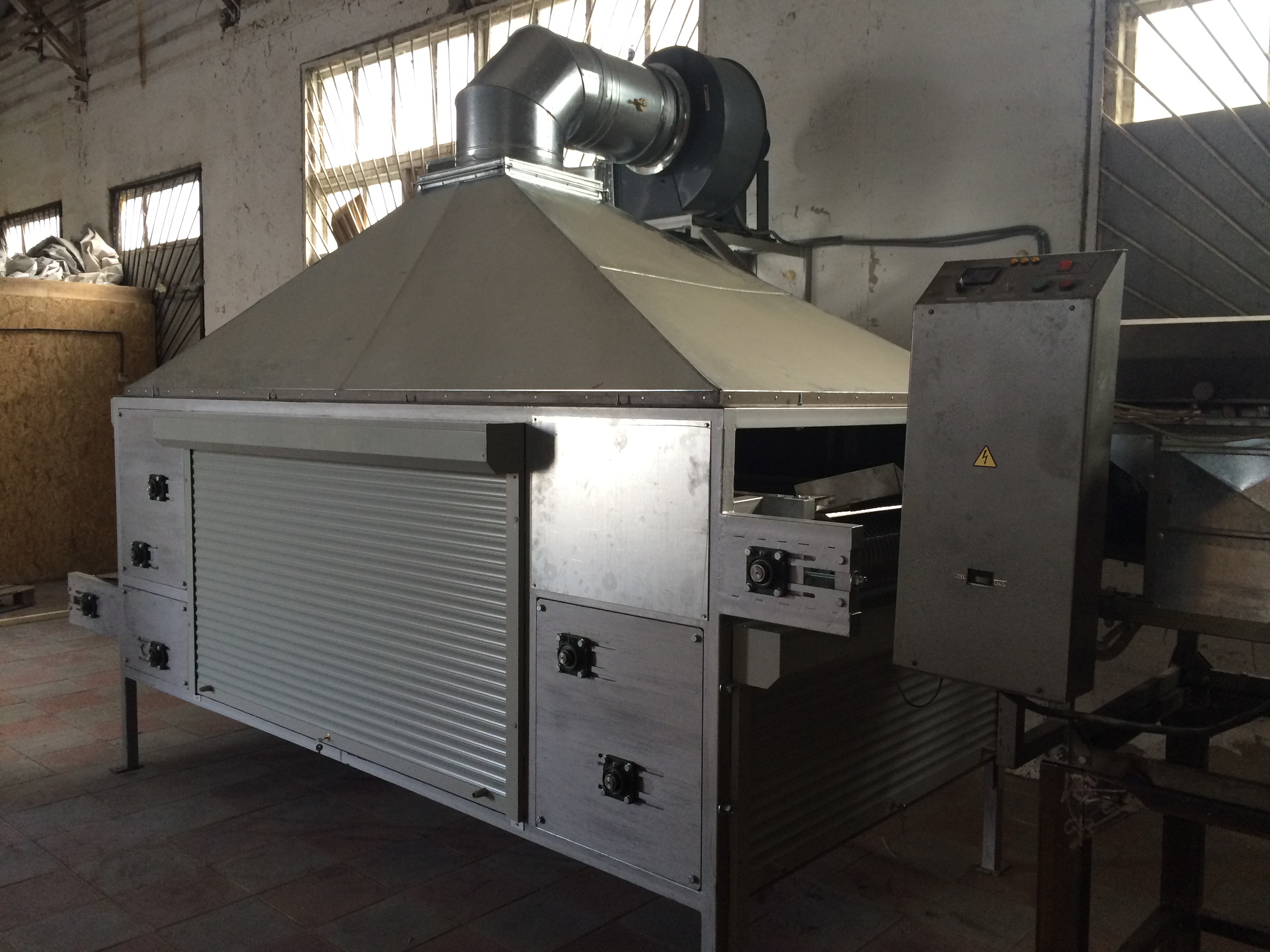
A cooling line is a link that is often underestimated. It seems enough to simply “let the product cool down”, but in reality incorrect cooling spoils what the oven managed to bake perfectly. Condensation on the packaging, cracks in confectionery, insufficient cooling before packing — all are consequences of an imprecisely designed line. This article breaks down how we design cooling of finished products.
Why controlled cooling is needed
After the oven, fryer or blanching the product has a temperature of 80–180 °C. If packed immediately, condensation forms inside the pack, creating an environment for mould and spoiling the appearance. If cooled uncontrollably, the surface sets faster than the core, which gives cracks in biscuits, cakes and bread. Controlled cooling solves both problems: the product reaches packing temperature evenly, without thermal shock or condensation.
Mesh belt: the basis of a cooling line
The base unit of a cooling line is a conveyor with a stainless steel mesh belt. Unlike a solid belt, the mesh has an open area of 60–80%, so air freely passes through the product and blows it from all sides, not just the top. This speeds up and evens out cooling. For delicate products we choose a fine-weave mesh, for heavy ones a reinforced one with a larger pitch. Mesh conveyors also do not retain moisture and clean well, which matters for hygiene.
The mesh weave type is selected for the product. Small and flat items need a tight weave, otherwise the product falls into the cells or a mesh imprint is left on it. For large items the cell can be larger — this improves blowing. The material also matters: in the zone where the product is still hot, stainless steel works, while where it is cooled, a food polymer is sometimes enough.
Cooling methods: air, spiral, tunnel
Depending on the product and throughput, different schemes are used. Below is a comparison of the main solutions.
| Cooling type | Principle | Footprint | Typical product |
|---|---|---|---|
| Straight-through air | Blowing on a straight conveyor | large | Biscuits, snacks |
| Multi-level | Several tiers of mesh conveyor | compact | Bakery products |
| Spiral | Mesh belt in a spiral | very compact | Confectionery, frozen |
| Tunnel | Enclosed tunnel with blowing | medium | Ready meals, meat |
Engineer’s tip. Cooling time determines conveyor length, not the other way round. First we calculate how many minutes the product must cool from process temperature to packing temperature. Then, from belt speed and throughput, we get the required route length. If it does not fit the workshop, we switch to a multi-level or spiral scheme, but we do not shorten the cooling time.
Calculating air volume and temperature
Cooling speed depends on three parameters: air temperature, its speed (blowing volume) and contact area. For most food products we work with air at 15–22 °C, supplied by fans with an air change rate calculated for the product’s heat capacity. It is important not to overcool: for bakery products fast blowing with cold air dries the crust. So on bakery lines we use a gentle regime — lower air speed and a longer route.
A separate point is dew-point control. If the product is cooled below the room’s dew point, condensation will settle on it after the line. So the final cooling temperature is kept 2–3 °C above the workshop dew point.
Integration into the line flow
A cooling line joins the oven at the inlet and the packing section at the outlet. The mesh conveyor speed must precisely match the oven’s throughput — otherwise the product either accumulates or the belt runs half-empty. So we equip the cooling conveyor drive with a frequency converter and synchronise it with the rest of the line. At the outlet we install a temperature sensor that signals if the product has not cooled to the norm.
Hygiene and maintenance of a cooling line
A cooling line works with open product, so its design must meet hygiene requirements. We choose the mesh belt so that it easily washes off crumbs, fat and sugar deposits — it is precisely these contaminants that accumulate on the line after bakery and confectionery products. We design the cooling zone with access for cleaning the fans and air ducts: dust that settles in the blowing system eventually reaches the product. So the air-intake filters and the ducts themselves must be repairable and accessible for regular cleaning.
Conclusion
A cooling line is not a passive “cooling-down zone” but an engineering unit with calculated time, temperature and air volume. An error here nullifies quality heat treatment. We design straight-through, multi-level and spiral cooling lines for a specific product and workshop footprint. If you need a cooling line, get in touch — we’ll calculate a scheme for your throughput.