Seaweed processing: line specifics
A case study of a seaweed processing line: salting, cutting, packing. We break down the equipment specifics and the results of a delivered project.
Seaweed (kelp) is a product with character. It is salty, slippery, abrasive due to sand and requires delicate cutting because it easily turns to mush. A line for its processing is not assembled from standard modules — it is designed around the product. This article is our case: a seaweed processing line from washing to packing.
The project task
A maker of seaweed salads came to us, processing the product almost by hand: manual rinsing, cutting on tables, packing with measuring scoops. The customer wanted to reach a stable 400 kg of finished salad per shift, remove manual cutting as a bottleneck and ensure repeatable portions for packing. The raw material is salted kelp in barrels, with residual sand and shell fragments.
Product specifics and materials
The first thing that defines the whole line is the aggressive environment. Seaweed brine is a saturated salt solution that corrodes ordinary stainless steel AISI 304 within months. Chloride ions destroy the steel’s protective oxide film and trigger pitting corrosion — point ulcers that quickly turn into through holes. So all contact surfaces of the line were made of stainless steel AISI 316L: the molybdenum addition in its composition makes the steel resistant precisely to a chloride environment. The second feature is sand: kelp is abrasive, so the cutting units are designed for wear and made repairable, with replaceable working elements.
The third feature is the slippery structure of the product. Kelp holds poorly on inclined and vertical surfaces, easily slides off and sticks. This was taken into account when choosing conveyor incline angles and the modular belt profile: too steep a rise would have caused the product to slide back.
| Line unit | Material / solution | Reason for choice |
|---|---|---|
| Contact surfaces | Stainless steel AISI 316L | Resistance to salt corrosion |
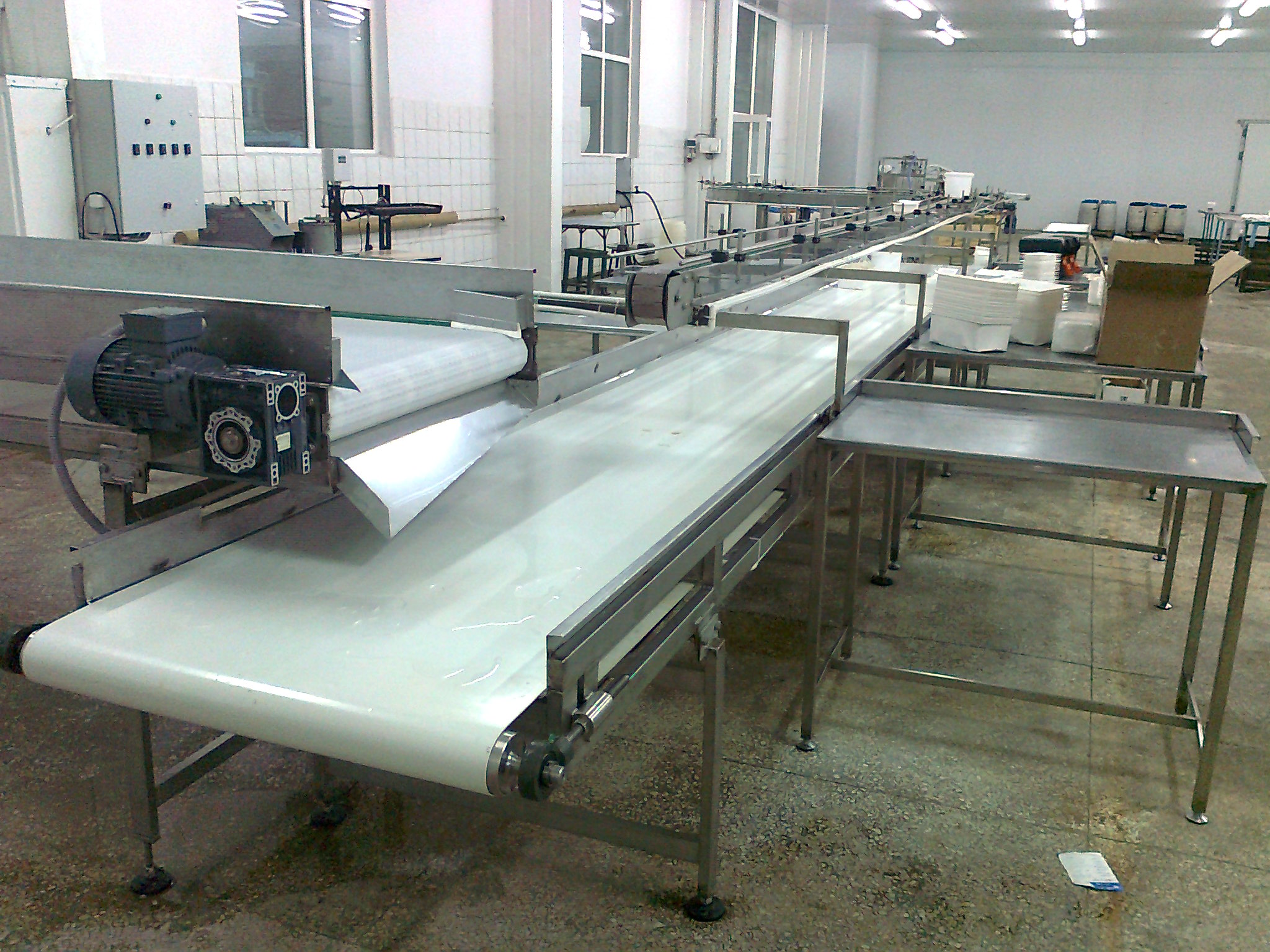
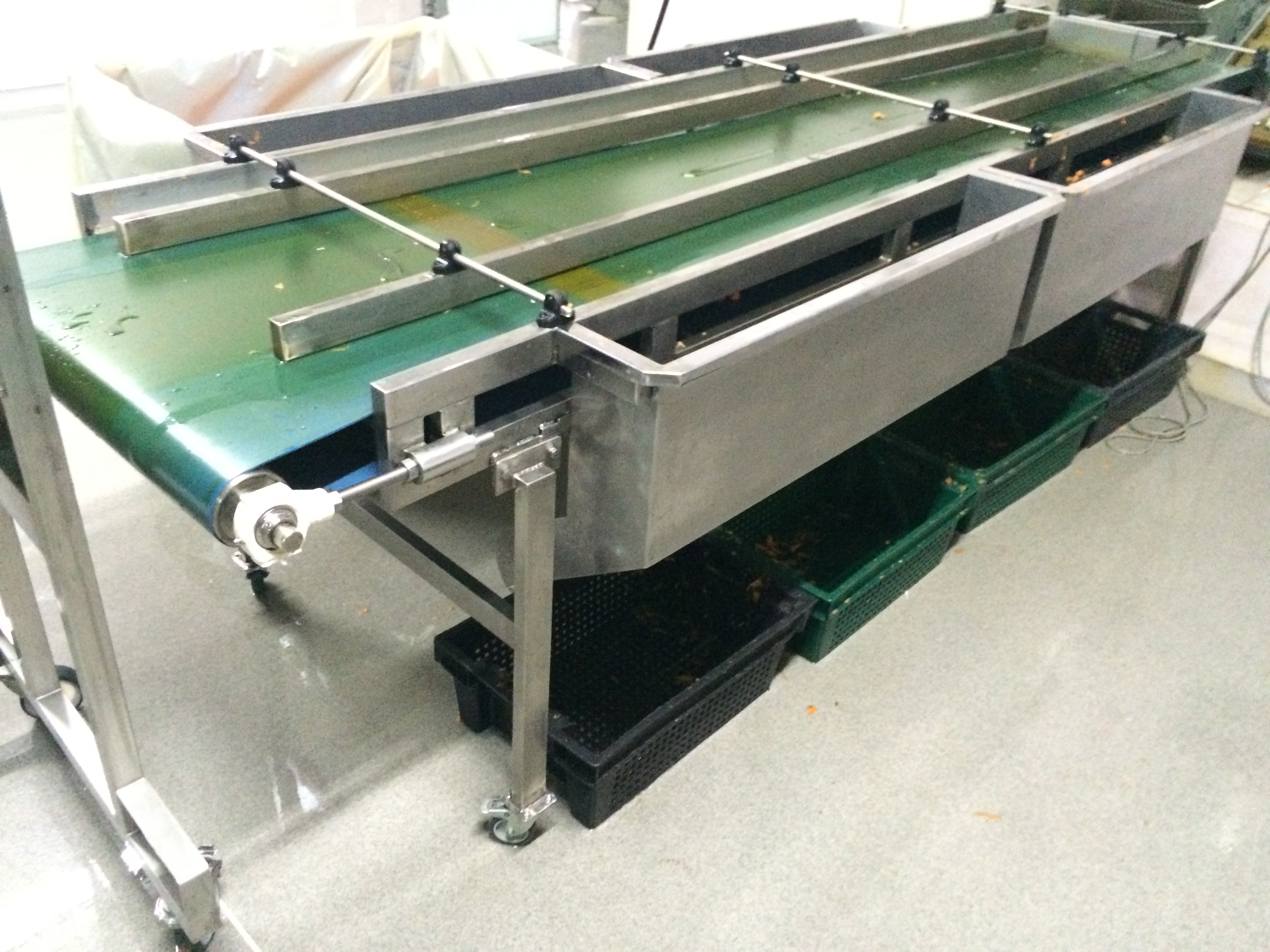
| Conveyor belts | Modular POM belt, blue | Washing, brine drainage, HACCP |
| Cutting blades | Tool steel, replaceable | Wear from sand in the kelp |
| Washing tanks | AISI 316L, with bubbling | Removal of sand and excess salt |
| Cutting drive | Geared motor with converter | Adjusting the cut length |
Line configuration
Before starting the design we measured the customer’s workshop, clarified the seasonal volume of raw material and agreed which SKUs the line would produce. This determined the throughput of each module and the total route length. The line was assembled from six sequential sections:
- Loading and loosening — kelp from barrels is fed onto a receiving conveyor where stuck-together layers are separated.
- Bubble washing — in a bubbling tank sand grains settle to the bottom while excess salt is washed out by running water.
- Draining — a modular belt with 35% open area removes water before cutting.
- Cutting — a rotary knife cuts the kelp into strips of set width; length is adjusted by feed speed.
- Inspection — operators remove shells and foreign fragments on an inspection conveyor.
- Packing — a volumetric doser forms portions into containers.
The sections were joined by modular belt conveyors, which withstand a wet environment and are cleaned without disassembly. The speeds of adjacent sections were matched so that kelp moves in an even flow without jams: at the joint of washing and cutting this is especially important, because an uneven feed throws off the rotary knife settings.
Engineer’s tip. On a seaweed line the main mistake is saving on the steel grade. Customers often ask for AISI 304 “because it is cheaper”, but in salt brine it develops pitting corrosion within one season. The price difference between 304 and 316L is about 30% on the metal, but 316L lasts for years without replacement. This is the case where saving at the start is costly.
Results
After launch the line reached its design throughput of 420 kg of finished salad per shift — 5% above plan. Manual cutting was fully removed: the rotary knife produces even strips 4–6 mm wide without defects. The portion deviation at packing is within ±3 g, which satisfied retail chains’ labelling requirements. Shift staffing fell from 6 to 3 people, now mostly occupied with inspection and control.
A separate result is hygiene. Thanks to the modular belts and a design without stagnation zones, the line is cleaned to CIP standard without disassembly, which roughly halved the sanitation time at the end of the shift. This is not only time saved but also stable passing of hygiene checks: on a line with manual cutting on tables such stability is unattainable.
Conclusion
A seaweed processing line is an example of how product specifics dictate every engineering decision: from steel grade to blade design. Universal equipment does not work here. If you process seaweed, algae or other salty products and want to move away from manual labour, get in touch — we’ll design a line for your product and volumes.