Drum washing for seeds: pros and cons
How a drum seed washer works, its throughput, water consumption and when a tunnel washer is the better choice over a drum one.
A drum washer is the most common solution for cleaning sunflower and pumpkin seeds of dust, husk and foreign matter. The design is simple and reliable but has clear application limits. In this article we break down how a drum washer works, what throughput it delivers and when a tunnel type is the better choice.
How a drum washer works
The heart of the machine is a perforated stainless steel drum mounted at a slight angle to the horizontal. Seeds are fed in at the upper end, and the drum rotates slowly — typically 8–20 rpm. Inside the drum there are helical guides (a screw flight) that gradually move the product towards the lower end.
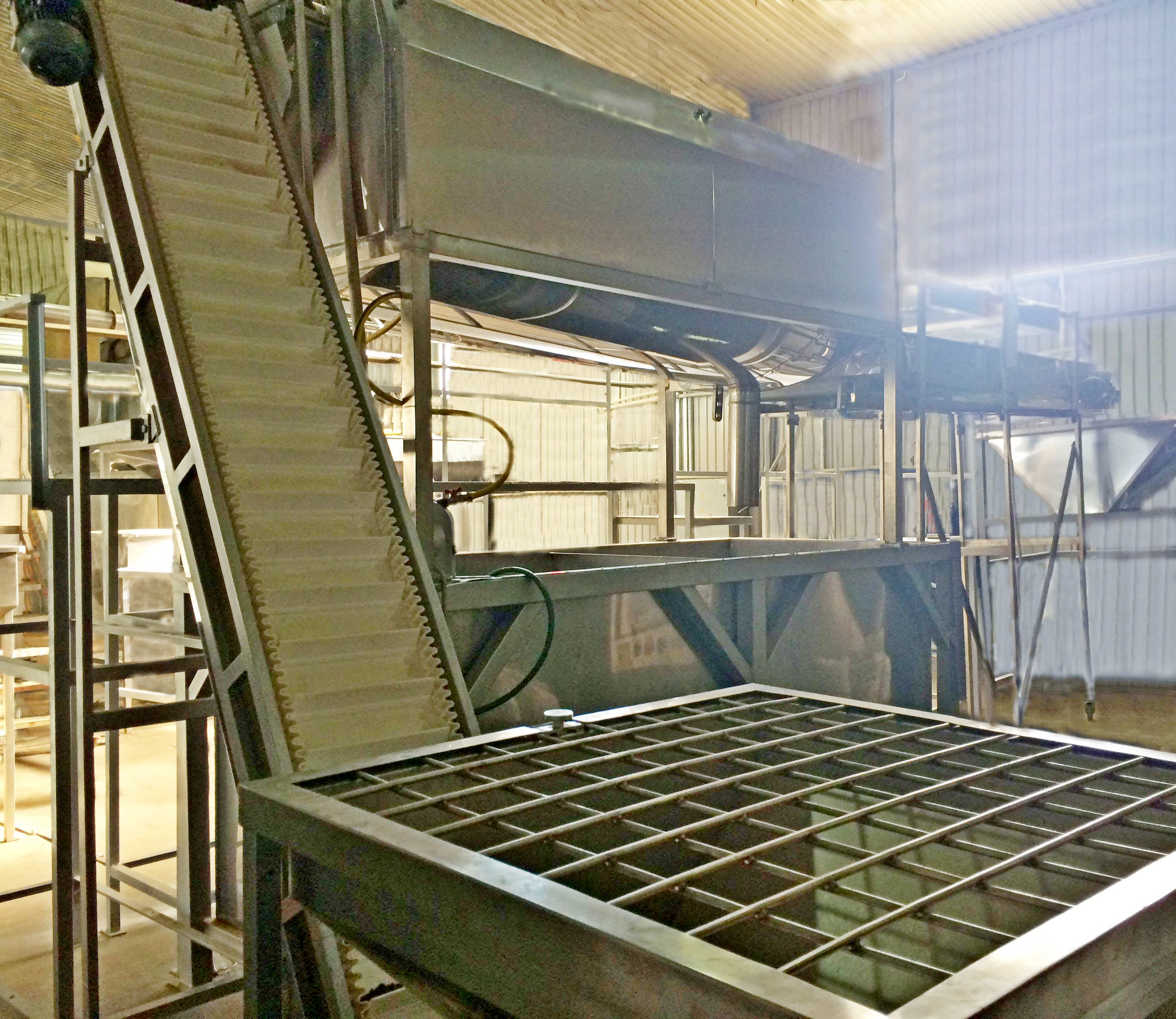
While the seeds travel through the drum, they are sprayed with water from nozzles. The rotation tumbles the product, ensuring it is washed on all sides, and the perforated walls drain dirty water and fine debris. Husk and empty seeds float up and are removed by an overflow. At the outlet the product passes to a mesh drain conveyor, where excess water leaves before drying.
Advantages of a drum washer
The drum washer has become an industry standard for seeds thanks to several strengths:
- Simple design — one rotating unit, minimum moving parts, high repairability.
- Gentle regime — seeds are not beaten against rigid elements, kernel integrity is preserved.
- Self-cleaning — rotation and slope prevent product from accumulating inside.
- Compact — the machine takes up less space than a multi-stage tunnel line.
- Low cost — in capital terms a drum is cheaper than a tunnel.
For small and medium processing volumes a drum washer is almost always optimal. We covered building the cleaning section in more detail in our articles on seed processing lines.
Technical parameters
The throughput of a drum washer depends on the drum’s diameter, length and rotation speed. Below are indicative characteristics of standard sizes.
| Drum diameter | Throughput | Water consumption | Drive power |
|---|---|---|---|
| 600 mm | up to 0.8 t/h | 1.5–2.5 m³/h | 1.1 kW |
| 800 mm | up to 1.5 t/h | 2.5–4.0 m³/h | 1.5 kW |
| 1000 mm | up to 2.5 t/h | 4.0–6.0 m³/h | 2.2 kW |
| 1200 mm | up to 4.0 t/h | 6.0–9.0 m³/h | 3.0 kW |
Engineer’s tip. Water consumption is the main operating cost item of a drum washer. On our projects we fit a recirculation system with a settling tank and a filter: this cuts fresh water consumption by 60–70% without losing wash quality.
Limitations of a drum washer
The drum copes well with dust, light husk and sand but has weak spots. The first — it washes off viscous and oily contamination worse, because the contact time with water is limited by the drum length. The second — throughput grows only by increasing the size: for large volumes a drum becomes too massive and heavy.
The third limitation is single-stage operation. In a drum there is effectively one wash zone, whereas heavily contaminated seeds need several consecutive stages with different water temperature and pressure. This is exactly where the advantage shifts to a tunnel washer.
When to choose a tunnel washer
A tunnel washer is worth considering when:
- Processing volume exceeds 4–5 t/h — a drum of that size becomes unwieldy.
- Seeds are heavily contaminated with soil, oil, plant residue.
- A multi-stage process is needed: pre-soak, main wash, final rinse.
- Stable quality matters despite fluctuations in incoming contamination.
A tunnel line costs more and takes up more space but delivers deeper cleaning and better scalability. The drum, meanwhile, remains the optimal choice for stable medium volumes with moderate contamination.
What we account for when selecting a drum washer
Selecting a drum washer starts with three input parameters: the crop and seed size, the required throughput, the nature of the contamination. Seed size determines the drum perforation pitch — the holes must let water and fine debris through but not the product itself. For small seeds we take a 3–5 mm perforation, for pumpkin seeds 6–8 mm.
The drum’s slope angle and rotation speed set the product’s residence time inside. The dirtier the seeds, the slower the drum must rotate and the longer the product is washed. On our projects we make a drive with frequency control — this lets the operator adjust the speed to the real contamination of the batch without stopping the washer. Separately we design the water treatment unit: a settling tank, a husk screen and a recirculation pump. All contact surfaces are made of AISI 304 stainless steel to hygienic design principles, with no water stagnation zones.
Conclusion
A drum seed washer is a reliable, compact and economical solution for cleaning sunflower and pumpkin seeds in medium volumes. Its limits are single-stage operation and limited throughput; beyond these limits a tunnel washer is more rational. If you are planning a seed cleaning section and are unsure which type to choose — get in touch, and we will calculate a solution for your volume and degree of contamination. More on the topic under the tag washing.