
Marinating line: designing for various products
How to design a marinating line for cucumbers, mushrooms, garlic and peppers: modules, changeover, brine dosing, stainless steel.
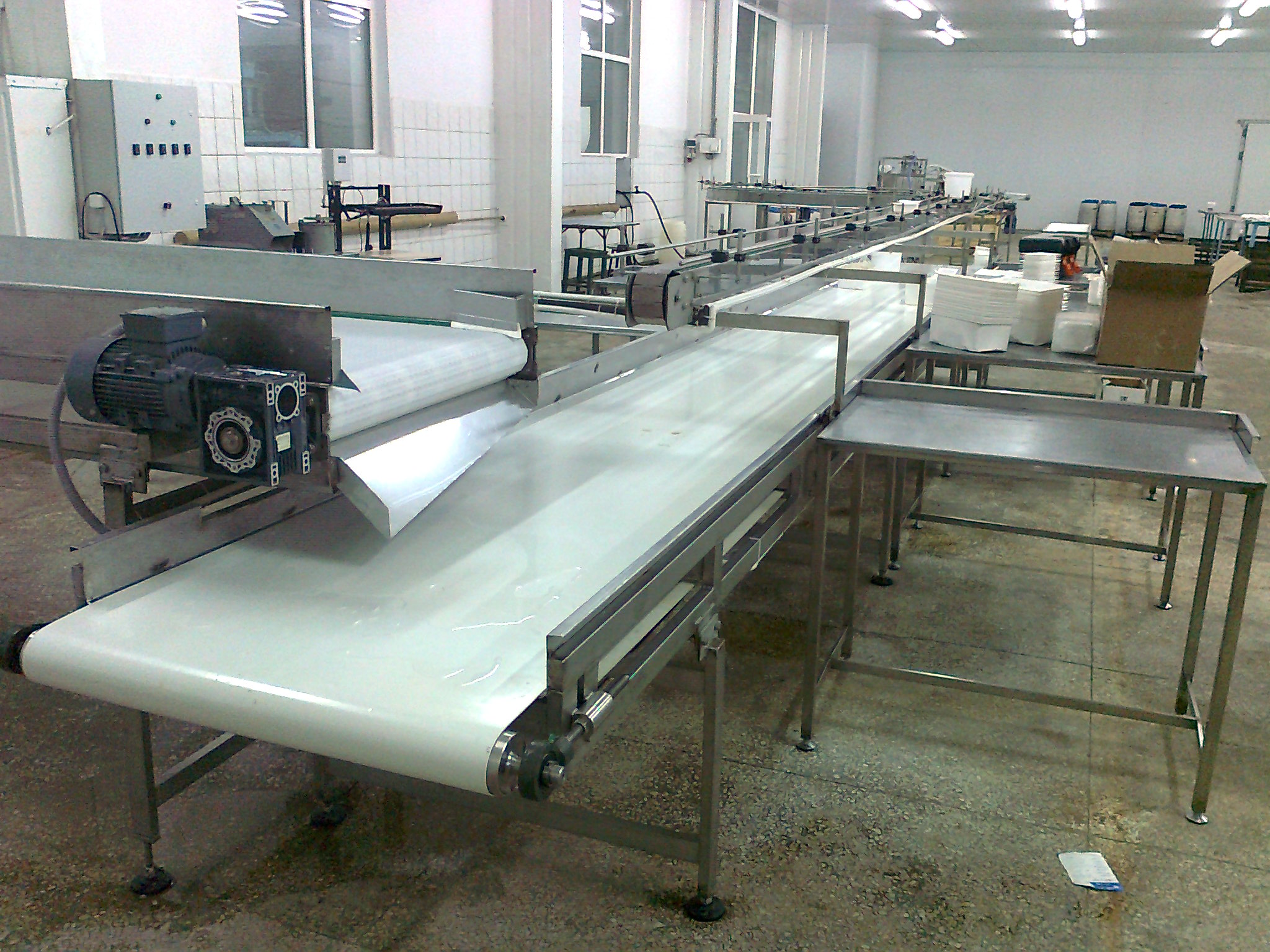
A marinated cucumber, mushroom, garlic clove and pepper go through a similar path: raw-material preparation, packing into containers, brine filling, sealing. This allows several SKUs to be served by one line — provided it is designed as flexible from the very start. The article covers how to build a marinating line for various products.
What is shared and what differs between products
All marinated products go through the same process logic, but the details differ. Cucumbers need calibration by length (typical groups 70–90, 90–110, 110–140 mm) and dense vertical packing — jar fill and shelf appearance depend on calibration accuracy. Mushrooms are delicate: a conveyor speed above 0.2 m/s and a transfer drop over 150 mm already cause cap breakage and darkening of cut surfaces. Garlic requires peeling and tends to clog feeders with fine husk — it is screened out before packing by aspiration or a sieve module. Peppers are bulky and light, with a bulk density 3–4 times lower than that of a cucumber, so they need wider guides and a softer flow support. A line working with all four must account for the most demanding product on each parameter: mat width is set for peppers, speed mode for mushrooms, feeder protection for garlic.
Modules of a marinating line
A typical line consists of sequential modules:
- Reception and washing — a bubble bath or a shower washer to remove dirt and sand, throughput 0.8–2.5 t/h.
- Inspection and calibration — an inspection conveyor at 0.1–0.15 m/s, reject removal, sorting by size.
- Preparation — cutting, peeling, blanching in water at 85–95 °C depending on the product.
- Packing into containers — manual or semi-automatic placing into 0.72–3.0 l jars.
- Brine dosing — filling with hot or cold brine with volume control, accuracy ±2%.
- Sealing and marking — twist-off capping, labelling, date stamping.
Between modules we place buffer accumulators: they smooth out the difference in tempo of manual and automatic operations. Without a buffer, a 30-second stop of the packer immediately stops the whole upstream line.
Throughput calculation and balancing
The throughput of a marinating line is set not by the fastest but by the slowest module. In practice the bottleneck is most often manual packing: one packer handles 4–8 jars per minute depending on the product. So we balance the line “from packing backwards”: we set the target output tempo, from it calculate the required conveyor speed and washer throughput with a 15–20% margin. We synchronise the brine dosing unit with the capper through a jar-position sensor — filling triggers only when the container is under the nozzle. This eliminates spilling hot brine onto the conveyor and reduces liquid losses, which amount to tens of litres per shift.
Technical parameters per product
| Product | Conveyor speed | Brine temperature | Brine pH | Feature |
|---|---|---|---|---|
| Cucumbers | 0.15–0.3 m/s | 85–90 °C | 3.4–3.8 | Calibration by length |
| Mushrooms | 0.1–0.2 m/s | 90–95 °C | 3.8–4.2 | Gentle mode, minimal transfers |
| Garlic | 0.15–0.25 m/s | 80–85 °C | 3.6–4.0 | Peeling, feeder husk protection |
| Peppers | 0.2–0.3 m/s | 88–92 °C | 3.5–3.9 | Careful packing of a bulky product |
How to build in flexibility
A line’s flexibility is not “buying more equipment” but thinking through fast changeover. We build this in through several solutions: variable frequency drives on all conveyors for speed change without stopping, interchangeable dosing nozzles for different viscosity and volume, adjustable guides on the conveyors for different container sizes, recipe profiles in the control system — the operator picks the product and the line sets the speeds and temperatures itself.
Engineer’s tip. Build the changeover time into the design as a separate parameter. A line that switches between SKUs in 15 minutes but costs 20% more pays back faster than a “cheap” one with a two-hour changeover — especially with small batches.
Hygiene and materials
A marinade is aggressive: acetic acid at 1–2% concentration and salt corrode ordinary steel, especially at weld seams. We make all contact surfaces of AISI 304 stainless steel, and for zones of constant contact with hot brine — AISI 316L with 2–3% molybdenum content, more resistant to chloride corrosion. We keep the roughness of contact surfaces at Ra ≤ 0.8 µm: biofilm does not anchor to a smoother surface and product washes off more easily. We design the line for washing without disassembly per EHEDG principles: internal corner radii of at least 3 mm instead of sharp joints, frame slopes of 3–5° for full runoff, no blind cavities or stagnation zones. Weld seams are made continuous and polished — an intermittent seam with gaps becomes a trap for product residue. This is part of the full vegetable and fruit processing line we assemble to order. Requirements for food contact are governed by EU Regulation 1935/2004.
Common design mistakes
From our project experience, marinating lines most often stumble on a few miscalculations. The first — saving on variable frequency drives: a line without speed control is rigidly tied to one product and does not justify its multi-product status. The second — underestimating the thermal unit: a brine tank without sufficient heating power cannot hold 90 °C during continuous filling, the temperature “drops” and undermines sterilisation. The third — a forgotten drainage system: spilled hot brine reaches the floor and creates both a hazard and a sanitary problem. The fourth — insufficient inspection conveyor length: at 0.15 m/s the operator physically cannot review the flow if the working zone is shorter than 1.5 m per inspector. We build all these points in at the technical design stage rather than fixing them later on a running line.
Conclusion
A marinating line for several products is not a compromise but deliberately built-in flexibility: VFDs, interchangeable nozzles, adjustable guides, recipe profiles. It must be designed for the most demanding product and with changeover time under control. Planning a marinating line? Get in touch — we will design a configuration for your set of SKUs.
