Conveyors for stone processing facilities
Specifics of conveyors for stone processing: abrasive dust, water protection, reinforced frames and high-strength belts — our experience and a case.
A stone-processing workshop is one of the harshest environments for a conveyor. Abrasive dust, water, heavy sharp-edged blanks and the vibration of cutting machines wear out standard equipment within months. In this article we break down the specifics of such lines and share a case of a conveyor for a workshop cutting granite and marble.
Why stone processing is hard on a conveyor
A conveyor in a stone-processing workshop works against several wear factors at once. Abrasive dust penetrates the bearings and gets under the belt, acting like grinding paste. Water from the cutting-disc cooling systems drains onto the route and the units. Blanks have sharp edges and a significant specific weight. All this means: a solution from a food workshop does not transfer here without serious changes.
A separate difficulty is the combination of water and abrasive. Stone dust mixed with water forms a hard paste that packs into every gap, hardens and jams moving parts. That is why the key design task is not just to protect the units but to make the structure such that this paste does not accumulate and can be washed off.
Key equipment requirements
Based on experience, we design a conveyor for stone processing on four principles:
- Reinforced frame — an enlarged-section profile, because the load from slabs is many times higher than food products.
- Bearing protection — labyrinth seals and closed housings that keep abrasive out.
- Water drainage — an inclined deck and drainage holes so water does not stagnate.
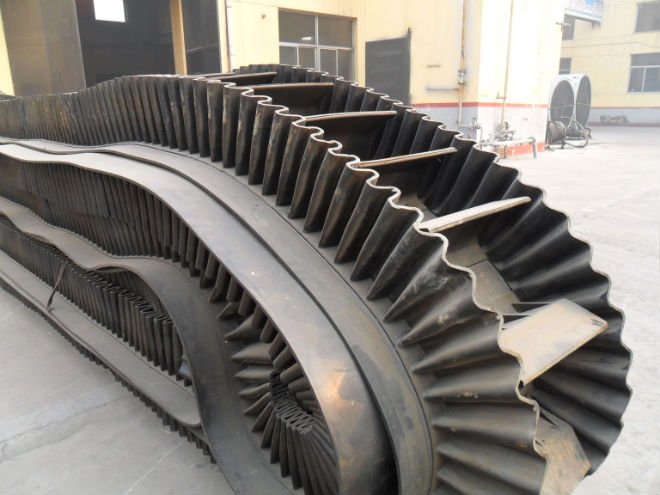
- Wear-resistant belt — a thick rubber-fabric belt with an abrasion-resistant cover or a steel slat deck.
Technical parameters of the line
Below are the typical parameters we work with on stone-processing sites.
| Parameter | Value |
|---|---|
| Belt type | Rubber-fabric abrasion-resistant, 8–12 mm |
| Belt alternative | Steel slat deck |
| Conveyor speed | 0.1–0.4 m/s |
| Specific load | up to 350 kg/m of route |
| Drive protection class | IP66 |
| Frame steel | structural with powder coating |
Choosing between a belt and a slat deck
The two basic solutions for stone processing — a rubber-fabric belt and a steel slat deck — have different application zones. A belt is cheaper, quieter, easier to clean of water, but a sharp slab edge will eventually cut it through. A slat deck made of 4–6 mm thick plates is practically invulnerable to cuts and withstands impact when a blank is dropped, yet it is heavier, more expensive and needs a more powerful drive.
The guideline is this: for fine screenings, chips and blanks with rounded edges we take an abrasion-resistant belt; for heavy slabs and sharp-edged offcuts — a slat deck. If the flow is mixed, the two are sometimes combined: a steel loading section and a belt transport section.
Case: a conveyor for a granite-cutting workshop
A workshop where granite and marble slabs were cut into tiles came to us. Transporting offcuts between the saws and the grinding zone was done manually with carts — this slowed the tempo and created an injury risk due to blank weight.
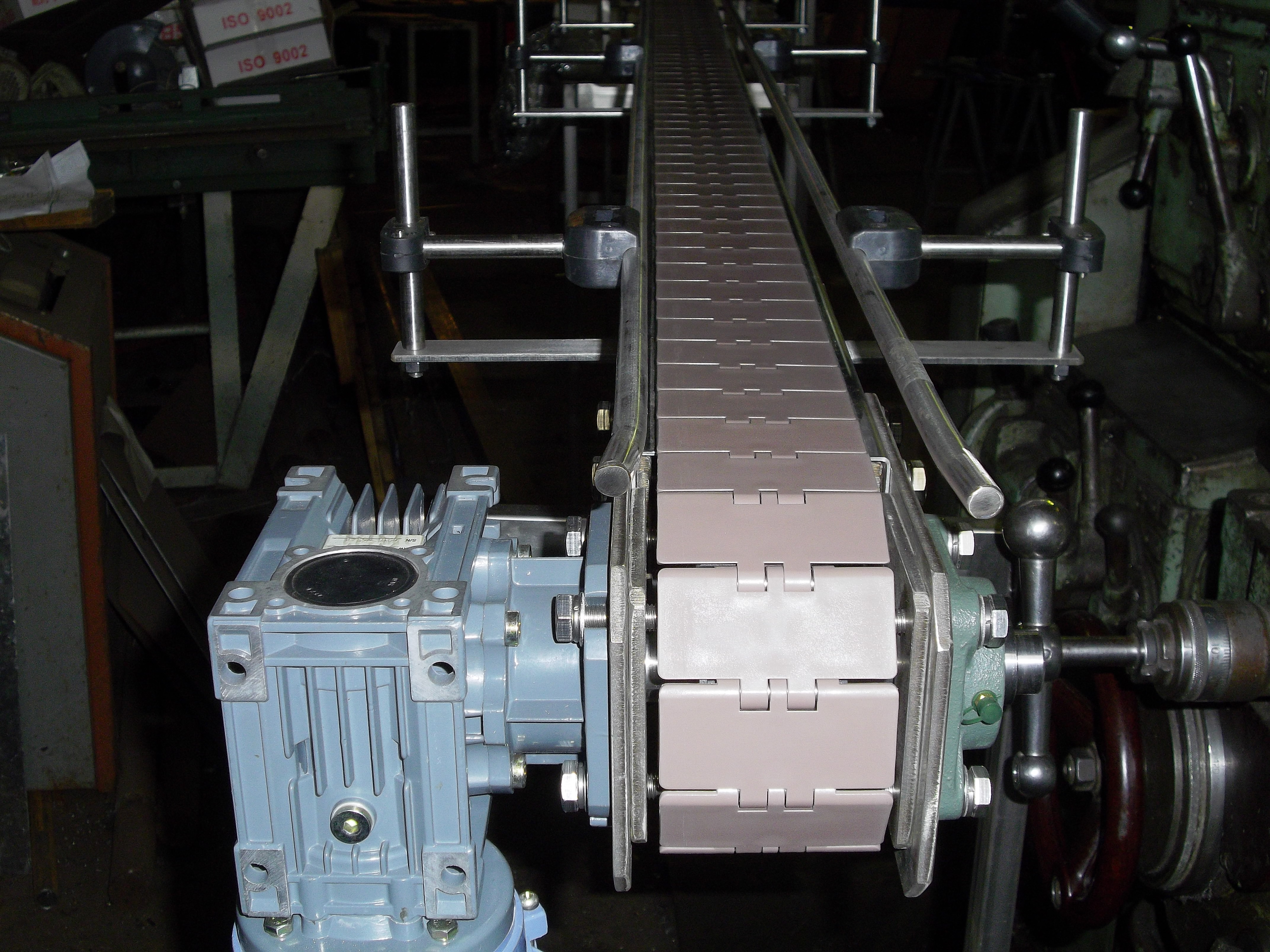
We designed an 11-metre slat conveyor with a steel deck. The frame — a reinforced profile on adjustable supports, the drive unit moved above the water-drainage zone and enclosed in an IP66 cover. The drum bearings received double labyrinth seals. The deck was inclined by 3° towards the drainage tray so water ran off by gravity.
The result after three months of operation: manual carrying of blanks was eliminated entirely, the section tempo grew by about a quarter, the injury-prone operation was removed. In the first year there was not a single unplanned stoppage due to unit wear — the closed bearings withstood the abrasive environment.
The customer separately noted a drop in injuries. Carrying heavy slabs by hand is a constant risk: pinching, back strain, a slab falling. The conveyor removed this operation entirely, and that is no less valuable a result than the tempo gain. In stone processing, staff safety is part of the production economics.
Engineer’s tip. In stone processing the main enemy is not blank weight but abrasive dust in the bearings. Saving on bearing-unit seals turns into a drum replacement within six months. Always design in labyrinth or double seals — it is the cheapest insurance of service life.
Why a standard solution does not fit
The temptation to install an ordinary belt conveyor is understandable — it is cheaper. But a thin belt wears through on the sharp edges of slabs, open bearings pack with dust, a light frame flexes under slab weight. Within six months such a conveyor costs more than the correct one — this is a clear illustration of the total cost of ownership logic. Stone processing requires solutions of the same class as slat conveyors for heavy loads.
Maintaining a conveyor in an abrasive environment
Even a correctly designed conveyor in stone processing needs disciplined care — otherwise abrasive will still find its way inside. On our sites the schedule is simple but must be followed without omissions:
- Shift washdown — after the shift the route and drainage trays are washed with water before the stone paste has hardened.
- Seal checks — once a month we check the condition of the labyrinth seals; sludge packed beneath them is removed and the unit re-lubricated.
- Tension check — abrasive accelerates belt wear, so tension is checked more often than on a food line.
- Deck inspection — cracks and burrs on the plates are detected before they start tearing the product or injuring staff.
Such care extends the service life of the units and removes the main hidden cost item of a stone-processing workshop — unplanned drum replacements.
Conclusion
A conveyor for a stone-processing facility is a reinforced frame, protected bearings, thought-out water drainage and a belt or deck resistant to abrasion. A standard food solution does not work here: the environment is too harsh. Planning to mechanise stone transport in a workshop? Get in touch — we will design a conveyor for your blank and layout.