Conveyors in the mining industry
The specifics of conveyors for the mining industry: high-strength belts, heavy frames, special bearings and protection against abrasive wear.
A mining conveyor works in the harshest conditions of all transport systems. The load is heavy and abrasive, flows are measured in hundreds of tonnes per hour, and a stop for repair costs more than the breakdown itself. In this article we break down how mining conveyors differ from food ones and what solutions this industry demands.
Three challenges of a mining conveyor
Mining transport sets three tasks atypical for food lines. Flow mass: rock and ore are counted in tonnes, not kilograms per metre — the running weight of the flow on a wide belt easily exceeds 150–200 kg/m. Abrasiveness: sharp fragments of quartzite, granite or ore wear the belt, drums and transfer chutes; the abrasiveness coefficient of such materials is tens of times higher than that of a food product. Impact load: at the loading point a lump of rock several dozen centimetres across falls onto the belt from a height of 1–2 m, and every impact is a test for puncture and carcass crushing.
A miscalculation of any of these factors means not a minor repair but the replacement of an expensive component and a long downtime. On a powerful line a day of downtime costs more than the annual budget for preventive maintenance, so decisions here are subordinated to predictability.
A high-strength belt
The heart of a mining conveyor is a belt designed for impact and abrasive load. Unlike a thin food belt 2–3 mm thick, multi-ply EP belts with a polyester-polyamide carcass or ST steel-cord belts with a tensile strength from 630 to 2500 N/mm and higher are used here. The working-side cover is 6–12 mm thick versus 0.8–2 mm on food belts.
Key requirements for a mining belt:
- High carcass tensile strength — under the weight of a multi-tonne flow and the start-up tension;
- A thick wear-resistant working-side cover of grade Y, W or X — a reserve against abrasive wear;
- Resistance to puncture and longitudinal cut by sharp rock fragments;
- An elongation margin — so the tensioning device compensates for carcass stretch over the whole service life;
- For underground workings — a self-extinguishing, antistatic design to a flame-resistance standard.
We select the working belt so that the working tension does not exceed 10–20% of the rated carcass strength: this margin absorbs start-up and braking peaks.
Heavy frames and reinforced components
A mining conveyor carries a load an order of magnitude greater than a food one. So frames are made of large-section steel (profile 4–8 mm thick versus 1.5–2 mm on food conveyors), idler rollers are placed at a 0.8–1.2 m pitch instead of 1.5–2 m, and at the loading zone impact idlers with rubber rings or cushioning bars are fitted — they absorb the impact of falling rock and protect the belt from point puncture. The chute is made three-roll troughed, with a 30–45° central angle, so the flow takes a stable profile and does not shift towards the edge.
Engineer’s tip. The greatest wear of a mining conveyor is concentrated at transfer points. We always design chutes so rock moves from conveyor to conveyor in the direction of travel and with minimum drop height. A correct chute extends belt life several times over — the cheapest way to save on a mining line.
Technical parameters of mining conveyors
| Parameter | Value |
|---|---|
| Belt type | steel-cord or multi-ply |
| Throughput | up to 1000 t/h and higher |
| Belt width | 800–1600 mm |
| Incline angle | up to 18° (more — with sidewall) |
| Frame material | high-strength steel |
| Belt speed | 1.5–4.0 m/s |
| Carcass strength | 630–2500 N/mm and higher |
| Cover thickness | 6–12 mm (working side) |
| Idler pitch | 0.8–1.2 m |
| Operating temperature | -40…+60 °C |
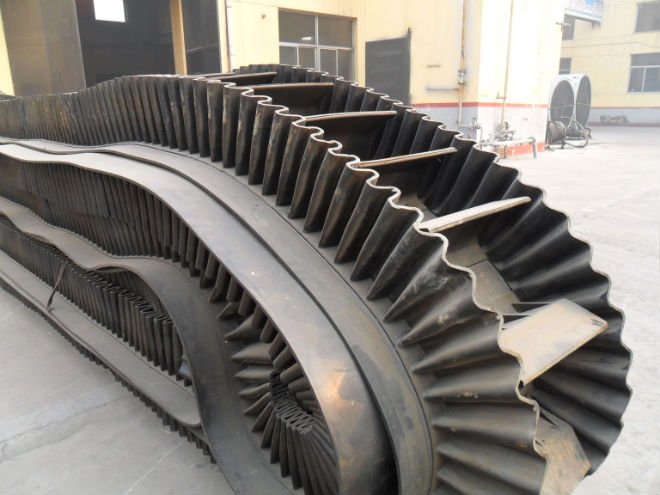
For steep incline sections sidewall belts are used — they allow rock to be lifted at an angle unattainable for an ordinary flat belt.
A conveyor for steep inclines
An ordinary flat belt will not hold a load at an angle above 18–20°: on a steeper slope rock starts rolling back faster than the belt carries it. When the route requires a 25–60° lift, we switch to a belt with a corrugated sidewall and transverse cleats. The sidewall holds the flow inside a “trough”, and cleats 60–160 mm high form isolated pockets from which rock does not spill out even on a steep incline or vertical section.
Such a conveyor saves floor space and eliminates intermediate transfer: one curved module replaces two or three inclined sections. At the discharge zone we fit a belt beater, since fine abrasive material sticks to the sidewall and reduces the height of the useful pocket.
Drive and start-up under load
The drive of a mining conveyor is calculated with a separate check of the starting torque: under full load on a long route the static tension at the moment of start-up is 1.5–2 times higher than the working tension. So on powerful lines we use a soft start through a fluid coupling or a variable-frequency drive — this removes the shock tension from the belt and the splice, extends the gearbox service life and rules out slip on the drive drum. On downhill sections, where the conveyor works in a generator mode, we add a backstop against reverse run.
Bearings and maintenance
Mining dust is abrasive and pervasive. An ordinary bearing does not last long in such conditions: dust gets under the seal, mixes with grease and works like sandpaper — its service life drops 3–5 times below the rated figure.
So in mining conveyors we fit bearings in a reinforced dust-protected version with labyrinth seals. We pay special attention to component accessibility for maintenance: on a powerful line a bearing replacement should take hours, not a shift. Belt cleaning scrapers are fitted in two cascades — a primary one on the drive drum and a secondary one behind it, because rock stuck to the return run gets between the belt and the drum. The approach to maintaining heavy systems is described in materials tagged conveyor.
Conclusion
A conveyor for the mining industry is a system designed for flow mass, abrasive wear and impact load. The key decisions: a steel-cord belt with a thick cover, heavy frames, impact idlers at the loading zone and dust-protected bearings. Planning a transport system for an extraction or processing operation? Get in touch — we will calculate a conveyor for your load and throughput.