
Chips production line from A to Z
Calibration, slicing, blanching, frying, flavouring, packaging — the full layout of a potato chips production line.
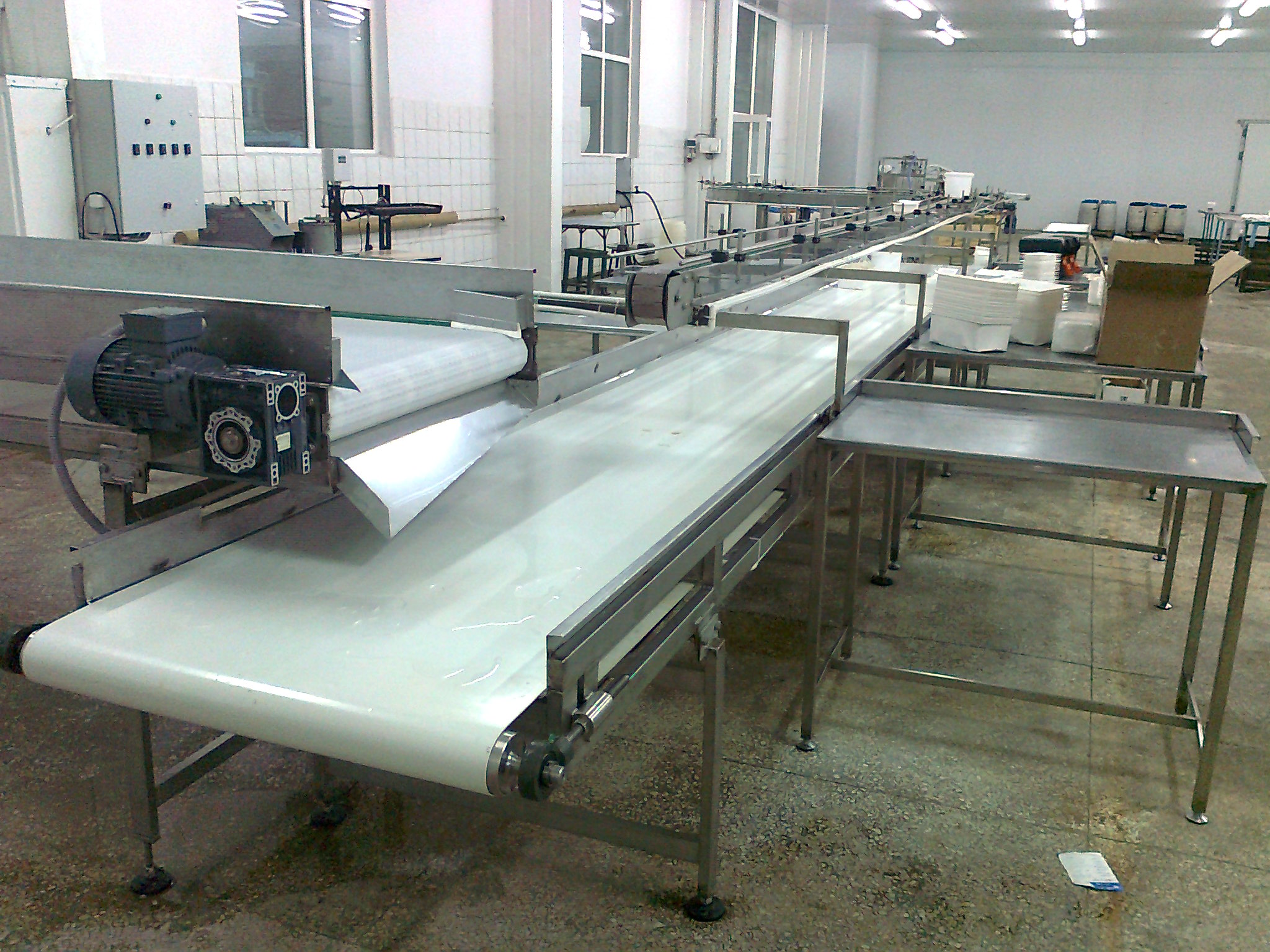
A chips production line is a sequence of precisely coordinated operations, where each stage affects the taste and crispness of the final product. From tuber calibration to packaging takes just a few minutes. In this article we look at the full line layout and the conveyor solutions that tie it into a single flow.
Where the line begins
The first stage is raw material intake and calibration. Potatoes are sorted by size: too small gives a lot of waste during peeling, too large gives an uneven slice. Calibrated tubers go to washing and peeling, where the skin is removed abrasively or by steam.
Then the potatoes move on conveyors and transporters to inspection — operators remove defective raw material. This section determines the quality of the whole flow: one spoiled tuber ruins the reject statistics.
A separate point is the potato variety. Not all varieties suit chips, only those with a low content of reducing sugars and a high content of dry matter. A sugary tuber darkens unevenly when fried and gives burnt spots. So raw material is checked not only for mechanical defects but also for technological suitability.
Slicing and slice preparation
Slicing is the most critical mechanical operation. A centrifugal slicer cuts the tuber into slices of a set thickness. For classic chips this is 1.2–1.8 mm, for ridged ones a profile blade is used. Slice thickness directly affects frying time and crispness.
After slicing, the slice is washed of starch that has come out on the cut. Unremoved starch sticks the slices together during frying and gives dark spots. The washed slice is blanched in hot water — this evens out the colour and reduces the content of reducing sugars.
Blanching performs several tasks at once. Besides evening out the colour, it inactivates the enzymes that cause browning and partly prepares the slice structure for frying. The blanching temperature and time are selected for the specific variety and slice thickness: an over-blanched potato becomes limp, an under-blanched one gives an uneven colour of the finished product.
Frying and de-oiling
| Stage | Parameter | Typical value |
|---|---|---|
| Slicing | slice thickness | 1.2–1.8 mm |
| Blanching | temperature / time | 65–75 °C / 1–3 min |
| Drying before frying | inlet moisture | up to 80% |
| Frying | oil temperature | 165–185 °C |
| Frying | time in fryer | 2–4 min |
| De-oiling | oil residue | up to 33–35% of mass |
Frying takes place in a continuous fryer: the slice is immersed in oil and moves on a conveyor under the surface. At the outlet the moisture drops to 1.5–2%, and the slice becomes crisp. After frying, excess oil is removed on a vibrating sieve and by air blowing.
Oil temperature is a critical parameter. Too low gives a greasy, undercooked product, too high gives burning and bitterness. So the fryer is equipped with precise zone temperature control, and fresh oil is constantly topped up to compensate for the carry-out with the product. Oil quality is monitored by the content of polar compounds — this determines both the taste and the shelf life of the chips.
Engineer’s tip. The most common mistake on a chips line is uncoordinated conveyor speed before and after the fryer. If the infeed conveyor is faster than the outfeed one, slices accumulate in the fryer and overcook. We always fit frequency converters on both drives and synchronise them through a common controller.
Flavouring and packaging
After cooling, the chips go to flavouring. Spices are applied in a rotating drum: the product tumbles while a dispenser feeds the dry seasoning evenly. The accuracy of spice dosing affects both taste and cost.
The final stage is packaging. Chips are fragile, so the path from the flavourer to the packaging machine is made as short and gentle as possible. A rotary table or a multihead weigher is used for accumulation before filling. The finished pack passes weight control and a metal detector.
A typical list of line sections:
- Intake, calibration, washing, peeling.
- Raw material inspection.
- Slicing, washing, blanching.
- Drying and frying.
- De-oiling and cooling.
- Flavouring.
- Weighing, packaging, control.
Coordinating section throughput
A chips line is fussy about speed balance. Each section has its own throughput, and the engineer’s task is to coordinate them so the product flows evenly. A slicer that cuts faster than the fryer can fry creates a jam before the fryer; a slow slicer leaves the fryer half-empty and worsens the economics.
So when designing we start from the “narrow” section — most often the fryer — and select the throughput of all other units around it with a small margin. The conveyors between sections are equipped with frequency converters to finely adjust the tempo during commissioning. Transfer points are monitored separately: a fragile slice breaks exactly where the product moves from one conveyor to another.
Conclusion
A chips production line is a continuous flow, where slice thickness, oil temperature and the coordination of conveyor speeds determine product quality. Each stage requires a separate calculation, but they work only as a single system. If you are planning a potato or snack processing line, get in touch — we will design it for your throughput and recipe. More on processing lines — in articles tagged production-line.
