Conveyors in cosmetics manufacturing
How conveyors for cosmetics manufacturing are designed: hygiene, stainless steel, flexible lines for various bottle shapes and fast changeover.
Cosmetics manufacturing combines two conflicting demands: food-grade hygiene and flexibility for a constantly changing range. One workshop fills cream into jars, lotion into bottles and decorative cosmetics into small containers. The conveyor system must accept all of it without a lengthy rebuild. In this article we break down how we design such lines.
Why cosmetics is a hybrid production
In cleanliness requirements cosmetics manufacturing is close to food: the product contacts the skin, so equipment contact surfaces are made of AISI 304 stainless steel, and in zones contacting aggressive emulsions or alcohol-based solutions — AISI 316. The structure is built on hygienic principles: no dead cavities, rounded internal corners. But in working logic a cosmetics workshop is closer to a packaging one — the container changes constantly here.
Hence the main challenge: the line must be hygienic and flexible at once. A conveyor rigidly set up for one bottle does not work — a cosmetics brand’s range is renewed several times a year, and one line can handle three or four different container formats per shift.
Handling different containers
Cosmetics bottles have a geometry difficult for a conveyor: a narrow base of 25–50 mm, a high centre of gravity, a slippery glossy or matte surface. The height-to-width ratio of a tube or lotion bottle often exceeds 3:1, so such a container tips over easily on acceleration, curves and section joints. An empty bottle before filling is especially unstable — even a side air flow shifts it.
Solutions we use for stable handling:
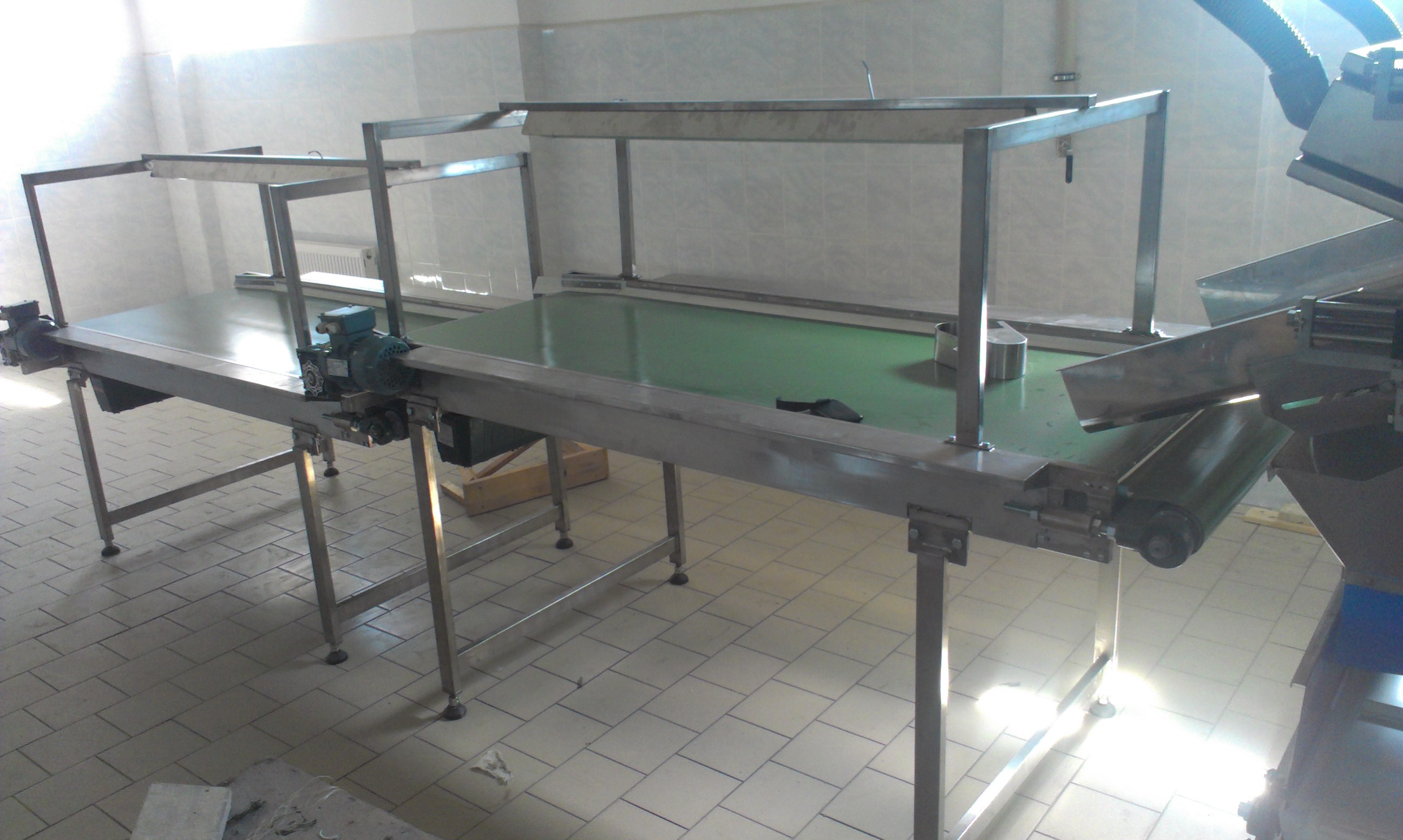
- Adjustable side guides of stainless rod or UHMW polymer — quickly reset for a new container width;
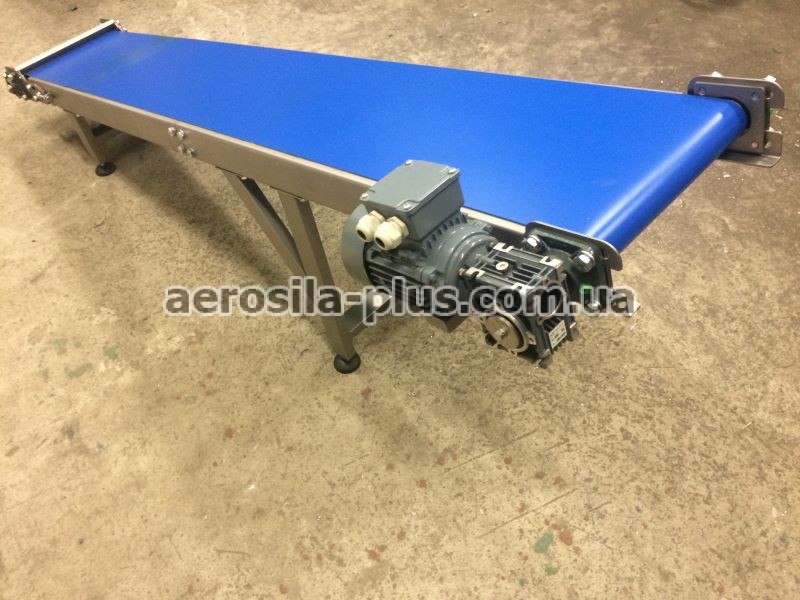
- Modular belt with a low friction centre — the bottle slides along the guides without tipping;
- Smooth start and braking via a frequency converter with a 1–3 s acceleration ramp — no jerks that knock containers over;
- Accumulation zones before packaging — smooth out the difference in machine tacts;
- Transfer plates at section joints with a gap up to 3 mm — so a small container base does not get stuck.
We keep the conveyor speed in the 0.1–0.4 m/s range: above it tipping starts on curves, below it the line cannot keep up with the filling machine.
Flexibility and fast changeover
The value of a cosmetics line is the speed of switching between products. If a changeover to a new bottle takes half a shift, the line loses throughput on small batches — and small batches are the basis of the modern cosmetics market.
So we design units with tool-free changeover: guides move along a scale with a vernier, heights adjust with locking handwheels, replaceable elements fit without a wrench on quick-release latches. On lines with frequent range changes we add servo drives for guide positioning with a recipe memory: the operator selects a format on the panel and the guides move to the stored position themselves — changeover is cut to 1–2 minutes.
Engineer’s tip. Fix the guide positions for each container format with marks or stops. The most time in a changeover is taken not by the reset itself but by finding the position “by eye”. With marks the operator sets the line precisely and identically every time.
Technical parameters of a cosmetics line
| Parameter | Value |
|---|---|
| Contact frame material | AISI 304 stainless steel |
| Mat type | modular plastic belt |
| Conveyor speed | 0.1–0.4 m/s |
| Container width range | 25–120 mm |
| Guide adjustment | tool-free, by scale |
| Drive protection class | IP65 |
| Modular belt curve radius | from 1.6× mat width |
| Start-up acceleration | 1–3 s ramp |
| New format switch time | 5–15 min (1–2 min with servo) |
For flexible sections with curves a modular belt is convenient — it passes radius curves as a continuous mat, without transfer between conveyors, where small containers are especially unstable.
Flow accumulation and buffering
A cosmetics line is a chain of machines with different tacts: filler, capper, labeller, packer. If they are linked rigidly, a stop of one machine instantly stops the whole line. So between uneven sections we fit accumulation conveyors.
The accumulator works as a buffer: when the next machine stops, containers are held on it without falling or pressing against each other. We size the buffer volume so that a short 20–40 second stop of the labeller does not reach the filler. This smooths the line and raises real throughput by 10–15% over a rigid link.
Hygiene on a cosmetics line
Cosmetics workshops are sanitised regularly, and the products themselves can be greasy and sticky. The conveyor must wash easily: a modular belt disassembles into sections without tools, frames have no stagnant zones, the drive is in a moisture-protected version.
We design cosmetics lines on the same hygienic principles as food production lines: gravity drainage, no dead cavities, cleaning access to every surface. The drive is made in an IP65 protection class so the conveyor withstands wash-down with a jet. For decorative cosmetics lines with pigments we separately provide quick guide disassembly — coloured dust from a previous batch must not get into the next one.
Container protection and labelling
Cosmetics packaging is expensive, and its appearance is part of the product. A scratch on a bottle or a crumpled label sends the item to scrap just as a production defect would. So we select contact surface materials not only for hygiene but for gentleness: UHMW polymer guides leave no scuffs on gloss, and a modular belt with a smooth surface does not scratch the base.
A separate requirement is flow stability before the labeller. The bottle must reach the working position without rotation or skew, otherwise the label sits crooked. Before these units we fit short sections with pressing guides that orient the container.
Conclusion
A conveyor for cosmetics manufacturing is a hybrid: food-grade hygiene plus the flexibility of a packaging line. The key decisions are adjustable guides, a modular belt, a smooth start and fast tool-free changeover. Planning a cosmetics filling or packaging line? Get in touch — we will design a flexible conveyor system for your container range.