Container tipper: types and applications
Hydraulic and electromechanical container tippers: which to choose, tipping angles, operation safety and integration into the line.
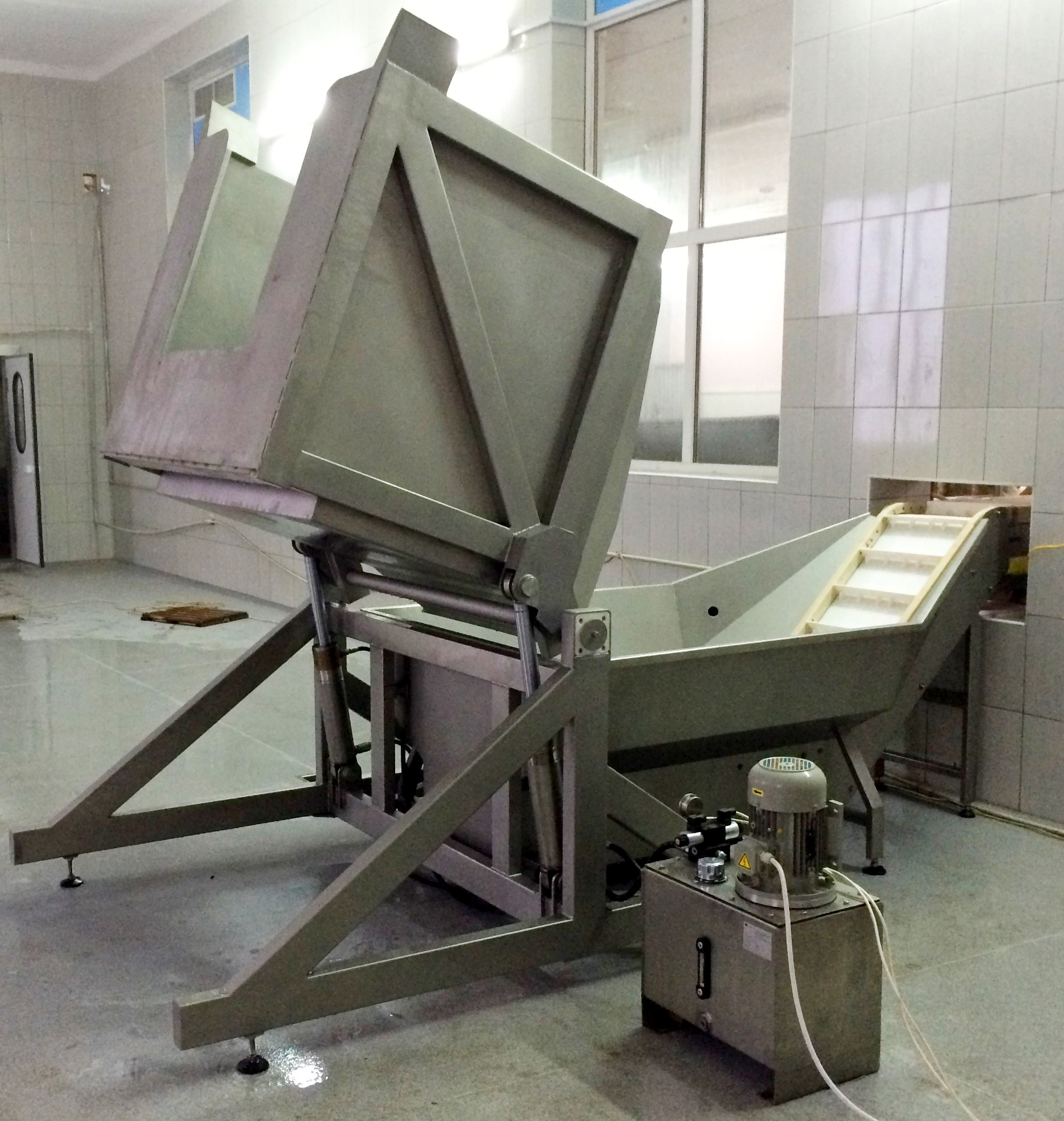
A container tipper unloads packaging — a crate, box or container — by lifting and tilting it so the product pours into a receiving bunker or onto a conveyor. This equipment removes a heavy manual operation at the line inlet and sets an even raw-material feed rate. In this article we look at tipper types, their tasks and safety requirements.
Why a tipper is needed
At the inlet of almost any food line there is the same task: emptying raw material from packaging into a receiving bunker. Done by hand it means an operator lifts a 15–25 kg crate to bunker height dozens of times a shift. That is injury-prone, slow and uneven.
A tipper does this mechanically: the packaging is secured on a platform, the platform rises and tilts, the product pours out. The operator only places and removes the packaging. The feed rate becomes steady and the load on staff’s backs disappears.
The economic effect here is not only about occupational hygiene. Manual bunker loading means an uneven flow: the operator empties several crates in a row, then pauses. A line behind such an inlet works in jerks, and the units endure variable loading. A tipper integrated into the control system feeds raw material evenly, at the tempo the line sets — and this directly affects finished-product quality and equipment life.
Types of tippers
Tippers differ by drive and by how the packaging is presented:
- Hydraulic — smooth motion, high force, suited to heavy containers from 200 kg. They run quietly and hold intermediate positions well.
- Electromechanical — driven via a gear motor and chain or screw; simpler to service, cheaper, optimal for packaging up to 150 kg.
- Floor-level — packaging is rolled onto the platform by trolley or pallet jack.
- Column type — packaging is gripped by forks and raised along a vertical column, giving a greater discharge height.
The choice depends on packaging weight, the required discharge height and cycle intensity.
Selection parameters
A tipper is selected across four parameter groups. Below are the typical operating ranges of our equipment.
| Parameter | Hydraulic | Electromechanical |
|---|---|---|
| Load capacity | 200–1000 kg | 50–150 kg |
| Tipping angle | 95–135° | 90–120° |
| Discharge height | up to 1800 mm | up to 1400 mm |
| Cycle time | 25–40 s | 15–30 s |
Engineer’s tip. A tipping angle above 120° is needed only for viscous and sticky products that do not pour out by themselves. For free-flowing seeds or whole vegetables 95–100° is enough — it is faster and reduces the risk of product hitting the bunker wall.
Operation safety
A tipper lifts a significant mass, so safety is built into the design. The mandatory minimum: a guard around the platform travel zone, limit switches for the end positions, an emergency stop button in the operator zone, and a holding valve in the hydraulic system that prevents the platform falling on pressure loss. The packaging is secured with clamps so it does not slide off during the tilt.
For food lines the platform and contact surfaces are made of AISI 304 stainless steel. The tipper integrates well with feeder conveyors and bunkers: product pours from the packaging into a receiving bunker and from there is fed in dosed amounts to the line. This is a typical combination for the inlet of a vegetable processing line.
Spill-free tippers for liquid products
A separate class is the spill-free tipper. If the packaging holds product in brine, marinade or water, an ordinary tipper will spill the liquid onto the floor along with the product. The spill-free design solves this geometrically: the packaging is tipped not over an open bunker but into a special receiving tray with walls and drainage. The liquid is led away through a separate channel while the product goes to the line. This is critical for pickling, marinating and brine-vegetable processing lines, where loss of brine means both a dirty floor and underfilling at the packing stage.
Cycle and throughput
The time of one tipper cycle directly determines how much packaging it handles per shift. The cycle consists of four phases: placing the packaging, securing it, tipping with discharge, returning to the starting position. On a continuous line the tipper must not be the bottleneck, so the cycle time is coordinated with the throughput of the next segment.
If a single tipper is not enough, two options are used: a tipper with a buffer packaging accumulator or a carousel arrangement with several platforms. For high-throughput lines the tipper is integrated into the line control system — it starts automatically on a signal from a level sensor in the receiving bunker, maintaining an even raw-material flow without operator involvement.
Conclusion
A container tipper is not a luxury but a way to make the line inlet safe and rhythmic. Hydraulics are chosen for heavy packaging and smoothness, electromechanics for light packaging and simple service. Need a tipper for your packaging and product? Get in touch — we’ll select the type and calculate the integration. More on inlet equipment under the tag equipment.