Case: automating a bakery workshop
A real project: how we added conveyors and a rotary table to a manual bakery and raised throughput without expanding the workshop.
A mid-sized bakery came to us with a typical problem: the workshop had outgrown its manual organization, but there was no room to expand. In this case study we describe how we automated the key sections with conveyors and a rotary table, raised throughput and reduced the load on staff — without a single square metre of new floor space.
The starting situation
The workshop baked bread and rolls with a daily output of about 6 tonnes and ran three shifts. Finished product from the oven was manually moved by staff onto carts, taken to the cooling zone, then again manually fed to packing. Every transfer is time, staff fatigue and a product damage risk. On the section from oven to packing the product was handled four times on average, and every touch of the hot crust left marks and crumbs.
The main problems we recorded during the survey:
- the section from oven to packing entirely on manual labour;
- uneven product flow, jams before the packer;
- a high scrap rate from product falling and deformation;
- staff overloaded with monotonous operations.
The project task
The customer stated the task clearly: remove manual transfers between oven and packing, smooth the flow unevenness and do it within the existing workshop. Room expansion was not considered — we had to fit the existing geometry with its columns and aisles. An additional condition — the equipment had to withstand daily wet washing and contact food product per EU 1935/2004 requirements. The customer tied the project budget to payback: the solution had to return the investment through output growth and freed staff in no more than two years.
Engineer’s tip. When automating an operating workshop, never start with buying equipment. First — a room survey and a time study of the real flow. On this project it was exactly the time study that showed the bottleneck was not the oven but the manual transfer before packing.
The proposed solution
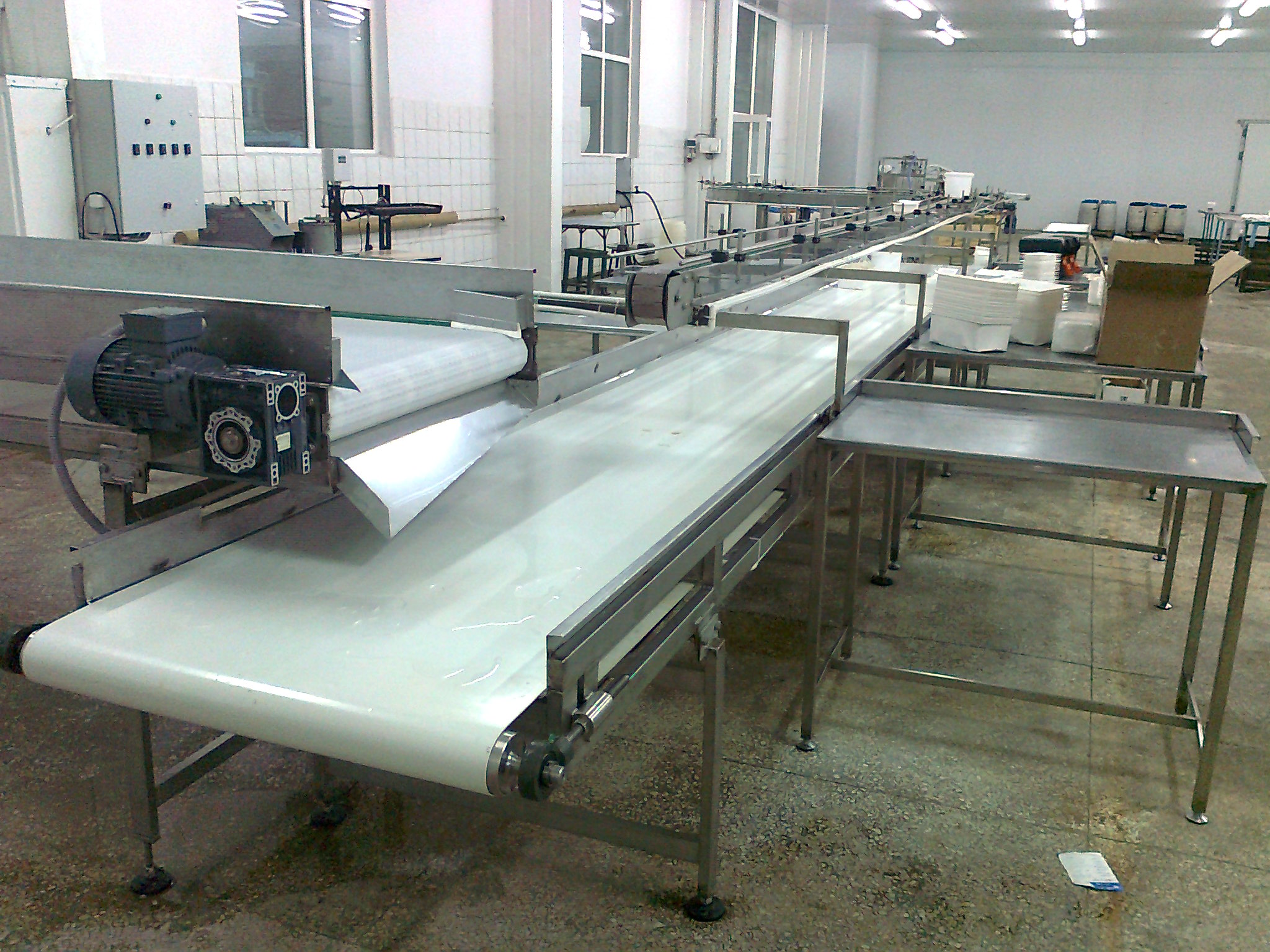
We designed a transport scheme that joined the oven, the cooling zone and packing into a continuous flow. Key elements of the solution:
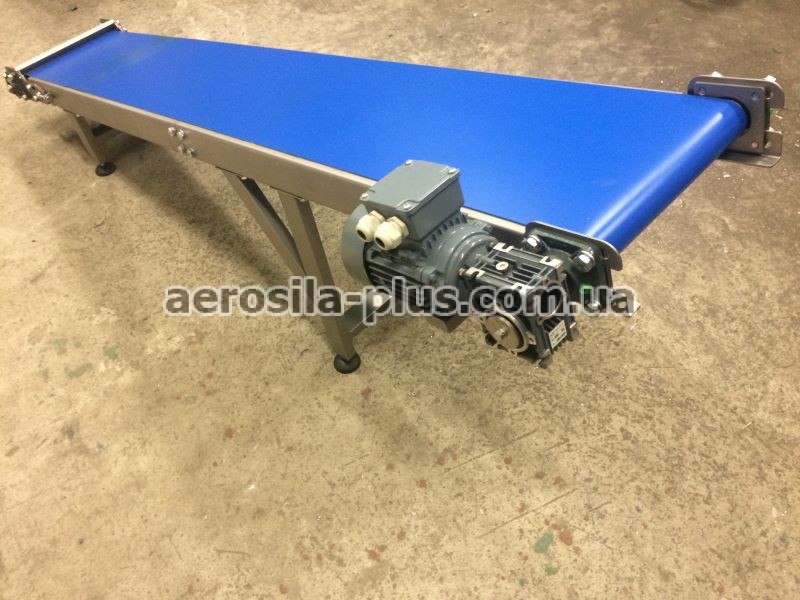
- a discharge conveyor from the oven — receives the hot product and feeds it to cooling;
- a multi-level cooling conveyor — folded into the vertical to save floor space;
- a rotary table before packing — accumulates product and smooths the tempo difference;
- a feeder conveyor to the packing machine.
The rotary table became the key element: it took on the role of a buffer, so short packer pauses no longer stopped the whole line. We sized the buffer from the real time study: the packer stopped on average for 20–40 seconds every few minutes — for a film-roll change or a minor adjustment. A 1200 mm table at the workshop’s output speed holds exactly that reserve of product, so the discharge conveyor and cooling conveyor run continuously without “running into” the packer.
We coordinated the section speeds so the product flows evenly: the discharge conveyor runs slightly faster than the oven exit, the cooling conveyor at the holding tempo, and the feeder conveyor is synchronised with the packing machine’s intake window. All drives received frequency converters, which gave a soft start and the ability to tune the line tempo for different product types.
Technical parameters of the installed equipment
| Unit | Parameter | Value |
|---|---|---|
| Discharge conveyor | length / belt | 4.5 m / heat-resistant |
| Cooling conveyor | tiers / holding time | 4 / 12 min |
| Rotary table | diameter / drive | 1200 mm / speed-adjustable |
| Feeder conveyor | belt width | 600 mm |
| Contact surface material | — | AISI 304 stainless steel |
| Drives | type / protection | gear motor with frequency converter / IP65 |
| Floor space taken | additional | 0 m² (within the workshop) |
Hygiene and servicing of the new line
Bread dust, crumbs and grease marks are constant companions of a bakery, so we designed the line for daily washing from the start. All contact surfaces are AISI 304 stainless steel, the frame has no blind pockets where crumbs could accumulate. The cooling conveyor got pull-out tier segments: an operator opens access to each level in a few minutes without tools. The belts are chosen for dry brush cleaning and periodic wet washing.
The drives are placed outside the wet zones and rated IP65 to withstand hose washing. Separately we trained the customer’s mechanics in a simple maintenance routine: a per-shift sweep-down, a weekly belt-tension check, a monthly inspection of bearing units. Such a routine keeps the line operational without unplanned stops.
The course of work
We carried out the installation in stages so as not to stop production for long. First we installed and commissioned the discharge conveyor and cooling conveyor over a weekend. The next stage — the rotary table and feeder conveyor. Each stage ended with commissioning and operator training. Full implementation took about three weeks, of which the actual workshop stop was only two weekends.
The results
After launching the upgraded line the customer got concrete figures. Manual transfers between oven and packing were fully removed — the product is no longer handled even once from oven to packing machine. Section throughput rose by about a quarter through eliminating jams before the packer. The scrap rate from falls and deformation dropped several times over — crumbs and crust chips practically disappeared. Two workers previously busy with transfers moved to quality control — a higher-value operation.
By the customer’s calculations, the combined effect of output growth and two freed workers brought the project to payback in about a year and a half — within the planned horizon. This is a typical picture for transport automation: it pays back not by “magic” but by simple arithmetic of removed losses.
A separate effect is tempo stability: the line now runs evenly, without jerks, which simplified shift planning. For more on the line-upgrade approach, see the article on modernizing an existing line and the articles tagged automation.
Conclusion
This case shows: a workshop can be automated without expanding floor space. A well-designed transport scheme with a discharge conveyor, multi-level cooling and a rotary-table buffer removes manual labour, smooths the flow and raises throughput. Have a bakery or food workshop running manually? Get in touch — we’ll run a survey and propose an automation scheme for your room.