Case: seaweed processing line modernization
How we modernized a working seaweed processing line: bottlenecks, unit replacement, +30% throughput without replacing the whole line.
Not every throughput gain requires a new line. In this case we tell how we modernized a working seaweed processing line and raised its output by about 30%, replacing only three units instead of all the equipment.
The starting situation
A company that processes seaweed — salting, cutting, packing — came to us. The line had run for several years and was physically sound, but no longer kept up with demand. The customer was considering buying a new line, but the budget of such a solution was significant.
We proposed a different path — first find the bottleneck. Often it is not the whole line that holds it back but one or two sections, and modernizing exactly those gives a result at a fraction of the cost of a new line.
The logic is simple: a line’s throughput equals the throughput of its slowest section. The rest of the equipment runs below capacity, adjusting to the weakest link. That is why there is no point replacing the whole line — it is enough to “unblock” one or two braking points, and the potential of the rest of the equipment reveals itself.
Bottleneck diagnostics
Seaweed is a difficult product to transport: slippery, wet, prone to tangling. We surveyed the line and timed each section. The result showed three braking points:
- The cutting section — uneven product feed, operators levelled the flow by hand.
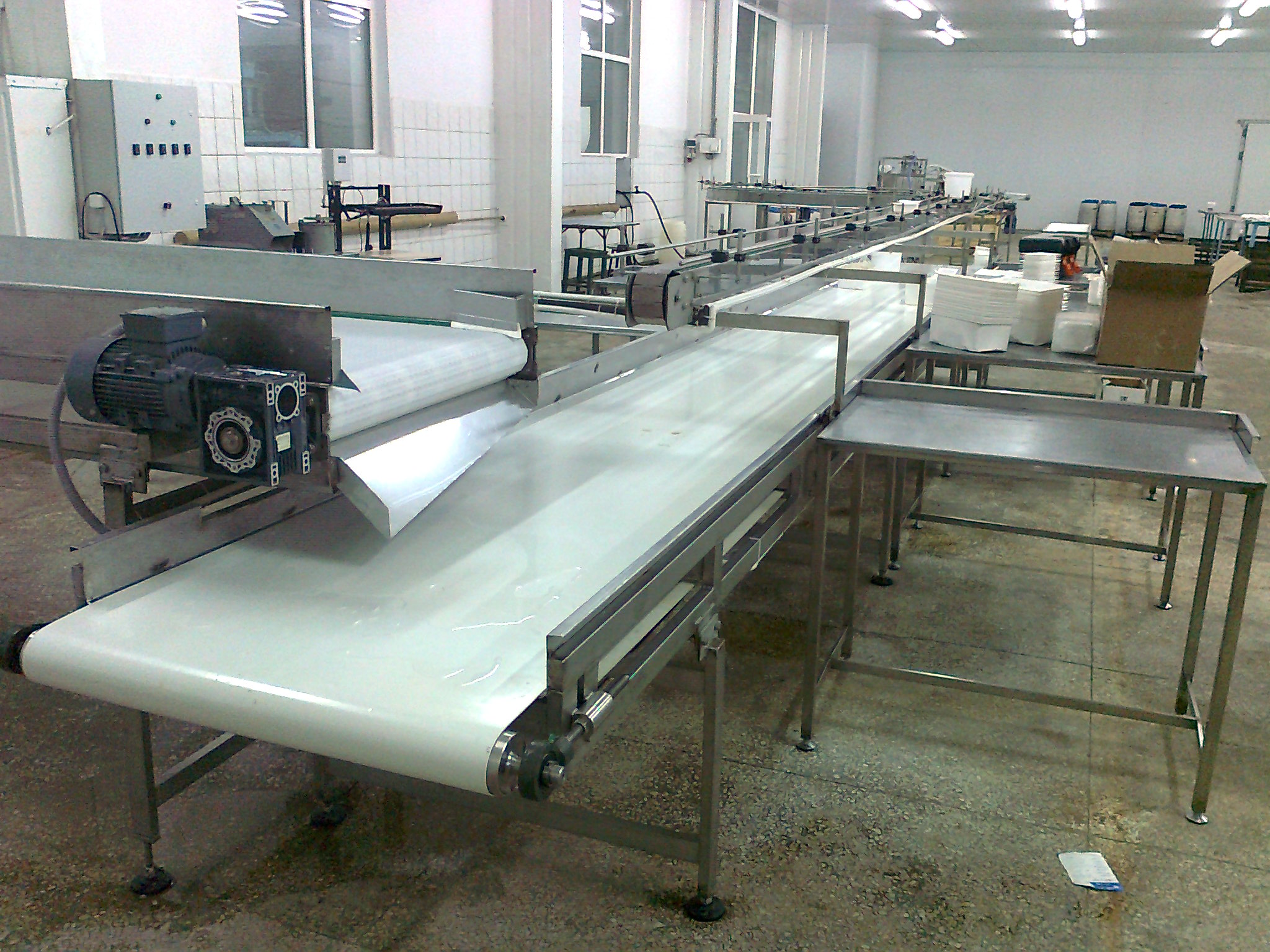
- The conveyor after washing — the old belt had lost its geometry, the product drifted to one side.
- Accumulation before packing — manual transfer slowed the tempo.
The rest of the line — salting, washing — had reserve and did not need modernization.
What we replaced
Based on the diagnostics, the modernization focused on three units:
| Section | Before | After |
|---|---|---|
| Feed to cutting | Manual levelling | Vibrating chute with adjustment |
| Conveyor after washing | Worn belt | Modular belt, new frame |
| Accumulation before packing | Manual transfer | Rotary accumulation table |
| Section speeds | Uncoordinated | Coordinated via frequency converters |
The key decision was coordinating the speeds of adjacent sections via frequency converters. Previously each conveyor ran at its own tempo, so the product either accumulated or the line stood idle.
Engineer’s tip. Before buying a new line, always time the existing one. In nine cases out of ten throughput is limited not by the whole line but by one bottleneck. Modernizing that section costs several times less than a new line and gives a result in weeks, not months.
Engineering nuances for the product specifics
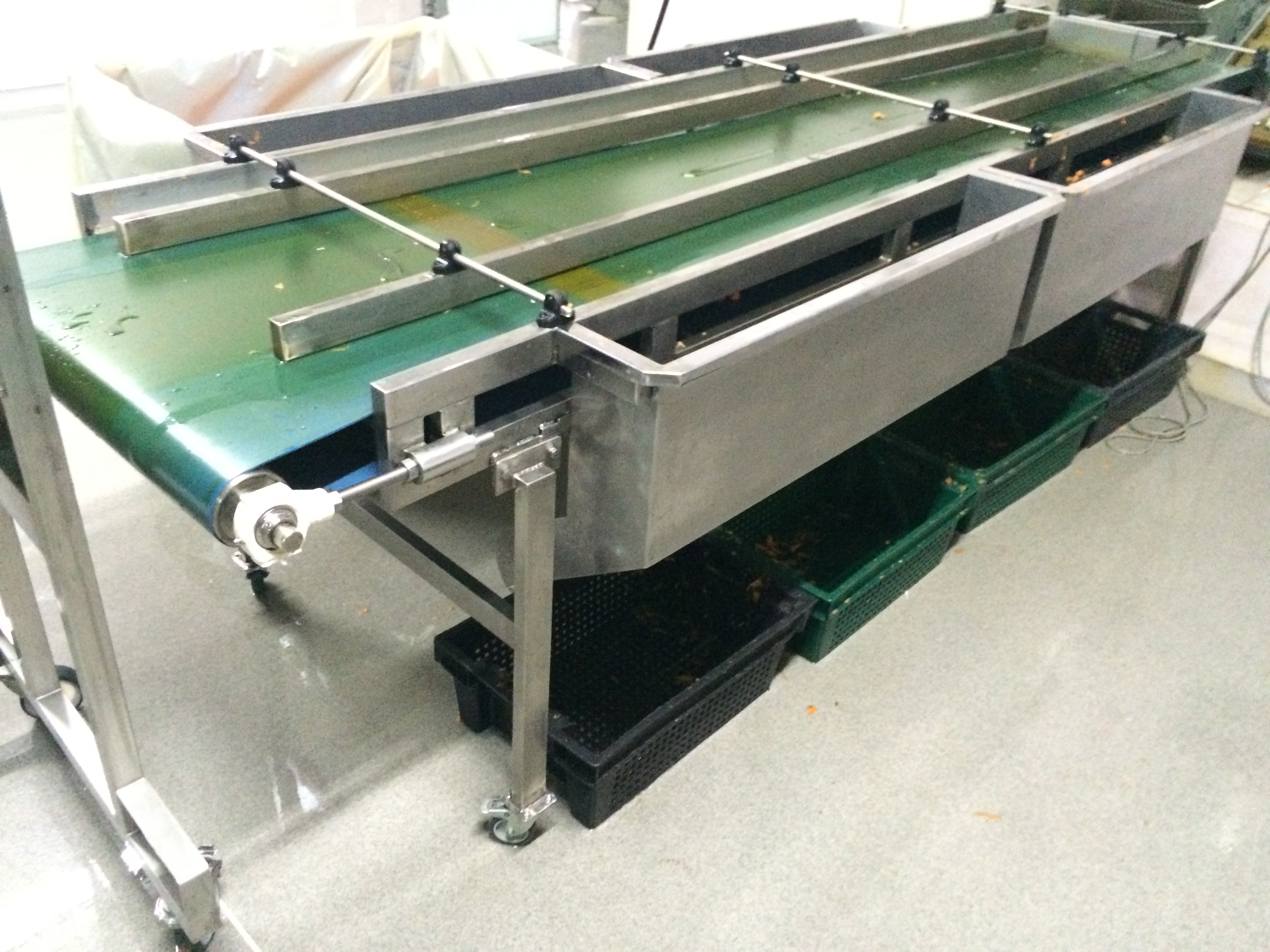
Seaweed is not a neutral load, so the new units were designed with its character in mind. A slippery wet seaweed sheet holds poorly on a smooth belt and slides down inclines, so for the conveyor after washing we chose a perforated modular belt: the holes drain off excess water, while the surface relief retains the product.
Several solutions that closed the product’s problem properties:
- Perforated modular belt — water drains through the belt, the product does not “float” over a wet surface.
- AISI 316 stainless steel on the new section’s units — seaweed carries salt, and grade 316 is more resistant to chloride corrosion than ordinary 304.
- Increased radii and no sharp corners — the slippery fibrous sheet does not catch or tangle at the transfer points.
- Adjustable vibrating chute — the frequency and amplitude of the oscillations are tuned to the moisture of the specific batch, because it noticeably changes the product’s behaviour.
These details are not visible in throughput percentages, but it is precisely they that determine whether the modernization will work stably and not only on the launch day.
The result
After modernization the line reached new figures. Output grew by about 30% — exactly what the three bottlenecks were “eating”. Manual operations on the problem sections were removed: the vibrating chute and accumulation table replaced levelling and transfer by hand. The line tempo stabilised — speeds coordinated via converters removed the jams.
Importantly, the modernization budget was a small share of the cost of a new line, and the retrofit downtime took a few days instead of months. This is a clear illustration of the modernization vs replacement logic.
Another non-obvious plus — the staff did not need retraining “from scratch”. The operators knew their line, and the new units only removed the manual operations that annoyed everyone anyway. Adaptation took a matter of days, with no drop in throughput during the learning period — typical for the launch of a completely new line.
Why modernization worked
Modernization works when the “skeleton” of the line is sound and the problem is localised. In this case the frame, salting and washing were in good condition — there was no point replacing them. Only the units that had exhausted their resource or had been a bottleneck from the start needed replacing. This approach fits the logic of total cost of ownership: money is invested pointwise, where it gives the maximum return.
Conclusion
The modernization of the seaweed line gave +30% throughput at a budget incomparably smaller than a new line. The key to the result is honest bottleneck diagnostics before any spending. If your line cannot keep up with demand, do not rush to buy a new one — get in touch, we will time it and show where the real bottleneck is.