Calibrating a screw: bulk feeding accuracy
How to calibrate a screw feeder on site: the parameters affecting accuracy, the measurement method and common mistakes.
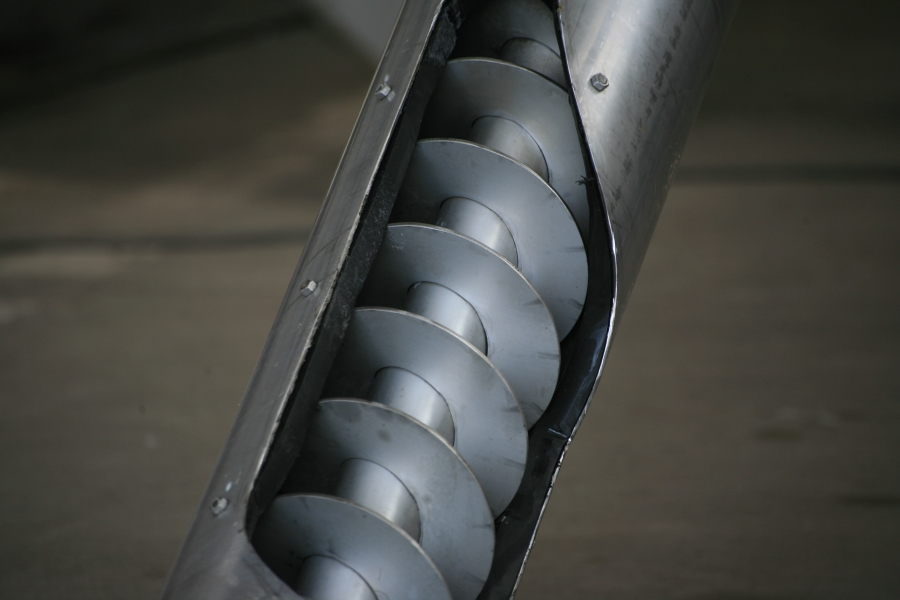
A screw doses a bulk product on the principle “one turn — one portion”, so in theory the feed should be perfectly stable. In practice a dozen factors affect the accuracy, and without calibration on the specific product a screw gives a 5–10% error. The article covers what exactly to calibrate and by what method.
Why a screw needs calibration
The calculated throughput of a screw is the geometric volume of the flight multiplied by the turns. But a real product does not fill the flight 100%: the fill factor for a free-flowing product is 0.3–0.45, and for a heavy or cake-prone one it drops to 0.15–0.25. There is air between particles, the product partly “rolls back”, and the bulk density floats with humidity and fraction — for the same grain it can vary within 10–15% over a season. So the rated figure is only a guideline. The exact “turns ↔ mass” ratio for your product is established only experimentally, and for each rotation frequency separately: at high turns the product does not have time to fill the flight evenly, and the actual feed per turn drops.
What affects feeding accuracy
Several groups of factors affect dosing stability:
- Product properties — bulk density, fraction, humidity, tendency to cake.
- Screw geometry — diameter, flight pitch, the clearance between flight and casing.
- Operating mode — rotation frequency, evenness of filling of the intake zone.
- Equipment condition — flight wear, shaft runout, stability of the motor supply.
The most treacherous factor is humidity: the same product after a rainy season can give a noticeably different mass per turn.
On-site calibration method
We calibrate using a simple repeatable procedure:
- Fill the bunker with the working product, run the screw until filling is stable.
- Set a fixed rotation frequency.
- Run the screw for a set number of turns and collect the whole portion.
- Weigh the portion on verified scales.
- Repeat the measurement 5–7 times, calculate the average and the spread.
- Build the “turns ↔ mass” relationship for several frequency values.
| Parameter | Typical value | Note |
|---|---|---|
| Number of measurements | 5–7 | Fewer is unreliable |
| Permissible spread | ±1–2% | More — look for the cause |
| Frequency points | 3–4 | To build the curve |
| Error after calibration | ±0.5–1.5% | Depends on the product |
| Flight fill factor | 0.15–0.45 | Depends on the product |
| Flight-to-casing clearance | 1–2 mm | More means roll-back |
Engineer’s tip. Calibrate the screw with the same product and the same batch the line will work with. Calibration on “similar” flour or sugar of a different grind gives an error the operator then blames on a “faulty feeder”.
Common mistakes
The first mistake is to calibrate at a low number of turns but operate at a high one: the error is non-linear, because as the turns rise the fill factor drops. The second is to ignore warm-up and initial filling: the first 2–3 portions are always lighter. The third is failing to recalibrate after a change of raw-material batch, although even a change of supplier of the same crop shifts the bulk density. The fourth is a worn flight: when the clearance between flight and casing grows from 1–2 to 5–6 mm, the product “rolls back” and the feed drops by 10–20%. The fifth is an unstable level in the bunker. If the measurement spread exceeds 2%, first look for a mechanical cause, do not twist the settings.
How the bunker level affects stability
The bunker’s influence deserves a separate look — it is the most common hidden cause of dose “drift”. The screw takes product from the zone under the bunker, and flight filling depends on the pressure of the product column above it. If the bunker empties from full to almost empty, the feed per turn slowly rises and then sharply drops at the end. To avoid this, we build in a minimum-level sensor with automatic refill or an agitator that breaks the arch. For products prone to bridging, we add sloped walls with an angle of at least 60° and a vibrator. We always carry out calibration at the same working bunker level that will be used in operation.
Volumetric and gravimetric dosing
The method described calibrates the screw in volumetric dosing mode: the controller counts the turns, and the mass is derived by calculation from the “turns ↔ mass” curve. This is the cheapest and fastest scheme, but it does not “see” a change in product density in real time — if the humidity jumps, the error returns. The accuracy of this mode is ±0.5–1.5% with stable raw material.
When stable accuracy is needed regardless of the batch, the line moves to gravimetric dosing: the screw is mounted on load cells, and the controller corrects the turns by the actual mass that has passed. This costs more but gives an error of ±0.1–0.3% even on a “floating” product. We recommend the volumetric scheme for stable raw material and soft tolerances, the gravimetric one for recipes where under- or over-feeding a component is critical.
Screw geometry for the product
Dosing accuracy is set already at the screw selection stage. For a fine-dispersed, free-flowing product we use a solid flight with a standard pitch equal to the diameter. For a fibrous or cake-prone one — an increased pitch or a ribbon (shaftless) flight that does not press the product. For accurate dosing we keep the clearance between flight and casing minimal — 1–2 mm, because it is through it that the product “rolls back”. A flight for abrasive raw material is hard-faced with a wear-resistant alloy, otherwise the geometry “drifts” within a season and calibration has to be repeated every month.
Calibration as part of maintenance
A screw is calibrated not once at start-up but periodically — on a raw-material change, after a repair, on a suspicion of wear. This is part of scheduled screw conveyor maintenance and the general culture of accurate dosing on the line. More technical material is under the tag technical.
Conclusion
Calibrating a screw is the conversion of geometry into real mass for a specific product and batch. A simple method of 5–7 measurements with verified scales gives an error of ±0.5–1.5% instead of the rated 5–10%. Need an accurate screw feeder for your product? Get in touch — we will select the geometry and carry out the calibration.