
Corrugated sidewall on a conveyor belt: when needed
Transport at steep incline angles: how a corrugated sidewall and cross profiles work and which products gain the most from this solution.
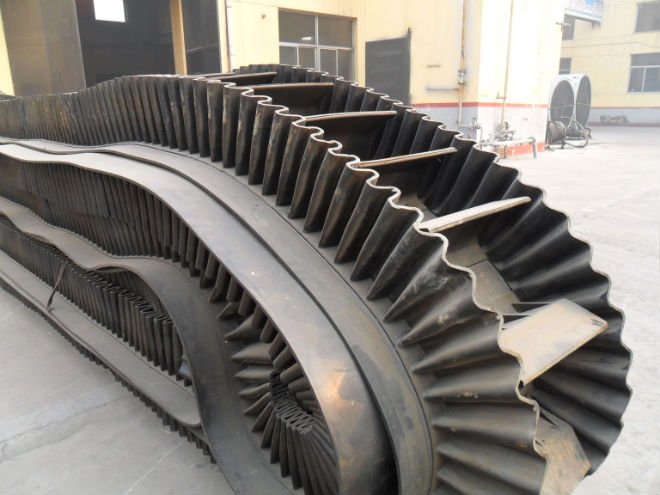
A corrugated sidewall is a corrugated side wall vulcanised to the edge of a conveyor belt. Together with cross profiles it turns an ordinary inclined belt into a conveyor capable of lifting bulk product at angles up to 90°. In this article we look at how it works, when the solution is justified and where its limits lie.
Why an ordinary belt cannot climb steeply
A flat belt holds bulk product only through friction and the angle of repose. In practice this limits the incline to 18–20°: above that the product starts rolling down faster than the belt carries it. To lift raw material 3–4 metres, a flat conveyor needs a 10–12 metre route — and in a tight workshop there is simply no room for it.
A corrugated sidewall solves this geometrically. The corrugated wall along the edges keeps product from spilling sideways, and the cross-profile partitions create “pockets” that carry product upward even on a vertical section. The route gets shorter, the workshop more compact.
How a sidewall belt is built
Such a belt consists of three elements: a base belt, two sidewalls and cross profiles. The sidewall comes in various heights, the profiles in various shapes (T, TC, C). Wall height and profile pitch are matched to the product and the required throughput.
The main elements of a steep-incline belt:
- Base belt — carries the tractive force, made of PVC or PU.
- Corrugated sidewall — a side wall 40 to 240 mm high, keeps product from spilling sideways.
- Cross profiles — partitions between the sidewalls, forming load pockets.
- Pop-up profile — a variant for delicate products, gentler contact.
Selection parameters by angle and product
Sidewall height is directly linked to the permissible incline angle and product size. Below are indicative values for our equipment.
| Sidewall height | Max incline angle | Typical product |
|---|---|---|
| 40 mm | up to 35° | fine seeds, grain |
| 60 mm | up to 45° | nuts, pellets |
| 80 mm | up to 60° | vegetables up to 50 mm |
| 120 mm | up to 75° | potatoes, onions |
| 160 mm and up | up to 90° | large vegetables, fruit |
Engineer’s tip. We take the sidewall height as at least 1.3 times the size of the largest product unit. If the wall is lower than the product, some raw material tips over the wall onto the return side and clogs the tension drum.
Where this solution is used
A sidewall belt is indispensable where product must be lifted in a compact workshop: feeding raw material from the floor into an elevated bunker, loading a grading machine, transferring product to an upper line tier. It is a classic part of conveyor belts for multi-tier layouts.
There are also limits. A sidewall complicates belt cleaning — product lodges in the profile pockets, so in wet zones we add knocker rollers or brush cleaners. For very sticky products another solution is better. We always carry out the selection of a sidewall belt together with the full conveyor calculation.
Profiles: T, TC, C and pop-up
The shape of the cross profile is matched to the product and the route angle. A T-type profile is the most common — a simple partition for most bulk and unit loads. A TC profile has an extra rib that holds product more reliably on a vertical section. A C profile with a curved shape forms a closed pocket — it is needed for fine-grained products that tend to “flow” back during vertical lifting.
The pop-up profile stands apart. Its partition is movable: at loading it is pressed down and does not injure the product, and on the lift it rises and holds the load. This solution is for delicate products — frozen berries, biscuits, wafers — where an ordinary rigid profile strikes and crushes the raw material. We always coordinate the profile height and shape with the sidewall height: a mismatch means the product either does not fit in the pocket or tips over the wall.
Throughput calculation
The throughput of a sidewall belt depends not on mat width, as on a flat conveyor, but on the volume of the pockets and how frequently they pass. The volume of one pocket is determined by wall height, profile pitch and belt width. Multiplying pocket volume by the number of pockets passing the discharge point per minute gives the per-minute throughput.
An important conclusion follows: the throughput of such a conveyor can be raised not only by belt speed but also by reducing the profile pitch. But a small pitch reduces the volume of an individual pocket, so the calculation is done comprehensively — we seek the optimum between pitch, wall height and speed for the specific required line throughput.
Conclusion
A corrugated sidewall with cross profiles is an engineering solution for steep lifting of bulk and unit products in a tight workshop. It saves space but requires correct wall-height selection and attention to cleaning. Need an inclined conveyor for your product? Get in touch — we’ll calculate the wall height, profile pitch and route angle. More on belt selection under the tag belts.
