Bunker with vibrating chute: dosed feeding
How the bunker plus vibrating chute tandem works: principle of dosed feeding, accuracy, throughput control and integration into a process line.
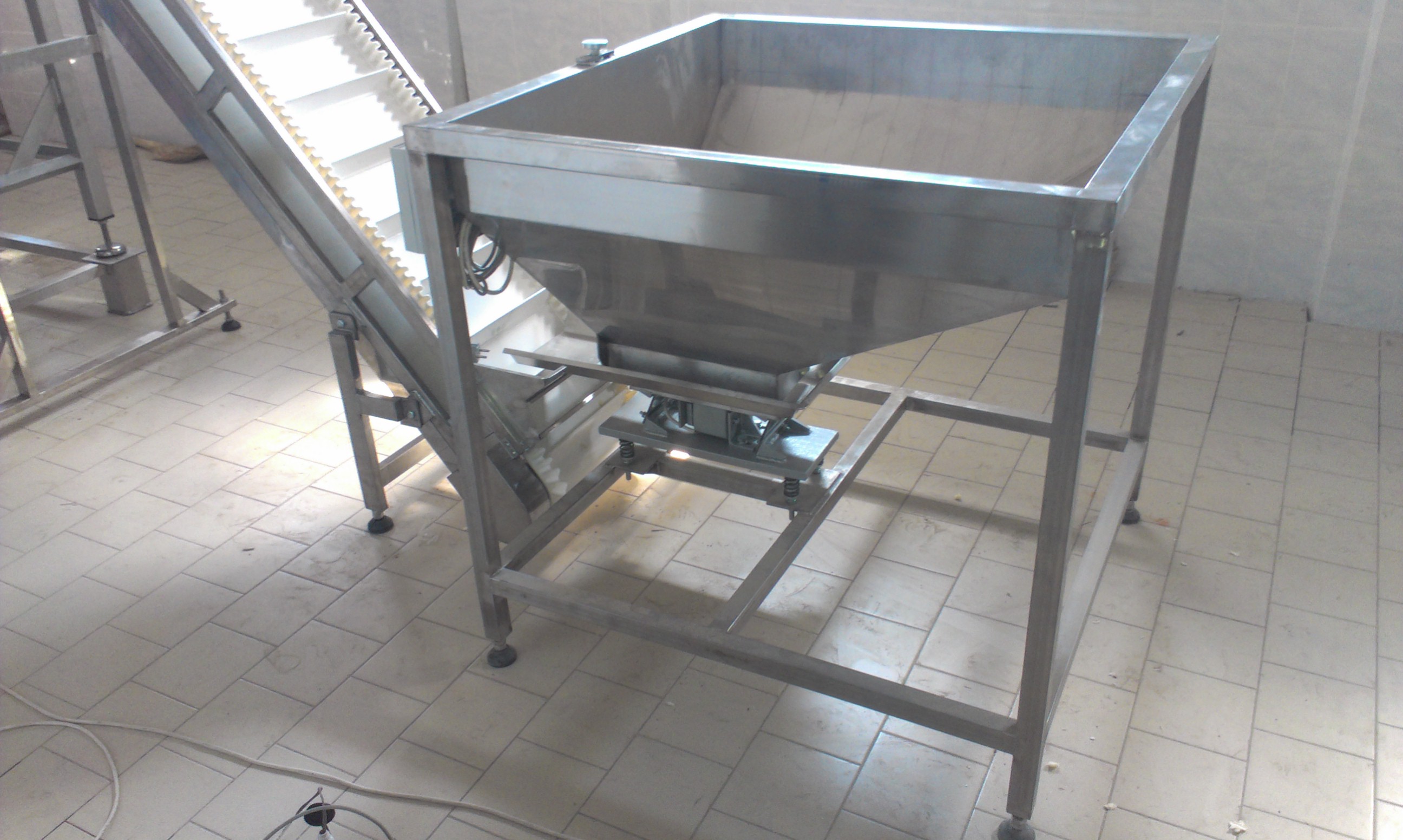
A bunker accumulates bulk product, a vibrating chute delivers it in an even dosed flow. Together they form one of the most reliable feeding units on a food line. This article explains how the tandem works, what determines dosing accuracy and how to fit the unit correctly into a process layout.
How the bunker plus vibrating chute tandem works
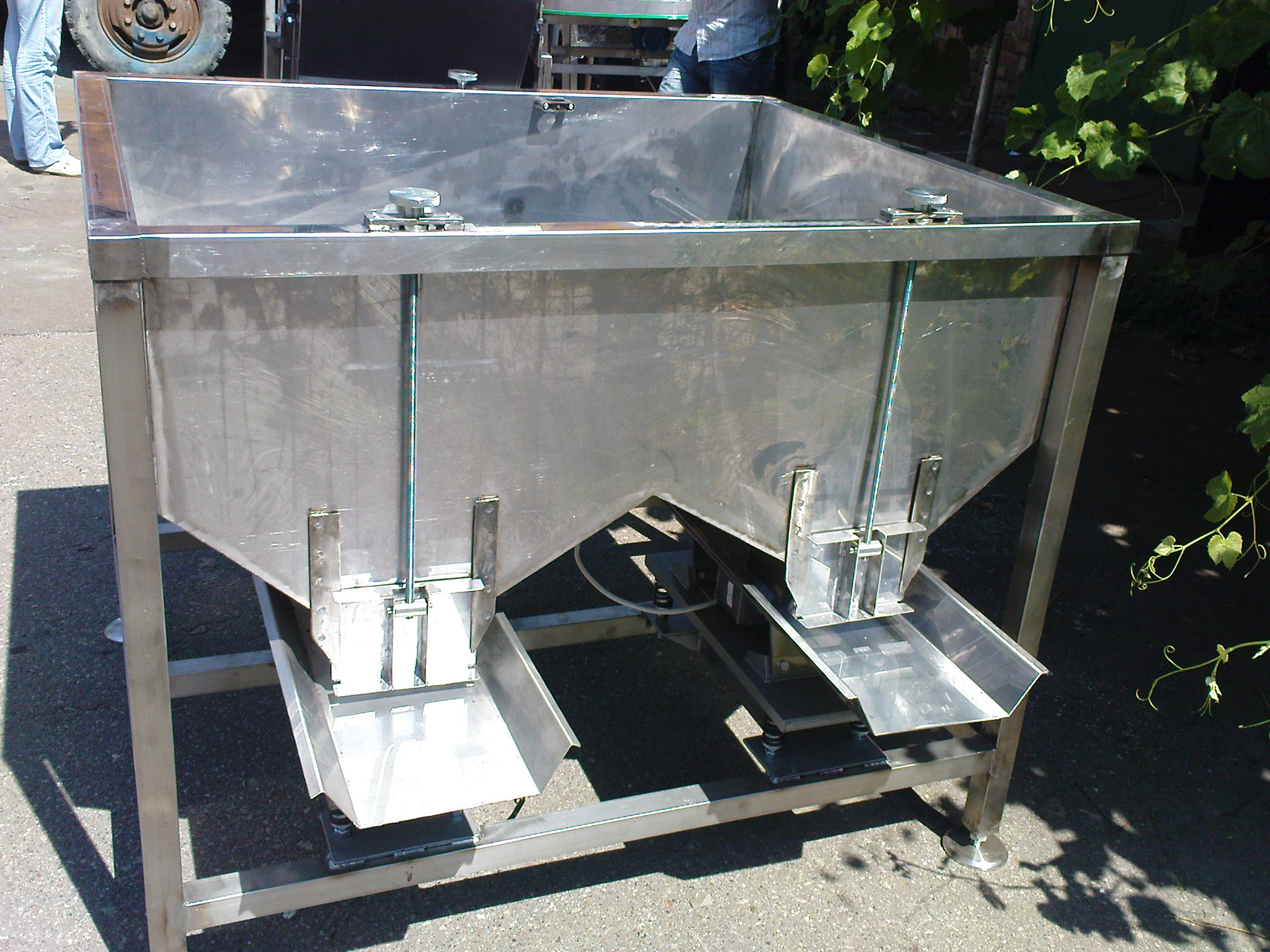
The bunker acts as a buffer vessel: raw material is loaded into it in batches, while it feeds the line continuously. Without a bunker, any pause in loading stops the line. A vibrating chute is mounted under the bunker discharge — an inclined or horizontal trough that oscillates at a frequency of tens of hertz.
Thanks to microscopic throws, the product moves along the chute in short hops, without sticking together or being crushed. Flow speed depends on vibration amplitude: increase the amplitude and the flow rises, decrease it and it falls. This is the basis of dosed feeding.
The physics is simple: the chute performs directed oscillations at 20–30° to the horizontal with an amplitude of 0.3–2.0 mm. On the upward phase a particle receives an impulse forward and up, briefly leaves the surface and lands slightly further ahead. Over 50 cycles per second this builds up to centimetres of travel. Importantly, the product barely slides along the chute — it “flies” in micro-hops, so abrasive wear of the surface is minimal and delicate raw material does not rub against the metal.
Electromagnetic or inertial drive
For food lines we use two types of vibratory drive. The electromagnetic type works at the mains frequency of 50 Hz, has no friction pairs and allows instant, smooth amplitude change by a signal from the controller — the best choice for accurate dosing. The inertial type (unbalanced vibrators) gives a larger amplitude and suits heavy or wet products prone to sticking, but is adjusted in steps and requires bearing maintenance. In 80% of food tasks we fit the electromagnetic drive for its repairability and absence of wearing parts.
What determines dosing accuracy
Accuracy is the key parameter of the unit. Several factors affect it:
- product flowability — granules flow more steadily than fibrous or sticky masses;
- bunker fill level — the product column creates pressure on the discharge, so with widely varying levels the flow “wanders”;
- discharge hopper geometry — the wall angle must exceed the product’s angle of repose;
- stability of the vibrator supply — voltage spikes change the amplitude.
To remove the influence of bunker level, we use an intermediate feeder or a retaining gate that keeps the product column height above the chute constant.
Technical specifications of a typical unit
Below are reference parameters of the units we build for food lines. Specific values are always selected for the product.
| Parameter | Value |
|---|---|
| Bunker volume | 0.1–2.0 m³ |
| Contact surface material | AISI 304 stainless steel |
| Chute throughput | 50–3000 kg/h |
| Vibration frequency | 50 Hz (electromagnetic drive) |
| Dosing accuracy | ±1–3% of the set flow |
| Flow control | smooth, 10–100% |
Throughput control
An electromagnetic vibrator allows smooth flow change from 10 to 100% without stopping the line. In schemes that require weight accuracy we add feedback: a load cell or check-weigher further down the line sends a signal to a controller, which automatically corrects the amplitude. This way the system holds the set mass feed even when the product’s bulk density changes.
Engineer’s tip. For fragile products — crackers, flakes, chips — choose a long chute with low amplitude over a short one with high amplitude. The product travels the same distance, but the number of micro-impacts per unit of path is lower, and breakage drops by a factor of 2–3.
Integration into a process line
The bunker plus vibrating chute unit rarely works on its own. Most often it stands at the start of the line and feeds the next operation — weighing, packing, roasting or conveyor transport. The key task in layout is to match the unit’s throughput with the tact of the next equipment.
If the chute feeds more than the packing machine receives, the product accumulates and spills. If less, the machine idles. So at the design stage we calculate the unit with a small margin and build in smooth control so the operator can tune the feed to the real line tempo. The bunker is sized to cover at least 10–15 minutes of line operation without refilling.
Typical tasks of the unit
On our projects a bunker with vibrating chute is used to feed seeds and nuts into calibration, dose spices and breading, evenly load dryers and ovens, feed multi-head weighers. Wherever a stable controlled flow of bulk product is needed, this unit proves simpler and more reliable than a screw or belt feeder. For more on feeding equipment, see the articles tagged bunker.
Maintenance and typical faults
The unit is undemanding, but a few points are worth monitoring. The most common cause of a “wandering” flow is loosening of the chute or drive fixings: when bolt torque drops, part of the oscillation energy is damped and the feed falls. Checking the tightening torque once a quarter is enough. The second typical fault is wet product caking in the chute corners; it is cured by increasing wall radii and slope, or by switching to a flat-bottom chute with a low sidewall. Drive springs are a consumable: on electromagnetic systems they are inspected once a year for cracks. AISI 304 contact surfaces are washed with water and detergents, and disassembling the chute for sanitation takes a few minutes without tools. A well-designed unit runs 8–10 years before an overhaul.
Conclusion
A bunker with a vibrating chute is a compact, repairable and accurate unit for dosed feeding of bulk products. Its efficiency depends on the right choice of bunker volume, hopper geometry and vibration mode for the specific product. Need a feeding unit for your line? Get in touch — we’ll calculate a bunker and chute configuration for your product and throughput.