Bubble bath: operating principle and applications
How a bubble bath works for gentle washing of vegetables and fruits: design, air pressure, for which products it is mandatory.
A bubble bath washes the product not with a jet or a brush but with a stream of air bubbles permeating the water. This is the gentlest cleaning method — it removes dirt, sand and light contaminants without damaging delicate skin. The article covers how a bubble bath is built, for which products it is mandatory and what to watch for when ordering.
The bubbling principle
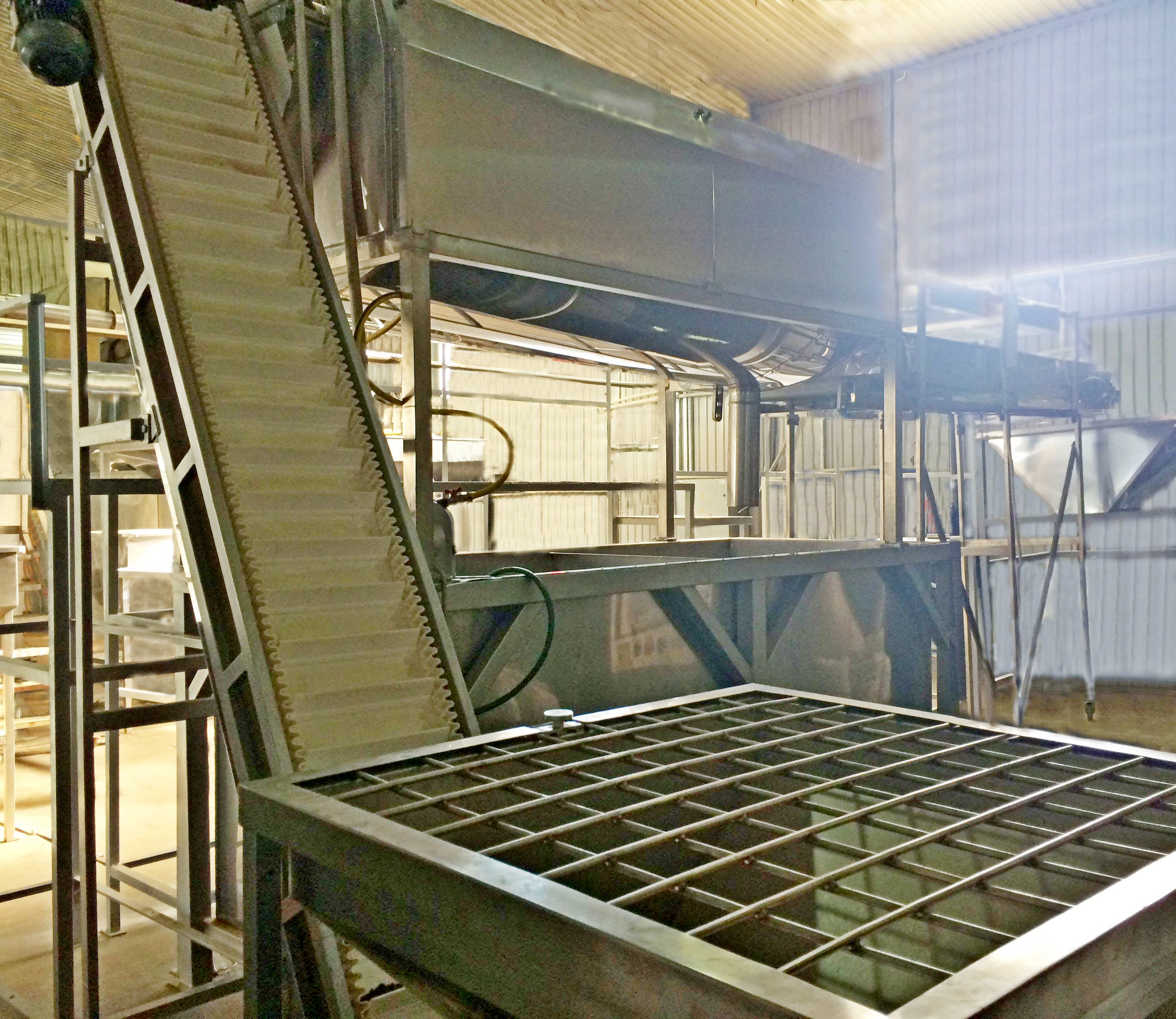
At the heart of the bath is a system of perforated pipes on the bottom into which compressed air is supplied. Holes 1.5–3 mm in diameter are spaced 30–50 mm apart so the bubble carpet is uniform across the whole area. Coming out through the holes, the air forms a dense stream of fine bubbles. Rising, they mix the water and create an intense but gentle circulation with an upward flow velocity of about 0.1–0.3 m/s. The product immersed in the bath is constantly washed from all sides: dirt soaks off and separates, heavy impurities settle onto the sloped bottom, light litter floats up and is carried off by the overflow. No mechanical contact with a brush or jet — the product simply floats in active water. Air is supplied by a separate compressor or blower; for even bubbling a stable pressure matters, so a receiver-damper is fitted in the line to smooth out pulsations.
Why bubbling is gentler than other methods
A classic shower washer hits the product with a jet pressurised at 1.5–3 bar — for a tomato or a berry this is traumatic. A drum washer turns the product over, which also does not suit delicate crops. Bubbling does without impact at all: the energy is carried by air, not by water or mechanics. This makes the bath indispensable where the product is easily crushed, cracked or loses its market appearance.
A separate advantage of bubbling is efficient separation of foreign objects by density. Stones, clods of earth and heavy sand settle to the bottom within the first seconds, while leaves, twigs and hollow fruits float up. Thus one operation performs both washing and primary removal of impurities, which reduces the load on the inspection conveyor further down the line. For product with caked-on soil, bubbling is combined with pre-soaking: the product is first held in water for 1–2 minutes, then intense mixing is switched on.
How the bath size and configuration are selected
The bath dimensions are calculated from the line throughput and the product residence time. If a line processes 2 t/h and the product must stay in the water for 60 seconds, about 33 kg of product is in the bath at any moment — and this sets the working zone volume. We keep the depth such that there is a water layer of at least 150–200 mm above the product: a thin layer does not let the bubbles build up speed and bubbling becomes weak. We match the bath width to the width of the conveyors feeding and removing the product, to avoid side jams. For a continuous line, an inclined mesh discharge conveyor leads the product through the bath; for batch work with small lots a bath with manual loading and unloading by baskets is used.
For which products it is mandatory
We build a bubble bath into the line when the product is sensitive to mechanical action:
- Leafy greens — lettuce, spinach, dill: a jet tears the leaves.
- Berries — strawberries, blueberries: burst from pressure.
- Tomatoes — the thin skin is easily damaged.
- Mushrooms — fragile, absorb water, do not tolerate turning over.
- Soft fruits — peaches, apricots, figs.
Technical parameters
| Parameter | Typical value | Note |
|---|---|---|
| Air pressure | 0.2–0.5 bar | Adjusted for the product |
| Water temperature | 8–15 °C | Cold for freshness |
| Product residence time | 40–90 s | Depends on contamination |
| Bath material | AISI 304 | Contact with food product |
| Air consumption | 3–8 m³/min per m² | Depends on depth |
| Water layer above product | 150–200 mm | Less means weak bubbling |
| Bottom slope angle | 5–8° | For sediment runoff |
Engineer’s tip. Do not chase maximum air pressure. Too intense bubbling lifts the product too high, it hits the wall and neighbouring fruits. The right mode is when the product slowly “dances” within the water body rather than jumping to the surface.
Water treatment and recirculation
The bath’s biggest operating cost item is water. Without a treatment system it gets dirty within an hour or two and requires a full change — and that means both consumption and downtime. So we build in a recirculation loop: water continuously overflows the wall, passes a sieve filter to catch large litter, then a settling tank for sand and stones, after which a pump returns it to the bath. This scheme allows working on a single water fill for a whole shift, only topping it up to replace evaporation and carry-off with the product. For product with a high dirt load, an intermediate settling tank is added to the loop. If the technology requires disinfection, a chlorine-based agent is dosed into the water or ozonation is used — the concentration is kept within limits safe for food contact.
Design and integration into the line
A bubble bath rarely works alone — it is the first wet module of a vegetable and fruit washing line. After the bath the product goes for rinsing with clean water, then to inspection and drying. We design the bath with a sloped bottom and a drain for sediment discharge, with a water recirculation system and a filter so the water need not be changed hourly. All surfaces are AISI 304 stainless steel, the geometry is for washing without stagnation zones. Bubbling is also used as a standalone bubble bath for specific cleaning tasks. For more on wet modules, see the articles tagged washing.
Conclusion
A bubble bath is gentle washing for products that cannot withstand a jet or a brush: greens, berries, tomatoes, mushrooms. The key to the result is correctly selected air pressure at which the product circulates gently rather than hitting the walls. Need a bath for your washing line? Get in touch — we will calculate the design for your product.