Antistatic belts: when they are mandatory
Where a conveyor needs an antistatic belt: dry bulk, flour, flammable products. Conductivity classes, marking and selection.
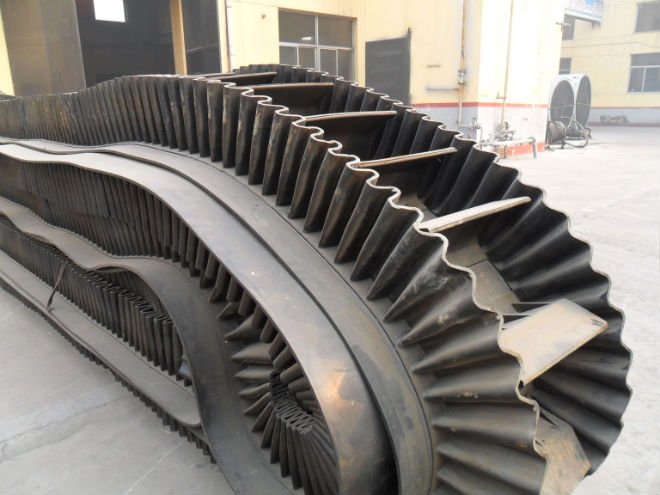
An ordinary polymer belt becomes electrified as it moves — friction against drums and rollers builds up a charge. On most lines this is harmless, but where dry dusty raw material is transported, a static discharge becomes a real hazard. Let us look at where an antistatic belt is mandatory, how it differs from an ordinary one and how to select it correctly.
Why static is dangerous
A polymer is a dielectric. A PVC or PU belt accumulates a surface charge during operation, with a potential reaching several kilovolts. As long as the charge stays on the belt there is no problem. The dangerous moment is the discharge: a spark between the charged surface and the grounded metal of the frame.
In a humid vegetable washing workshop such a spark is harmless. But if flour, icing sugar, starch or milk powder dust hangs in the air, a spark is enough to ignite the dust-air mixture. This is the classic dust explosion scenario, and it is exactly what an antistatic belt prevents.
How much energy ignition takes
The hazard is best assessed in numbers. The energy of a spark accumulated on a charged belt easily reaches 10–30 mJ. The minimum ignition energy (MIE) for many food dusts is substantially lower: flour and starch ignite from 30–50 mJ, but icing sugar and some protein powders ignite from as little as 5–10 mJ. In other words, an ordinary belt’s discharge genuinely exceeds the ignition threshold.
The severity of the explosion itself is characterised by the Kst class. Most food dusts fall into class St1 (Kst up to 200 bar·m/s) — a “mild” but quite destructive explosion capable of wrecking a workshop. An antistatic belt does not lower Kst; it removes the ignition source itself — the static discharge — and so breaks the “dust + oxygen + spark” chain.
Where an antistatic belt is mandatory
Antistatic execution is needed not everywhere but on specific line types:
- Transport of flour, starch, milk powder, icing sugar.
- Lines for dry mixes, spices, coffee, cocoa powder.
- Conveyors of pellets, granules, animal feed with dust generation.
- Zones near mills, crushers, sifters.
- Sections where the process map requires ATEX zoning.
If the product is wet or unit-type, an antistatic belt is not needed and there is no point paying for it.
How a conductive belt works
An antistatic belt does not accumulate a charge but drains it away. Conductive fillers — carbon black or carbon fibres — are added to the polymer, making the material slightly conductive. The charge does not sit on the surface but flows through the belt to the drum and on to the grounded frame.
The key condition is an unbroken grounding chain. A conductive belt is useless if the conveyor frame is not grounded or the drum is insulated by a layer of paint. We always check the resistance of the “belt — frame — earth loop” chain after installation. The target resistance to earth is no higher than 10⁶ Ohm; anything above means the charge drains too slowly and a dangerous potential builds up between cycles.
A separate subtlety is the break points in the chain. A painted drum coating, plastic bearing units, a rubber lagging of the drive drum with no conductive additive — each such element interrupts the charge drainage. So on ATEX lines we fit conductive lagging, metal current-collector brushes or grounding pigtails pressed against the return run of the belt. Grounding the frame with a separate conductor of at least 4 mm² cross-section to the common earth loop is a mandatory part of the solution, not an option.
Conductivity classes and parameters
| Belt type | Surface resistance | Application |
|---|---|---|
| Ordinary (insulator) | over 10¹² Ohm | unit, wet products |
| Antistatic | 10⁶–10⁹ Ohm | dry bulk, dust |
| Conductive (ESD) | below 10⁶ Ohm | ATEX zones, explosive |
| Operating temp. PVC AS | -10…+80 °C | standard workshops |
| Operating temp. PU AS | -30…+90 °C | hot washing, cooling |
How to select and verify
Selecting an antistatic belt rests on three steps:
- Classify the zone. Determine whether the line falls under ATEX zoning and which conductivity class is needed.
- Choose the material. PVC AS for dry standard conditions, PU AS for hot washing and cooling.
- Close the grounding. Check the grounding of the frame, drums, scrapers and measure the chain resistance.
Engineer’s tip. The “antistatic” marking on a belt guarantees nothing on its own. We always require a surface-resistance measurement report from the supplier and check the grounding chain with an instrument on the already installed line. The belt may be conductive while the conveyor is not.
Why conductivity is lost over time
A belt’s antistatic properties are not eternal. Conductivity is provided by carbon fillers evenly distributed in the polymer. With use the surface layer wears, clogs with grease, flour dust and detergents — and the surface resistance creeps up. A belt that started at 10⁷ Ohm may, after a year of intensive use, exceed 10⁹ Ohm and effectively stop being antistatic while looking exactly the same.
That is why on ATEX lines you do not “fit and forget” antistatic. We build in periodic checks: measuring the belt’s surface resistance and the grounding chain resistance with a megohmmeter once a quarter, and monthly in a dusty workshop. A grease film is removed by alkaline washing, and if the resistance does not return to normal the belt is due for replacement even if mechanically it is still intact. We always include this item in the line’s maintenance schedule.
Antistatic and the rest of hygiene requirements
Antistatic belts are compatible with food certificates: PU AS executions are produced with approval under regulation EU 1935/2004. So a belt can be conductive, food-grade and hot-wash-capable at the same time. We select conveyor belts so that one execution covers all the line’s requirements — both dust safety and product contact. More on belt materials under the tag belts.
Conclusion
An antistatic belt is mandatory where dry dusty raw material is transported and there is a dust explosion risk. On wet and unit-load lines it is not needed. The main thing is not just the belt itself but a closed grounding chain of the whole conveyor. If your line handles flour, spices or dry mixes, get in touch — we will select an antistatic belt and check the grounding scheme.