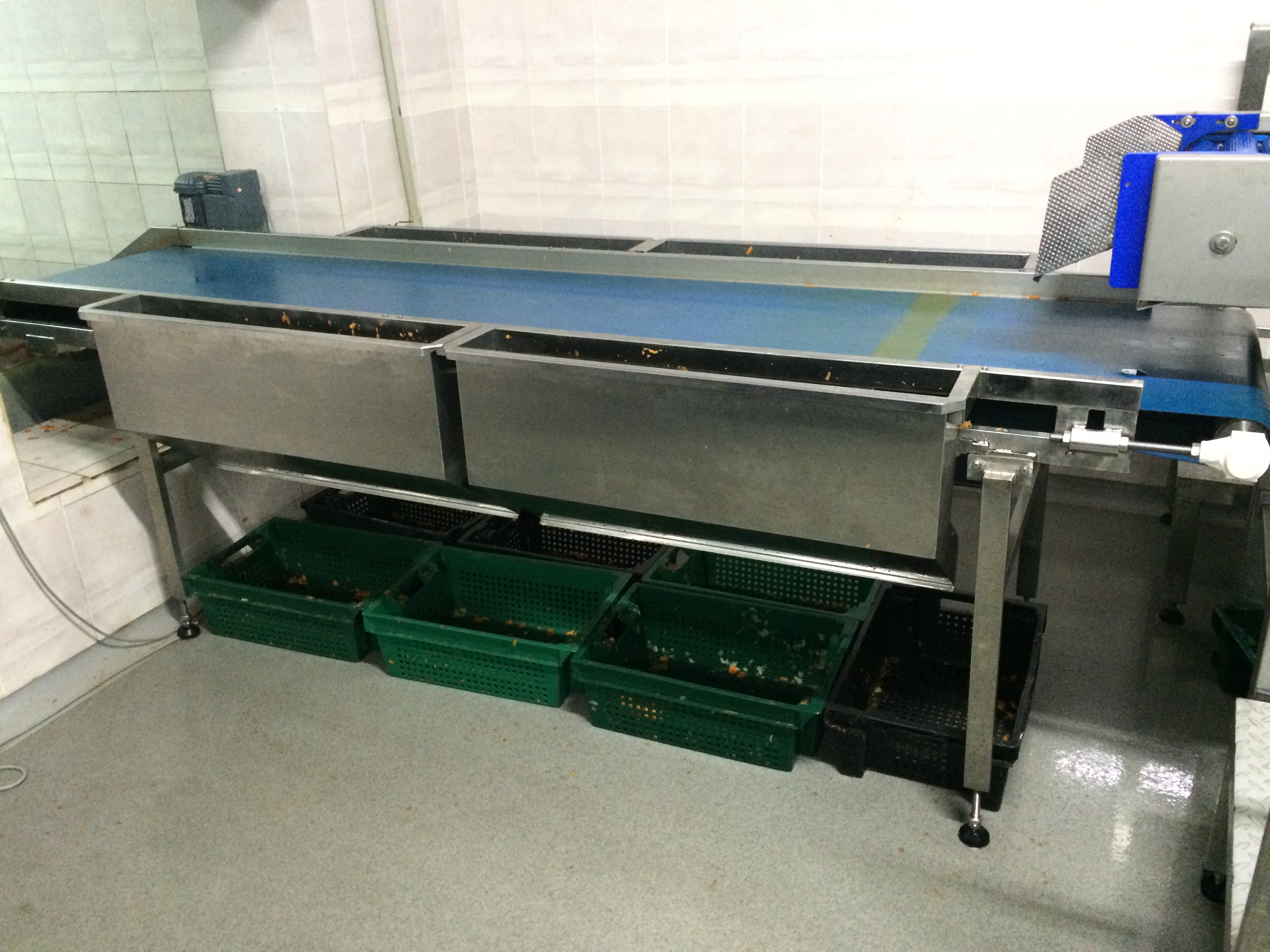
AI quality control: rejection on the line
How AI models classify the quality of vegetables, nuts and chips on a conveyor: cameras, model training, rejection — real examples and cost.

AI quality control on a conveyor is a camera that sees a defect and a model that decides in a fraction of a second. The technology already works on processing lines for vegetables, nuts and snacks. In this article we break down how a machine-vision rejection system is built, what it actually delivers and how much it costs.
How AI inspection on a conveyor works
The principle is simple to describe and complex to implement. A camera and even lighting are installed above an inspection conveyor. Every object in the flow is photographed, the AI model classifies it — “good” or “reject” — and on the system’s command an actuator removes the reject: an air nozzle, a pusher or a diverting chute.
The key here is speed. On a line with a throughput of several units per second, the model must decide before the object reaches the rejection point. So the system works in real time, and the conveyor moves at a constant, precisely known speed.
The mechanics of the conveyor itself also matter. At the moment of capture the object must be in the zone of sharp focus, not vibrate and not be overlapped by neighbours. So for AI inspection we design a section that spreads the product out in the flow: a narrow conveyor or a roller conveyor that lays the product into a single layer. Without this, even the best model “sees” stuck-together objects and makes mistakes.
Which defects AI sees
Machine vision recognises defects that are hard to detect by other methods. Different features are critical for different products.
| Product | What the AI classifies | Typical result |
|---|---|---|
| Nuts | shell, mould, broken kernels | 95–98% of defective rejected |
| Vegetables | rot, deformation, colour | sorting into 3–4 categories |
| Chips | scorching, size, shape | levelling batch quality |
| Dried fruit | foreign inclusions, shade | cleaning from impurities |
| Berries | bruising, unripeness | gentle sorting |
Unlike a classic colour sorter that reacts only to colour, an AI model learns from shape, texture and a combination of features — so it catches complex defects that a colour sensor misses.
Lighting and optics — half the success
Engineers meeting machine vision for the first time underestimate lighting. In fact light is half the recognition quality. Unstable or uneven lighting produces shadows and glare that the model perceives as a defect — and vice versa. So above the inspection zone we install LED panels with a constant spectrum and shield the section from outside light from windows and workshop lamps.
Different optics suit different products. Glossy objects — tomatoes, berries — produce glare, which is suppressed with a polarising filter. For transparent inclusions, backlighting or the infrared range is sometimes used. We mount the camera on a rigid bracket isolated from drive vibration: even micro-shaking blurs the frame in a fast flow.
Model training — the main work
AI does not work “out of the box”. The model must be trained on a specific product of a specific manufacturer. This means collecting and labelling several thousand images: where the product is good, where it is a reject, where it is a borderline case. The better the labelling, the more accurate the classification.
It is also worth accounting for the fact that the product changes from season to season. Nuts of a new harvest may differ in shade, vegetables in shape. So the model is not “trained once and for all” — it is periodically retrained on fresh data. This is a normal part of operating an AI system, and it should be built into the maintenance plan alongside cleaning the camera optics and checking the lighting.
Engineer’s tip. Do not start with AI where a simpler solution is enough. If the defect is a clear colour difference, a classic colour sorter is cheaper and more reliable. AI is justified when the defect is complex: shape, texture, a combination of features. First state exactly what you are classifying — and only then choose the technology.
What it costs and when it pays off
An AI inspection system is more expensive than a simple inspection belt with operators, but it pays off on several things: it reduces the share of rejects reaching the consumer, removes the human factor and frees up operators. On a line where 6–8 people previously sorted by hand, an AI unit often pays off in 12–18 months through wages and a drop in complaints.
Importantly, AI does not fully replace all inspection. We usually leave one manual control post for non-standard situations. For more on inspection solutions, see the articles tagged inspection.
Integrating an AI unit into the line
AI inspection is not a stand-alone machine but a unit that must fit organically into the flow. At the design stage we resolve several integration questions. First, speed coordination: the model has a certain time budget per frame, and the conveyor speed is matched to the compute device’s performance, not the other way round. Second, the rejection point: an air nozzle or pusher acts with a delay, so the distance from the camera to the actuator is calculated precisely for the belt speed.
Third, statistics. A modern AI unit does not just sift out rejects but keeps a record: how many defects of which type, at what time, on which batch. We display this data on the operator panel — it shows not only product quality but also problems upstream, for example a fault at the calibrator or washer. A conveyor with AI inspection becomes not only a filter but a diagnostic source for the whole line.
Conclusion
AI quality control on a conveyor is a real, working technology for rejecting complex defects a colour sensor cannot see. Its effectiveness depends 80% on the quality of model training, and its payback — on the volume of manual labour it replaces. Thinking about automatic inspection? Get in touch — we’ll assess whether AI is justified for your product.